
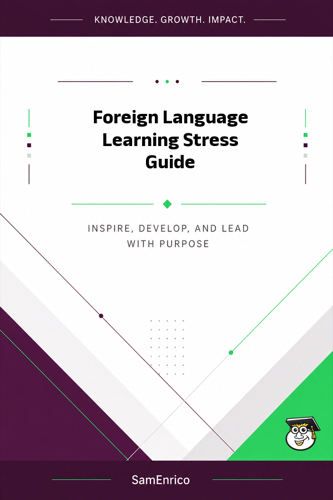
Non-FictionSelf-HelpLanguage Learning
Foreign Language Learning Stress Guide eBook
Manages speaking anxiety and vocabulary retention
Manages speaking anxiety and vocabulary retention pressure.
Formats
Free sample
Chapter 1: The Language Freeze...--–- The first time your mind goes blank in a foreign language, you think it’s a fluke. The second time, you feel a flicker of shame. By the tenth time, you have started to believe something is wrong with you.You are not alone. And nothing is wrong with you.Let me tell you about Maria.Maria is a 34-year-old marketing director from São Paulo. She studied English for twelve years—through elementary school, high school, and a private language institute where her teachers praised her written work.
She scored 620 on the TOEIC, a score that places her in the top fifteen percent of test-takers in Brazil. She can read The Economist without a dictionary. She writes professional emails that her American colleagues compliment as “impeccable.”But six months ago, Maria was transferred to the company’s New York office. On her first day, her manager asked a simple question during a team meeting: “Maria, what do you think about the Q3 campaign?”Maria’s mind went white.Not foggy. Not slow.
White. Like someone had erased a chalkboard mid-sentence.She felt her face flush. Her palms began to sweat. She heard herself say, “I… uh… sorry, I…” and then stop. The silence stretched for what felt like minutes.
Her colleague James, sitting next to her, whispered, “The Q3 numbers?” Maria nodded and managed to mumble, “Yes, the numbers are good.” But the damage was done. She had frozen in front of twelve people.That night, Maria sat in her Brooklyn apartment and cried. Not because she didn’t know English. She did. Not because she hadn’t studied.
She had studied more than anyone she knew. She cried because she felt like two different people existed inside her: the competent, articulate professional who wrote beautiful emails, and the mute, stammering imposter who couldn’t answer a simple question in a meeting.Maria has a name for this second person. She calls her “the freezer.”And Maria is the reason I wrote this book.The Epidemic Nobody Talks About Maria’s story is not unusual. In fact, it is so common that I have stopped being surprised when I hear it. Over the past decade of researching language acquisition psychology and working with anxious learners, I have collected hundreds of versions of the same confession:“I can read.
I can write. I can pass any test. But when I try to speak, I freeze.”The numbers back this up. Studies using the Foreign Language Classroom Anxiety Scale (FLCAS)—the gold-standard diagnostic tool we will use throughout this book—consistently find that nearly one in three language learners experiences clinically significant levels of speaking anxiety. Not mild nervousness.
Not occasional butterflies. Debilitating anxiety that leads to avoidance, withdrawal, and in many cases, complete abandonment of language learning goals.But here is the strange thing: most of these anxious learners are not bad at languages. In fact, many of them are excellent students. They do their homework. They memorize vocabulary.
They understand grammar rules that confuse their peers. The correlation between academic performance and speaking anxiety is nearly zero—and in some studies, it is actually positive. High achievers are more likely to suffer from speaking anxiety, not less.This is the paradox that standard language teaching ignores. Most classes focus on input: reading, listening, grammar exercises. They assume that if you know the words, you can say the words.
But speaking is not just vocabulary retrieval. Speaking is performance. And performance introduces something that fill-in-the-blank worksheets never do: social threat.When you speak a foreign language in front of another person, your brain does not treat it as an academic exercise. It treats it as a survival situation.The Neuroscience of the Freeze To understand why Maria froze, you need to understand a small, almond-shaped cluster of neurons deep inside your brain called the amygdala.The amygdala is your brain’s threat-detection system. It evolved over hundreds of millions of years to do one thing: keep you alive.
It scans your environment constantly for signs of danger—a predator, a falling rock, an aggressive rival. When it detects a threat, it triggers a cascade of physiological responses that psychologists call the “fight, flight, or freeze” response. Your heart rate accelerates. Your breathing becomes shallow. Blood rushes to your large muscle groups.
And crucially, your prefrontal cortex—the part of your brain responsible for deliberate thought, working memory, and language production—is partially shut down.This is an excellent survival strategy if you are being chased by a lion. You do not need to think about philosophy when you are running for your life. You need speed. Your body prioritizes survival over cognition.But here is the problem. Your amygdala is not very sophisticated.
It does not distinguish between a genuine physical threat (a lion) and a social threat (being judged for your accent). It only knows that something is wrong. And when you speak a foreign language in front of others, your amygdala often perceives social evaluation as a threat.Why? Because for most of human evolutionary history, social rejection was a death sentence. Being cast out from your tribe meant losing access to food, protection, and mating opportunities.
Your ancestors who were sensitive to social cues—who felt a spike of anxiety when they might be judged negatively—were more likely to survive and reproduce. You inherited their brains.So when you open your mouth to speak Spanish in class, or French at a restaurant, or Mandarin with a colleague, your amygdala asks one question: “Is this safe?” And if you have ever been corrected harshly, laughed at, or even just sensed impatience from a listener, your amygdala files that memory under “danger.” The next time you try to speak, it triggers the freeze response—not because you are in actual danger, but because your ancient survival brain cannot tell the difference between a sabertooth tiger and a mildly annoyed waiter.This is the language freeze. And it has nothing to do with how much you have studied.Eustress vs. Distress: Not All Anxiety Is Your Enemy Before we go any further, I need to make an important distinction. Not all anxiety is bad.
In fact, some anxiety is essential for high performance.Psychologists distinguish between two types of stress: eustress (from the Greek *eu-*, meaning “good”) and distress (the familiar, unpleasant kind). Eustress is the feeling of alertness, focus, and energy that comes before a challenging but achievable task. It is the flutter in your stomach before a first date, the heightened awareness before an athletic competition, the sharp clarity before a important presentation. Eustress improves performance. It sharpens your recall.
It heightens your senses.Distress is different. Distress is the feeling of overwhelm, of threat, of “I cannot handle this.” Distress impairs performance. It narrows your attention to the point of tunnel vision. It floods your working memory with self-monitoring (“How do I sound?” “What do they think?”) until there is no room left for vocabulary retrieval. Distress is what causes the freeze.The goal of this book is not to eliminate all anxiety from your language learning.
That would be impossible and undesirable. The goal is to shift your experience from distress to eustress—from the anxiety that…
This is the end of the free sample. Get the eBook to keep going. Buy now
About this book
Details
- Author
- Loera Shawnda
- Publisher
- SamEnrico
- Language
- English
- Genre
- Non-Fiction, Self-Help, Language Learning
- Released
- 2026-06-08
- Pages (approx.)
- 152
- Available as
- eBook, Audiobook

Read better in the ZLOADR app
Your eBooks on your phone or tablet. Sign in with your SamEnrico account and start reading.
More by Loera Shawnda
 Animation AddictLoera Shawnda$11.99
 Asset Allocation Retirement GuideLoera Shawnda$11.99
 Tailgating Trigger Management GuideLoera Shawnda$11.99
 Loving Kindness for Nurse ExhaustionLoera Shawnda$11.99
 Mozart: The Divine Fire of ViennaLoera Shawnda$11.99
 Understanding Neuhauser–daly–magnelli SyndromeLoera Shawnda$17.99
 Excel Economics VisualizerLoera Shawnda$12.99
 Kohl's SWOT LibraryLoera Shawnda$12.99
 Indirect TaxLoera Shawnda$11.99
 How to Become a Lay-out TechnicianLoera Shawnda$11.99
You may also like
 Hong Kong Handover 1997Dunn Johnnie$11.99
 Zumba For Postnatal Recovery CourseNeal Christian$11.99
 Zumba for BeginnersLadner Nikia$11.99
 YouTube Comment Mining GuideHumes Pandora$12.99
 Worry Box MeditationCarlin Rudy$11.99
 Workplace Stress MeditationNguyen Lynn$11.99
 Workplace Stress and Sleep RepairHawley Ivory$11.99
 Workplace Perfectionism CureDelaney Jeffry$11.99
 Workplace Injustice Anger GuideWallen Isabelle$11.99
 Work Addiction and Burnout LinkGreenwood Ester$11.99
 Women in Yoga and WellnessBeattie Galina$11.99
 Women in Stand Up ComedyChun Evangeline$11.99