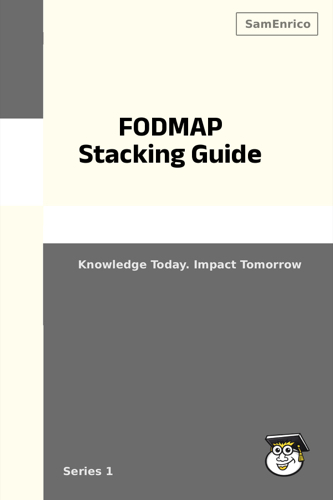
FODMAP Stacking Guide eBook
Avoid combining multiple moderate FODMAP foods in
by Serna Lera
Avoid combining multiple moderate FODMAP foods in one meal.
Formats
Free sample
Chapter 1: The Math of Pain--–- Melissa had done everything right. For six weeks, she had followed the low FODMAP diet with religious precision. She downloaded the Monash app. She weighed her portions. She avoided garlic, onion, wheat, and dairy.
She ate only "green-light" foods. And yet, every single night, she curled up on her bathroom floor with the same crushing bloating and abdominal pain that had driven her to the diet in the first place.–- "I'm broken," she told her dietitian, tears streaming down her face. "The diet isn't working. Nothing works."–- Her dietitian asked a simple question: "What did you eat yesterday?"–- Melissa pulled out her food log. Breakfast: a smoothie with half a banana, a handful of spinach, and almond milk.
Lunch: a quinoa bowl with ¼ avocado, a few cherry tomatoes, and a sprinkle of pumpkin seeds. Dinner: baked salmon with ½ cup of sweet potato and a side of green beans. Snack: a small apple with a tablespoon of peanut butter.–- Every single item on that list is low FODMAP. Every single item is "safe" according to the app. And yet, every single item contributed to a hidden problem that no one had ever explained to her: FODMAP stacking.–- This chapter will teach you why Melissa's experience is not a failure of the low FODMAP diet, but rather the single most common reason the diet fails.
You will learn the unified definition of stacking that will guide this entire book, the suitcase analogy that makes it visual, and why "low FODMAP" has never meant "no FODMAP." By the end of this chapter, you will understand why your "safe" meals might be making you sick — and more importantly, that you are not broken. Your combinations were just wrong.The Paradox That Breaks the Diet–- The low FODMAP diet has changed millions of lives. Developed by Monash University in Australia, it is the only evidence-based dietary treatment for Irritable Bowel Syndrome (IBS) and other functional gut disorders. Studies show that 50-80% of patients experience significant symptom improvement when following the diet correctly. The science is solid.
The protocols are proven.–- So why do so many people like Melissa fall into the same trap? They do everything right, and they still suffer.–- The answer lies in a mathematical reality that most low FODMAP resources fail to emphasize. The diet was designed around single foods in isolation. Monash researchers tested one food at a time, eating it alone, and measured FODMAP content. A 75-gram serving of green beans is low FODMAP.
A 50-gram serving of sweet potato is low FODMAP. A 30-gram serving of chickpeas is low FODMAP.–- But here is the hidden truth: the diet was never tested on combinations of multiple low FODMAP foods eaten together.–- When you eat green beans and sweet potato in the same meal, you are not eating two low FODMAP foods. You are eating one medium FODMAP meal. When you add chickpeas, you are eating a high FODMAP meal — even though each ingredient, measured alone, would earn a green light.–- This phenomenon has a name. In the research literature and clinical practice, it is called FODMAP stacking.
And it is the number one reason that 20-50% of patients fail the low FODMAP diet despite perfect adherence.Defining Stacking: One Clear Rule–- Before we go any further, we need a clear, consistent definition. Throughout this book, stacking will be defined as follows:–- FODMAP stacking occurs when you consume fermentable carbohydrates from multiple sources within a time window shorter than your gut's natural clearing time — specifically, less than 3 hours between eating events.–- This definition has three critical components:Multiple sources — You are not stacking if you eat a large portion of a single food. That is simply exceeding your threshold for that food. Stacking requires at least two different foods contributing to the same FODMAP family total.Within a time window — Stacking is not just about what is on your plate at one moment. It includes foods eaten across a snack, a meal, and even the previous meal if they are close enough together.Less than 3 hours — This is the magic number.
Research on small intestinal transit time suggests that FODMAPs take approximately 3-4 hours to move from the small intestine to the large intestine, where fermentation occurs. If you eat again before that clearance is complete, the new FODMAPs join the old ones in the large intestine simultaneously.–- Throughout this book, we will use this unified definition exclusively. When we say "stacking," we mean consuming FODMAPs from multiple foods within the same 3-hour window. Period.–- This means that Melissa's day, described at the start of this chapter, was not a mystery. Her breakfast, lunch, snack, and dinner all fell within a 3-hour window?
Let's examine. Breakfast at 8 AM, lunch at 12 PM (4 hours later — that's safe, the 3-hour window had reset), snack at 2 PM (2 hours after lunch — that's stacking, the window had NOT reset), dinner at 6 PM (4 hours after snack — that's safe again). Her problem was not dinner. Her problem was that her lunch and her snack stacked. Those two "safe" eating events combined into one FODMAP load that overwhelmed her gut.The Suitcase Analogy: Seeing the Invisible–- FODMAP stacking is invisible.
You cannot see the fermentable carbohydrates accumulating in your small intestine. You cannot feel them until they reach the large intestine hours later, at which point it is too late to undo the damage.–- To make stacking visible, we need a mental model. This book will use the Suitcase Analogy, which will guide us through the first few chapters before we replace it with the more precise concept of the "stack budget."–- Imagine that your small intestine is a suitcase. You are going on a trip, and you can only carry so much weight. Each FODMAP you eat is like packing an item into that suitcase.–- A single low FODMAP food — say, half a cup of sweet potato — is like packing one shirt.
It fits easily. You close the suitcase. No problem.–- A second low FODMAP food from the same FODMAP family — say, half a cup of green beans — is like packing a pair of pants. Still fine. The suitcase closes, maybe with a little effort.–- A third low FODMAP food from the same family — say, a quarter cup of chickpeas — is like packing a jacket.
Now the suitcase is bulging. You have to sit on it to close the zipper. This is your gut straining to process the load.–- A fourth low FODMAP food from the same family — say, a slice of sourdough bread — is like trying to pack a winter coat into an already overstuffed suitcase. The zipper breaks. The suitcase bursts.
This is your symptoms: bloating, pain, gas, diarrhea, or constipation.–- The critical insight of the Suitcase Analogy is this: no single item broke the suitcase. It was the combination of all of them.–- This is why Melissa was suffering. She was not eating any "bad" foods. She was packing too many items into her gut's suitcase within a short time window. Each food alone was a shirt…
This is the end of the free sample. Get the eBook to keep going. Buy now
About this book
Details
- Author
- Serna Lera
- Publisher
- SamEnrico
- Language
- English
- Genre
- Non-Fiction, Health & Wellness, FODMAP
- Released
- 2026-06-07
- Pages (approx.)
- 133
- Available as
- eBook, Audiobook

Read better in the ZLOADR app
Your eBooks on your phone or tablet. Sign in with your SamEnrico account and start reading.
More by Serna Lera
 Workaholism in MilitarySerna Lera$11.99
 Submarine War Diving TourismSerna Lera$11.99
 Anger for MusiciansSerna Lera$11.99
 The Identity Based Habits GuideSerna Lera$11.99
 The Swiss Pikes of Marignano: The Last Stand of the Mercenary KingsSerna Lera$11.99
 How to Become a Lead-burner SupervisorSerna Lera$11.99
 Trauma Informed Micro BreaksSerna Lera$12.99
 Cooperative Success StoriesSerna Lera$12.99Cooperative Success StoriesSerna Lera$12.99
 Auto RacingSerna Lera$11.99
 Understanding Spontaneous Periodic HypothermiaSerna Lera$17.99