
Non-FictionBusiness BriefConsulting
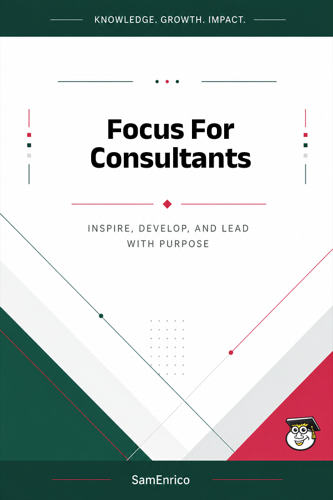
Focus For Consultants Audiobook
Teaches client analysis and deliverable creation w
by Medlin Staci
Teaches client analysis and deliverable creation without interruption.
Formats
Free sample
Chapter 1: The Unethical Distraction--–- The email arrived at 9:47 AM. A simple question from a client: "Can you add a quick slide on market share trends in Southeast Asia?" The consultant, mid-way through building a detailed P&L bridge analysis, paused for "just a second" to respond. Forty-seven minutes later, he had answered three emails, checked Linked In twice, and completely lost the thread of the bridge. That evening, he worked until 11 PM to rebuild what he had lost. The client never knew.
But the insight—the one subtle pattern in the numbers that would have changed the recommendation—never surfaced. Because he was too busy to see it.This is not a story about poor time management. This is a story about a quiet, pervasive, and almost completely unexamined failure in the consulting industry. It is the failure to protect attention—not as a personal productivity quirk, but as a professional obligation to the client.Let us name this problem directly: When a consultant splits their attention during client analysis, they are not merely being inefficient. They are stealing from the client.That statement sounds harsh.
It is meant to. For decades, the consulting industry has framed distraction as a personal weakness—something to be solved with better habits, tighter discipline, or yet another time management app. But this framing is wrong, and it has allowed a systemic problem to fester. The truth is that distraction is not a personal failure. It is a professional betrayal, and it begins with a myth so deeply embedded in our culture that most consultants do not even recognize it as a myth.The Myth That Kills Insight The myth is simple, seductive, and entirely false: Smart people can multitask.The word "multitasking" suggests parallel processing—the ability to do two things at once, like a computer juggling threads.
But the human brain does not work this way. What we call multitasking is actually task-switching: the rapid, continuous, and costly process of moving attention from one cognitive task to another and back again.Every time a consultant shifts from analyzing data to answering email, the brain must perform a series of operations. It must disengage from the first task, storing the current mental context in working memory. It must orient to the second task, retrieving the relevant context. It must perform the second task.
Then it must switch back—reloading the original context, finding the lost thread, and resuming. Each switch costs not just time…
This is the end of the free sample. Get the Audiobook to keep going. Buy now
About this book
Details
- Author
- Medlin Staci
- Publisher
- SamEnrico
- Language
- English
- Genre
- Non-Fiction, Business Brief, Consulting
- Released
- 2026-06-06
- Pages (approx.)
- 135
- Available as
- eBook, Audiobook

Listen in the VoxFlicks app
Audiobooks and audio dramas wherever you go. Sign in with your SamEnrico account and press play.
More by Medlin Staci
 Email Batching StrategyMedlin Staci$11.99
 Crime Scene Timeline ReconstructionMedlin Staci$11.99
 The Startup Credit Card GuideMedlin Staci$11.99
 Imposter For Creatives GuideMedlin Staci$11.99
 Hospitality Talent MigrationMedlin Staci$11.99
 Academic Research BlockingMedlin Staci$11.99
 Pre Sleep Hypnosis ListeningMedlin Staci$11.99
 The Betrayal Code: How the NSA's Secret Backdoor Undermined Global TrustMedlin Staci$11.99
 Love and Honor at Fort Laramie: The Bloody Hand WarMedlin Staci$11.99
 How to Produce Dough WheelsMedlin Staci$11.99
 Cardoon: Stalk HarvestingMedlin Staci$11.99
 Exploring Roman Art: Mosaics, Frescoes & PortraitsMedlin Staci$11.99
You may also like
 Hong Kong Handover 1997Dunn Johnnie$11.99
 Zumba For Postnatal Recovery CourseNeal Christian$11.99
 Zumba for BeginnersLadner Nikia$11.99
 YouTube Comment Mining GuideHumes Pandora$12.99
 Worry Box MeditationCarlin Rudy$11.99
 Workplace Stress MeditationNguyen Lynn$11.99
 Workplace Stress and Sleep RepairHawley Ivory$11.99
 Workplace Perfectionism CureDelaney Jeffry$11.99
 Workplace Injustice Anger GuideWallen Isabelle$11.99
 Work Addiction and Burnout LinkGreenwood Ester$11.99
 Women in Yoga and WellnessBeattie Galina$11.99
 Women in Stand Up ComedyChun Evangeline$11.99