
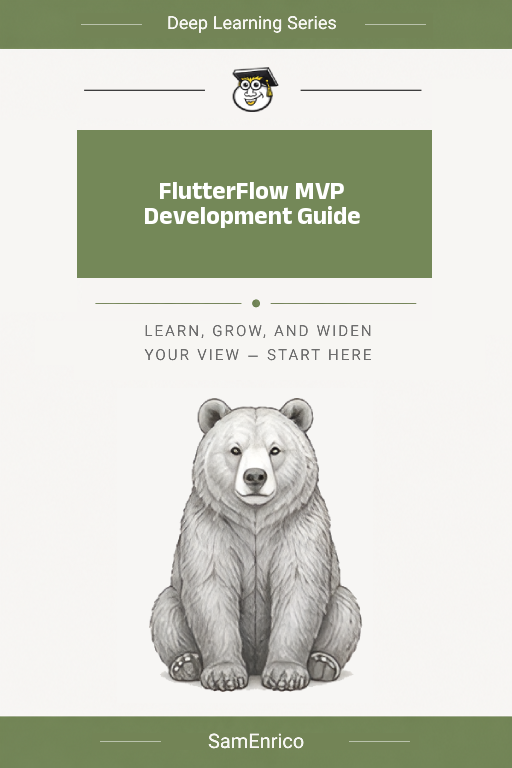
FlutterFlow MVP Development Guide eBook
Build mobile app MVP on FlutterFlow without coding
Build mobile app MVP on FlutterFlow without coding. UI design, Firebase integration, and app publishing.
Formats
Free sample
Chapter 1: The Speed Obsession--–- The year is 2026. A first-time founder named Marcus has an idea for a fitness app that gamifies running—think Strava meets Pokémon Go. He has no coding experience, 3,000insavings,andaburningdesiretolaunchbeforehiscompetitor,afundedstartupacrossthecountry.Marcusfacesachoicethatwilldetermineeverything:learn Swiftand Kotlinforsixmonths,hireanagencyfor3,000 in savings, and a burning desire to launch before his competitor, a funded startup across the country. Marcus faces a choice that will determine everything: learn Swift and Kotlin for six months, hire an agency for 3,000insavings,andaburningdesiretolaunchbeforehiscompetitor,afundedstartupacrossthecountry.Marcusfacesachoicethatwilldetermineeverything:learn Swiftand Kotlinforsixmonths,hireanagencyfor50,000, or try something called Flutter Flow that promises to turn his vision into a real app without writing a single line of code.Marcus represents millions of people today. You might be one of them.
You have an idea that keeps you awake at night. You know there's a market. You've talked to potential users who said, "I'd download that tomorrow." But there's a gap between your idea and reality—a gap traditionally filled by expensive developers, months of waiting, and the terrifying risk of building the wrong thing.This chapter is about closing that gap. Not by teaching you to code faster, but by rethinking what "building an app" even means in 2026. We'll explore why traditional software development is fundamentally misaligned with the needs of new products, how a new generation of visual tools has changed the game, and why speed—not perfection—is the only metric that matters before product-market fit.By the time you finish these pages, you will understand not just the what of Flutter Flow, but the why.
And that understanding will guide every decision you make in the remaining eleven chapters.The Hidden Cost of Traditional Development Let me tell you about Jake. He was a brilliant i OS developer who decided to build his own app—a platform for freelance graphic designers to showcase their portfolios. Jake did everything "right." He wrote clean Swift code. He followed MVC architecture. He wrote unit tests for his authentication flow.
He spent four months building version 1.0.When he launched, seventeen people downloaded the app. Four created accounts. Zero returned after the first week.Jake's app wasn't buggy. It wasn't ugly. It was feature-complete, well-architected, and technically impressive.
It was also completely wrong. Jake had assumed that designers wanted a dedicated portfolio app. They didn't. They wanted Instagram to add a "portfolio mode." They wanted Behance to improve their mobile experience. They wanted nothing that Jake built.The tragedy of Jake's story isn't that he failed.
It's that he spent four months failing in private, without any feedback, when he could have learned the same lesson in four days with a landing page and a "Sign up for beta" button.This is the hidden cost of traditional development: opportunity cost multiplied by time. Every week you spend coding is a week you're not learning from real users. Every feature you perfect is a feature you might delete. Every assumption you code into existence becomes harder to challenge because of the effort already invested.The numbers bear this out. According to a 2025 study by the Standish Group, only 29% of software projects succeed (defined as on time, on budget, and with satisfactory features).
For startups, the success rate is even lower—around 12% for first-time founders. The primary reason isn't technical failure. It's building features nobody wants.Traditional development assumes you know what to build. But the Lean Startup movement, popularized by Eric Ries, argues the opposite: you don't know anything until you test it. Your job isn't to build a product.
Your job is to run experiments that reveal what product to build.The conflict is clear. Traditional development optimizes for execution certainty—building exactly what was specified, on time, without bugs. But startups need learning speed—building the smallest possible thing to test the riskiest assumption, then iterating based on results.This is why Flutter Flow exists. Not as a toy for non-technical people. As a strategic tool for validated learning.Flutter Flow vs.
The Alternatives (2026 Edition)When I tell people about Flutter Flow, they usually ask one of three questions. Let me answer them all upfront."Isn't Flutter Flow just another no-code toy?"This is the most common objection, usually from developers who haven't tried it. The confusion comes from lumping Flutter Flow with website builders like Wix or Squarespace. Those tools generate generic HTML and CSS. They're fine for a restaurant menu, terrible for a mobile app with complex logic.Flutter Flow generates real Flutter code.
Flutter is Google's open-source framework for building native cross-platform apps. It's used by Google itself (for Google Pay and Stadia), by Alibaba, by BMW, by Tencent. It powers hundreds of thousands of apps in production.When you build in Flutter Flow, you're not dragging and dropping onto a webview. You're building a Flutter app using a visual interface. The code that runs on your user's phone is indistinguishable from code written by a professional Flutter developer.
It compiles down to ARM machine code. It runs at 60 frames per second. It supports gestures, animations, and platform-specific UI components.The difference between Flutter Flow and a traditional Flutter project is the authoring experience, not the runtime output. Instead of typing Container(padding: Edge Insets.all(16), child: Text('Hello')), you drag a Container, set its padding to 16 in a properties panel, and drag a Text child inside it. Same result.
Different workflow."But doesn't Bubble or Adalo do the same thing?"No, and understanding why will save you from choosing the wrong tool.Bubble.io is a powerful web application builder. Its visual programming language (workflows) is genuinely impressive for complex logic. But Bubble apps run inside a webview on mobile. That means they inherit all the limitations of a web browser: slower rendering, limited access to device hardware, and a non-native feel. Users notice.
They'll pinch to zoom and accidentally trigger browser chrome. They'll see lag when scrolling long lists. They'll abandon your app because it feels "cheap."Adalo is simpler than Bubble but shares the same fundamental limitation: webview-based rendering. It's great for very simple apps (directories, event listings, basic CRUD). But the moment you need custom animations, offline support, or complex gestures, you hit a wall.Flutter Flow is different because Flutter is different.
Flutter doesn't use webviews. It draws every pixel directly using the device's graphics processing unit (the same GPU that renders games). This approach, called "direct rendering," gives you:Predictable performance: 60fps scrolling even with complex layouts Native gestures: Swipe to dismiss, long press, drag and drop—all work as users expect Device hardware access: Camera, GPS, accelerometer, Bluetooth—via standard plugins Offline support: Store data locally and sync when connection returns Smaller app size: No embedded browser engine means less bloat For an MVP, these differences might seem minor. But user expectations are higher than ever. A 2025 study by Google found that 53% of users abandon an app if it takes more than three seconds to load or feels "janky" during scrolling.
Flutter Flow eliminates those technical objections so you can focus on what matters: your product."What if I need to add custom code?"This is the smartest question. The answer is: you can.Flutter Flow supports custom actions—small Dart functions you write…
This is the end of the free sample. Get the eBook to keep going. Buy now
About this book
Details
- Author
- Nesmith Rebekah
- Publisher
- SamEnrico
- Language
- English
- Genre
- Non-Fiction, Startup Guide, No-Code Build
- Released
- 2026-06-01
- Pages (approx.)
- 152
- Available as
- eBook, Audiobook

Read better in the ZLOADR app
Your eBooks on your phone or tablet. Sign in with your SamEnrico account and start reading.
More by Nesmith Rebekah
 The Degrees' Long WaitNesmith Rebekah$11.99
 Life Review And Meaning CourseNesmith Rebekah$11.99
 Imposter Syndrome Dismantling GuideNesmith Rebekah$11.99
 Peruvian Business GuideNesmith Rebekah$11.99
 The Power Nap Optimization GuideNesmith Rebekah$11.99
 The Vanishing of Farah Fawcett: Egypt's Unsolved Starlet Mystery (1979)Nesmith Rebekah$11.99
 Operations Role Promotion CaseNesmith Rebekah$12.99
 Understanding Van Der Woude Syndrome 2Nesmith Rebekah$17.99
 k-Nearest Neighbors OperatorNesmith Rebekah$11.99
 How to Become a GathererNesmith Rebekah$11.99
You may also like
 Bubble URL Parameters GuideTierney Tatiana$12.99
 FlutterFlow vs Native DevColby Bo$12.99
 FlutterFlow Version ControlMorehead Macie$12.99
 FlutterFlow UI Design GuideFelton Zulema$12.99
 FlutterFlow Template GuideLafleur Chanel$12.99
 FlutterFlow Scaling GuideChapa Farah$12.99
 FlutterFlow Push NotificationsBenevides Liliana$12.99
 FlutterFlow Payment GuideMidkiff Deetta$12.99
 FlutterFlow Firebase GuideLupi Taina$12.99
 FlutterFlow Custom CodeWhitner Kasha$12.99
 FlutterFlow Cost GuideSweeney Brynn$12.99
 FlutterFlow CollaborationHager Temeka$12.99