
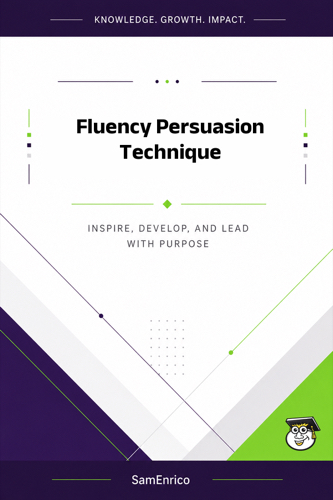
Non-FictionSelf-HelpCognitive Fluency
Fluency Persuasion Technique eBook
Easy to process information feels more truthful an
by Battle Kirby
Easy to process information feels more truthful and persuasive.
Formats
Free sample
Chapter 1: The Font That Changed a Verdict--–- The judge adjusted his reading glasses and sighed. Before him lay two identical legal briefs, two identical sets of facts, two identical requests for leniency. The only difference between them was invisible to the casual observer. One was printed in Arial, clean and crisp, with generous margins and clear section breaks. The other was printed in Haettenschweiler, a heavy, condensed font that packed words together like commuters on a rush-hour train.He read the first brief.
It took him four minutes and thirty-seven seconds. He read the second brief. It took him six minutes and twelve seconds. The words were exactly the same. The arguments were exactly the same.
The lawyers, the defendants, the charges—identical.Yet when the judge delivered his ruling, something strange happened. For the defendant whose brief was printed in the clean, easy-to-read font, the judge granted leniency. For the defendant whose brief was printed in the dense, difficult font, the judge handed down a harsher sentence. The judge, when asked about his decision later, had no explanation. He didn't remember the fonts.
He didn't think about readability. He simply felt that one case was more convincing than the other.This actually happened. Not once, but dozens of times in a controlled study that would upend everything psychologists thought they knew about persuasion.The Study That Should Not Have Worked In 2005, researchers at the University of Michigan conducted a simple experiment that would become legendary in the field of cognitive psychology. They took a persuasive argument—a detailed legal brief arguing for a reduced sentence—and printed it in two different fonts. The first version used Arial, a clean sans-serif font that most people find easy to read.
The second version used Haettenschweiler, a condensed font that most people find slightly annoying to read.The content was identical. Every word, every comma, every argument was exactly the same. The only difference was the visual presentation.The results were staggering. When the argument was presented in the easy-to-read font, 73% of participants found it persuasive. When the exact same argument was presented in the hard-to-read font, only 41% found it persuasive.
The font alone changed the outcome by 32 percentage points.But here is the truly disturbing part: When the researchers asked participants why they found one argument more persuasive than the other, not a single person mentioned the font. Not one. Instead, participants said things like "the first argument was better reasoned" or "the second argument had weak evidence." They invented logical reasons to explain a feeling they didn't know they were having.Their brains had experienced the feeling of ease and interpreted it as truth. Then their conscious minds, desperate for coherence, invented a story to explain why that truth felt true.Welcome to the Cognitive Hijack.Your Brain Is Not a Logic Machine Most of us walk through life believing that we are rational creatures. We believe that we gather evidence, weigh options, consider alternatives, and then make logical decisions based on the best available information.
This belief is not just wrong. It is spectacularly, dangerously wrong.Your brain is not a logic machine. It is a survival machine. And survival machines do not waste energy on careful analysis when a shortcut will do.This chapter introduces the single most important concept in the entire book: the Cognitive Miser. Your brain, like a miser hoarding coins, hoards cognitive energy.
Thinking is expensive. Your brain runs on glucose, and deep analytical thought burns through that fuel at an alarming rate. Evolution solved this problem by creating a brain that defaults to shortcuts—mental heuristics that produce good enough answers with minimal energy expenditure.The most powerful of these shortcuts is the fluency heuristic: Easy to process feels true.Before you consciously evaluate a single word of a message, your brain has already made a preliminary judgment based on how easy that message was to process. If the processing was smooth—clear font, short words, familiar concepts, rhythmic structure—your brain tags the message as "probably true." If the processing was choppy—dense paragraphs, jargon, unusual fonts, awkward sentences—your brain tags the message as "probably false."This judgment happens in milliseconds. It happens before you decide whether to pay attention.
It happens before you engage your "critical thinking." It happens, most disturbingly, without your awareness or consent.System 1 and System 2: The Two Brains Inside Your Head The Nobel Prize-winning psychologist Daniel Kahneman popularized a useful framework for understanding this two-track system. He called them System 1 and System 2, though you could just as easily call them the Automatic Pilot and the Manual Driver.System 1 is fast, intuitive, automatic, and always on. It recognizes faces, drives familiar routes, detects danger, and makes snap judgments. System 1 operates without effort, without awareness, and without your permission. It is the part of your brain that knows 2 + 2 = 4 without having to think about it.
It is the part that flinches at a loud noise before you consciously register what happened. System 1 handles the vast majority of your daily decisions—far more than most people realize.System 2 is slow, analytical, deliberate, and lazy. It solves complex math problems, evaluates evidence, considers counterarguments, and makes conscious choices. System 2 requires effort, attention, and energy. It is the part of your brain that calculates 17 x 24.
It is the part that reads a dense legal contract before signing. System 2 is powerful but reluctant. It only engages when System 1 cannot find a quick answer.Here is the crucial insight for persuasion: Fluency is the native language of System 1.When information is fluent—easy to see, easy to read, easy to understand, easy to remember—System 1 accepts it immediately. No need to wake up System 2. No need to burn extra calories on analysis.
The Cognitive Miser smiles, stamps "TRUE" on the message, and moves on.When information is disfluent—hard to read, confusing, unfamiliar, awkward—System 1 cannot process it. The Cognitive Miser frowns and reluctantly wakes up System 2. But System 2 is grumpy, slow, and suspicious. It processes the information, but it does so with a bias toward rejection. The effort itself feels like evidence of falsehood.This is why bullet points are more persuasive than paragraphs.
Not because they are better organized, not because they convey more information, but because they are faster to scan. Your reader's Cognitive Miser sees the bullet points and thinks, "Ah, easy. Must be true." Your reader's Cognitive Miser sees a dense paragraph and thinks, "Ugh, work. Must be suspicious."This is why you trust Wikipedia more than most expert blogs. Not because Wikipedia is always right—it isn't—but because the uniform formatting, neutral tone, and consistent structure create a feeling of objective authority.
The information feels true because it feels easy.This is why a confident lie often beats a hesitant truth. The confident lie flows smoothly; the hesitant truth stumbles and pauses. The Cognitive Miser prefers the smooth lie because smooth feels true.The Metacognition Trap If all of this is happening below your awareness, how can you ever trust your own judgment? This is the question that keeps cognitive psychologists awake at night.Metacognition is thinking about thinking. It is your ability to reflect on your own mental…
This is the end of the free sample. Get the eBook to keep going. Buy now
About this book
Details
- Author
- Battle Kirby
- Publisher
- SamEnrico
- Language
- English
- Genre
- Non-Fiction, Self-Help, Cognitive Fluency
- Released
- 2026-06-06
- Pages (approx.)
- 129
- Available as
- eBook, Audiobook

Read better in the ZLOADR app
Your eBooks on your phone or tablet. Sign in with your SamEnrico account and start reading.
More by Battle Kirby
 Nutrition for Brain RecoveryBattle Kirby$11.99
 Automation Engineering CreativityBattle Kirby$11.99
 The Struggle Is Data GuideBattle Kirby$11.99
 The Italian Longevity DietBattle Kirby$11.99
 The Silent Senator: The Untold Story of Hiram Rhodes RevelsBattle Kirby$11.99
 Customer Engagement ManagerBattle Kirby$11.99
 YC African Startup Pitch DeckBattle Kirby$12.99
 VAT Automation ToolsBattle Kirby$12.99
 Understanding Tuberculous MeningitisBattle Kirby$17.99
 How to Start a Camels (dromedary) Raising and Breeding Business (Beginners Guide)Battle Kirby$11.99
You may also like
 Hong Kong Handover 1997Dunn Johnnie$11.99
 Zumba For Postnatal Recovery CourseNeal Christian$11.99
 Zumba for BeginnersLadner Nikia$11.99
 YouTube Comment Mining GuideHumes Pandora$12.99
 Worry Box MeditationCarlin Rudy$11.99
 Workplace Stress MeditationNguyen Lynn$11.99
 Workplace Stress and Sleep RepairHawley Ivory$11.99
 Workplace Perfectionism CureDelaney Jeffry$11.99
 Workplace Injustice Anger GuideWallen Isabelle$11.99
 Work Addiction and Burnout LinkGreenwood Ester$11.99
 Women in Yoga and WellnessBeattie Galina$11.99
 Women in Stand Up ComedyChun Evangeline$11.99