
Non-FictionSelf-HelpJournaling
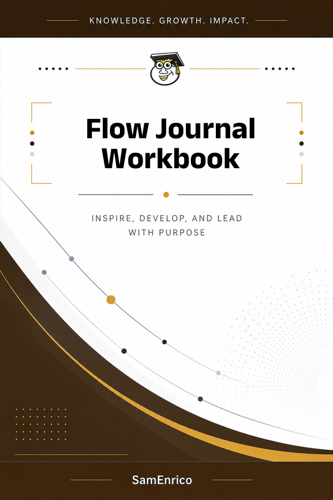
Flow Journal Workbook eBook
Track your flow experiences and identify patterns
Track your flow experiences and identify patterns with this guided journal.
Formats
Free sample
Chapter 1: The Nine Hidden Doors--–- You have experienced flow before. You may not have called it that. You may have called it "being in the zone," "losing yourself in the work," or "having a great day at the office." But regardless of the label, you know the feeling: the complete absorption, the effortless action, the strange way that hours pass like minutes. You looked up from your desk and three hours had vanished. You wrote page after page without stopping to second-guess a single sentence.
You solved a problem that had seemed impossible just moments earlier, and the solution arrived not through struggle but through a kind of quiet clarity.That feeling has a name. It is called flow.And here is the truth that most books will not tell you: flow is not mysterious. It is not a gift granted only to athletes, artists, or geniuses. It is not something you have to wait for, hope for, or stumble into by accident. Flow is a scientifically measurable neuropsychological state with nine specific, identifiable characteristics.
And once you learn to recognize those nine characteristics, you can begin to track them, measure them, and eventually engineer them into your daily life.This chapter is not a motivational pep talk. It is a diagnostic. By the time you finish these pages, you will know exactly what flow is, what it is not, and how often you currently experience it. You will take the Flow Self-Assessment Quiz and receive a clear score placing you into one of four categories: Flow Novice, Occasional Visitor, Regular Achiever, or Master. You will complete the "Not Flow" Reflection, identifying a recent "good day" that may not have been flow at all.
And you will walk away with something more valuable than inspiration: a precise, actionable map of your current relationship with optimal experience.Let us begin by dismantling the most common misconception about flow.The Misconception That Keeps You Stuck Most people believe that flow is simply "being focused." If they can concentrate on a task without getting distracted, they assume they are in flow. This is incorrect. Focus is a component of flow, but it is not the whole picture. You can be intensely focused on a boring spreadsheet because your boss is watching over your shoulder. That is not flow—that is anxious vigilance.
You can be focused on scrolling social media for an hour without looking up. That is not flow—that is passive consumption. You can be focused on a difficult problem while feeling frustrated, stuck, and self-critical. That is not flow—that is struggle.Flow is not just focus. Flow is the marriage of focus with effortless action, intrinsic reward, and a balance between what you can do and what the task demands of you.The second most common misconception is that flow is "losing track of time." Many people point to an afternoon that disappeared while they were working and say, "See, I was in flow." But losing track of time can happen for many reasons, including boredom (time drags, but you lose track because you stop checking the clock) and dissociation (a stress response where you mentally check out).
True flow involves time distortion, yes, but it also involves a dozen other characteristics that boredom and dissociation lack.The third misconception is the most dangerous: that flow is something you have to wait for. "I just don't feel inspired today," people say, as if flow were a weather system that moves through randomly. This belief makes flow into a passive experience—something that happens to you rather than something you create. The research tells a different story. Flow emerges when specific conditions are met.
Those conditions are within your control. And the first step to controlling them is knowing exactly what you are looking for.The Nine Characteristics of Flow Mihaly Csikszentmihalyi, the psychologist who spent decades researching optimal experience, identified nine characteristics that appear whenever a person is truly in flow. Not all nine need to be present at maximum intensity every single time, but the more of them you experience, the deeper your flow state. Think of these as nine doors. Each one opens into the same room, but from a different angle.
Some people enter through the door of clear goals. Others enter through the door of immediate feedback. By the end of this chapter, you will know which door is closest to you.Characteristic One: Complete Immersion in the Task When you are in flow, you are fully present. Your attention is not divided between the task and your worries about tomorrow, your regrets about yesterday, or your to-do list for later. The task fills your entire field of awareness.
This is different from hyperfocus, which can be rigid and effortful. In hyperfocus, you are locked in but not necessarily enjoying it. In flow, immersion feels natural, almost gravitational. You do not have to force yourself to pay attention; attention simply happens.Ask yourself: In the past week, have you had any activity where you lost awareness of your surroundings? Where you did not notice someone entering the room or the phone ringing?
That is immersion.Characteristic Two: Loss of Self-Consciousness This is one of the most liberating aspects of flow. In ordinary life, we are constantly monitoring ourselves. Am I doing this right? What do they think of me? Do I look stupid?
This internal chatter is exhausting. In flow, the self temporarily disappears. You are not thinking about how you are performing because you are too busy performing. The critic in your head falls silent.This is why people often describe flow as "losing yourself" in the activity. You are not gone—you are more present than ever.
But the part of you that worries about being judged, the part that second-guesses every move, that part takes a vacation.Ask yourself: In the past week, have you done anything where you stopped worrying about what others thought? Where you acted without self-judgment?Characteristic Three: Distorted Time Perception Five hours feel like thirty minutes. Thirty seconds feel like five minutes. Time warps in flow. This happens because your brain stops tracking time when it is fully engaged.
The internal clock that normally ticks away in the background goes quiet. Some people experience time speeding up (a long session feels short). Others, in high-stakes flow like surgery or competitive sports, experience time slowing down (a critical moment stretches out). Either way, your perception of time becomes unreliable.Ask yourself: In the past week, have you looked up and been surprised by how much time had passed? Or have you had a moment that felt stretched out, where you noticed details you would normally miss?Characteristic Four: Clear Moment-to-Moment Goals This characteristic is often misunderstood, so pay close attention.
Csikszentmihalyi is not saying that you need to set long-term goals before entering flow. He is saying that while you are in flow, you always know what to do next. The path is clear moment by moment. A rock climber does not think "I want to reach the summit by noon." She thinks "My right hand goes to that hold, then my left foot moves here, then…
This is the end of the free sample. Get the eBook to keep going. Buy now
About this book
Details
- Author
- Spellman Rosalva
- Publisher
- SamEnrico
- Language
- English
- Genre
- Non-Fiction, Self-Help, Journaling
- Released
- 2026-06-06
- Pages (approx.)
- 139
- Available as
- eBook, Audiobook

Read better in the ZLOADR app
Your eBooks on your phone or tablet. Sign in with your SamEnrico account and start reading.
More by Spellman Rosalva
 Cognitive Diversity GuideSpellman Rosalva$11.99
 Outsourcing for Church LeadersSpellman Rosalva$11.99
 The SMART for Business GuideSpellman Rosalva$11.99
 Growth Mindset In RelationshipsSpellman Rosalva$11.99
 The Investment Loss GuideSpellman Rosalva$11.99
 Financial Self Compassion GuideSpellman Rosalva$11.99
 Five Minute Mindfulness PracticeSpellman Rosalva$11.99
 The Man Who Invented the Modern Navy: John Philip Holland and the Birth of the SubmarineSpellman Rosalva$11.99
 Operation Blackout: The Fall of the Sinaloa Cyber CartelSpellman Rosalva$11.99
 The Essential Guide to Alternative RapSpellman Rosalva$11.99
 How to Produce Punching and Training BagsSpellman Rosalva$11.99
 How to Produce Electronics AccessoriesSpellman Rosalva$11.99
You may also like
 Hong Kong Handover 1997Dunn Johnnie$11.99
 Zumba For Postnatal Recovery CourseNeal Christian$11.99
 Zumba for BeginnersLadner Nikia$11.99
 YouTube Comment Mining GuideHumes Pandora$12.99
 Worry Box MeditationCarlin Rudy$11.99
 Workplace Stress MeditationNguyen Lynn$11.99
 Workplace Stress and Sleep RepairHawley Ivory$11.99
 Workplace Perfectionism CureDelaney Jeffry$11.99
 Workplace Injustice Anger GuideWallen Isabelle$11.99
 Work Addiction and Burnout LinkGreenwood Ester$11.99
 Women in Yoga and WellnessBeattie Galina$11.99
 Women in Stand Up ComedyChun Evangeline$11.99