
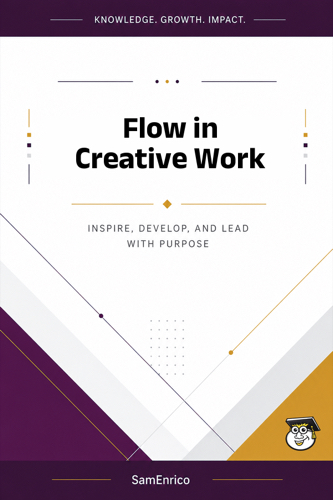
Flow in Creative Work eBook
Applies flow principles to writing, art, music, an
Applies flow principles to writing, art, music, and design.
Formats
Free sample
Chapter 1: The Creative Wound--–- You are staring at a blank page. Or a blank canvas. Or a blinking cursor on a dark screen. Your hands are on the keyboard, or holding the brush, or resting on the guitar strings. You have been here for forty-five minutes.
The vision in your head is vivid and brilliant—a story that will make readers weep, a painting that will stop people mid-stride, a melody that will lodge itself in someone's memory for years. The vision is perfect. The problem is that you cannot seem to transfer that vision from your imagination into reality. Every word you type feels flat. Every brushstroke looks wrong.
Every chord progression sounds like something you have heard a thousand times before. And the voice in your head—the one that sounds suspiciously like your high school art teacher, your college workshop leader, or your own worst self—says, "See? You have no talent. You are a fraud. You should just stop."This is the Creative Wound.
It is the gap between your taste and your skill, between your vision and your execution, between the masterpiece in your head and the garbage on the page. Every artist knows this wound. It is the price of admission to the creative life. But here is what no one tells you: the wound is not the problem. The way you have been taught to think about the wound—the myths you have absorbed about creativity, suffering, and genius—that is the problem.The Two Kinds of Struggle Most people believe that struggle is a single, uniform experience.
If you are struggling, you are struggling. If it hurts, it is bad. If it is hard, you must be doing something wrong. This is dangerously reductive. The first critical distinction this chapter will establish—and the foundation for everything that follows—is the difference between productive struggle and destructive friction.Productive struggle is what you feel when you are learning a new skill, stretching beyond your comfort zone, or working at the edge of your ability.
It is the discomfort of a muscle tearing to rebuild stronger. It is the frustration of practicing a difficult passage on the piano, playing it wrong fifty times, and then—on the fifty-first—playing it right. Productive struggle leads to growth, mastery, and eventually, to flow. It feels like effort, but it is effort with a purpose. It is the struggle of a weightlifter adding five more pounds, not of someone trying to lift a building.Destructive friction is something else entirely.
Destructive friction is the grinding, repetitive loop of self-criticism, comparison, and paralysis that leads to creative blocks and burnout. It is not the struggle of learning. It is the struggle of judging yourself while you are trying to learn. It is the voice that says "this is terrible" while you are still writing the first sentence. It is the instinct to delete, to erase, to scrap the whole project and start over, again and again, until you have nothing left but a blank page and a bruised ego.Most creatives cannot tell the difference between productive struggle and destructive friction.
Both feel like difficulty. Both involve discomfort. But one leads to a finished book, a completed painting, a recorded song. The other leads to an abandoned project, a wasted afternoon, and a growing conviction that you are not good enough. The difference is not in the activity.
The difference is in the relationship between your generative mind and your critical mind.The Generative Brain vs. The Critical Brain Your brain has two modes that are relevant to creative work. The first is the generative mode. This is the associative, pattern-seeking, divergent-thinking network that makes novel connections between seemingly unrelated ideas. It is the source of improvisation, of surprising metaphors, of unexpected solutions.
The generative mode is fast, messy, and prolific. It produces quantity, not quality. It is the part of your brain that generates a hundred ideas, ninety-five of which are terrible, five of which are brilliant. The generative mode does not judge. It simply produces.The second is the critical mode.
This is the evaluative, logical, convergent-thinking network that judges, refines, and selects. It is the editor, the proofreader, the quality-control manager. The critical mode is slow, precise, and discriminating. It takes the five brilliant ideas from the generative mode and polishes them into three truly excellent ones. The critical mode is essential.
Without it, you would have endless messy drafts and nothing finished. Without it, creativity is just chaos.The problem is that these two modes cannot operate at full capacity at the same time. When the critical mode is active, it suppresses the generative mode. When you are judging, you are not generating. When you are editing, you are not creating.
This is not a flaw in your brain. It is a design feature. The brain cannot be in two contradictory states simultaneously. It must switch between them.The Creative Wound is not the gap between vision and execution. That gap is inevitable.
The Creative Wound is the habit of keeping your critical mode turned on while you are trying to generate. It is the attempt to edit the first draft before the first draft exists. It is the demand that everything you produce be good, right now, on the first try, without any garbage in between.The Tortured Genius Myth There is a story that Western culture has been telling itself for centuries. It is the story of the Tortured Genius. The artist who suffers for their art.
The writer who drinks themselves to death. The painter who cuts off their ear. The musician who overdoses at twenty-seven. The story goes like this: great art requires great suffering. The more you bleed, the better your work.
If you are not miserable, you are not a real artist.This story is a lie. It is a dangerous, destructive lie that has convinced generations of creatives to reject the very things that would help them—therapy, medication, sleep, boundaries, healthy relationships, basic self-care—because they believe that suffering is the price of admission. They look at the statistics—the rates of anxiety and depression among artists, writers, and musicians are two to three times higher than the general population—and they nod knowingly. "Of course," they think. "That is the cost.
That is what it takes."But what if the statistics tell a different story? What if the high rates of mental illness among artists are not evidence that suffering produces great art, but evidence that the creative life, as currently lived, is toxic? What if the tortured genius is not a model to aspire to but a warning to avoid?The truth is that most of the great art in history was not produced by tortured souls. It was produced by disciplined professionals who showed up, did the work, and went home to dinner. Mozart wrote constantly, but he also loved parties and practical jokes.
Shakespeare was a businessman as much as a playwright. The myth of the tortured genius is a romantic fantasy that allows us to excuse bad behavior, reject help, and romanticize our own suffering. It is time to…
This is the end of the free sample. Get the eBook to keep going. Buy now
About this book
Details
- Author
- Dove Clementine
- Publisher
- SamEnrico
- Language
- English
- Genre
- Non-Fiction, Self-Help, Creativity
- Released
- 2026-06-09
- Pages (approx.)
- 94
- Available as
- eBook, Audiobook

Read better in the ZLOADR app
Your eBooks on your phone or tablet. Sign in with your SamEnrico account and start reading.
More by Dove Clementine
 Student Language LearningDove Clementine$11.99
 Group Creativity Timing GuideDove Clementine$11.99
 Declutter Five MinutesDove Clementine$11.99
 OKR For ProcrastinationDove Clementine$11.99
 Acupuncture for Weight LossDove Clementine$11.99
 Self Hypnosis for Physical AnxietyDove Clementine$11.99
 Massage For InsomniaDove Clementine$11.99
 Ghosts of the Hindu Kush: The Soviet Spetsnaz Ambush at Takur GharDove Clementine$11.99
 The Double Agent Who Stole the Manhattan ProjectDove Clementine$11.99
 How to Produce Dehumidifier AccessoriesDove Clementine$11.99
 A Collector's Handbook to the Volvo 145e EstateDove Clementine$11.99
 Polish UI UX Design GuideDove Clementine$12.99
You may also like
 Trance for Creativity BoostEngel Colene$11.99
 Self Hypnosis for Creativity HabitsGerman Bernetta$11.99
 Mindfulness Meditation for Creativity BlockPage Duane$11.99
 Joyful Creativity Through GratitudeJacob Antoine$11.99
 Ideation Techniques For SolutionsKim Vincent$11.99
 Fear Of Failure In CreativityCrean Fairy$11.99
 EQ For Creative Professionals GuideGilley Elanor$11.99
 Creative Legacy GuideHooker Georgiana$11.99
 Alcoholism Recovery for Creative Souls WorkbookCompton Leota$11.99
 Creativity Trance MethodLy Morgan$11.99
 Creative Morning Routine GuideBetancourt Jacquelynn$11.99
 Walking Meditation For Creative BlockStevens Irvin$11.99