
Non-FictionBusiness BriefProperty InsuranceRisk Assessment
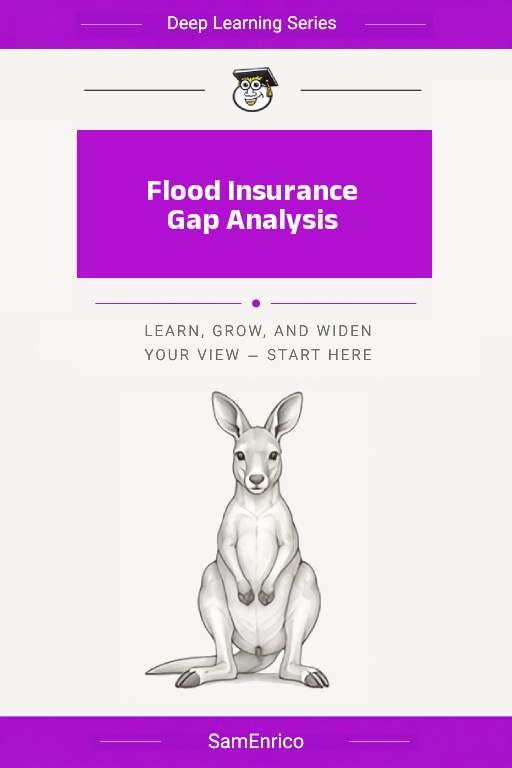
Flood Insurance Gap Analysis
Identify properties excluded from standard commerc
by Castillo Bob
Identify properties excluded from standard commercial policies and purchase NFIP or private excess coverage before the next hundred-year storm.
Formats
About this book
Free sample
Chapter 1: The $1 Trillion Blind Spot--–- Maria Castellano had done everything right. For twenty-three years, she had awakened at 4:30 a.m. to bake bread, cookies, and birthday cakes for the small New Jersey town that had become her home. Her commercial insurance policy was paid in full each year, automatically deducted from her business checking account. She had never filed a claim.
Her agent, a family friend, had assured her that she had "full coverage." On the night of August 23, 2026, Maria stood in her bakery's kitchen, water rising past her knees, watching three decades of work float away—and learned for the first time that "full coverage" did not include flood.The next morning, her agent returned her call. His voice was careful, practiced. "Maria, I'm so sorry. Flood is excluded under the standard commercial property form. You would have needed a separate policy." She asked why he had never mentioned it.
The silence lasted long enough for the water line on her wall to dry. Maria Castellano is not real. But she is every commercial property owner who has ever discovered, after the water receded, that their insurance was an illusion.This is the $1 trillion blind spot.The Protection Gap Defined The term protection gap appears in actuarial reports, academic journals, and legislative testimony. In plain English, it means this: the difference between what a disaster destroys and what insurance pays. For flood, that gap is not a crack.
It is a chasm.According to Moody's 2026 Catastrophe Risk Report, a single 100-year flood event across the United States would generate approximately 375billioninuninsuredeconomiclosses.Thatisnotthetotaldamage—thatisthe∗uninsured∗portion.A500−yearevent,thekindofstormthat FEMAmapssuggesthasa0.2375 billion in uninsured economic losses. That is not the total damage—that is the *uninsured* portion. A 500-year event, the kind of storm that FEMA maps suggest has a 0.2% annual chance of occurring, would push uninsured losses past 375billioninuninsuredeconomiclosses.Thatisnotthetotaldamage—thatisthe∗uninsured∗portion.A500−yearevent,thekindofstormthat FEMAmapssuggesthasa0.21 trillion. To put that number in context: $1 trillion exceeds the combined annual revenues of Amazon, Apple, and Microsoft. It is roughly equivalent to the entire GDP of Australia.
And it is the amount of wealth that would simply vanish because the properties at risk either carried no flood…
This is the end of the free sample. Get the eBook to keep going. Buy now
Contents
- Chapter 1
- Chapter 2
- Chapter 3
- Chapter 4
- Chapter 5
- Chapter 6
- Chapter 7
- Chapter 8
- Chapter 9
- Chapter 10
- Chapter 11
- Chapter 12
Details
- Author
- Castillo Bob
- Publisher
- SamEnrico
- Language
- English
- Genre
- Non-Fiction, Business Brief, Property Insurance, Risk Assessment
- Released
- 2026-05-29
- Pages (approx.)
- 139
- Available as
- eBook, Audiobook

Read better in the ZLOADR app
Your eBooks on your phone or tablet. Sign in with your SamEnrico account and start reading.
More by Castillo Bob
 Sleep And Working MemoryCastillo Bob$11.99
 Mayor of a Refugee CityCastillo Bob$11.99
 Parental Self Care Daily RoutineCastillo Bob$11.99
 Coping With Foreclosure ProcessCastillo Bob$11.99
 School Crisis Leadership GuideCastillo Bob$11.99
 Amazon Inventory Management GuideCastillo Bob$11.99
 Code Commit FrequencyCastillo Bob$11.99
 Microbiome Sports PerformanceCastillo Bob$11.99
 Thyroid and MoodCastillo Bob$11.99
 The Phantom of Wembley: England’s 55-Year Curse and the Night It BrokeCastillo Bob$11.99
 The Sound of America: The Pioneers of JazzCastillo Bob$11.99
 The Grand Calculators of Timbuktu: Masters of the Mathematical UniverseCastillo Bob$11.99
You may also like
 Hong Kong Handover 1997Dunn Johnnie$11.99
 Zumba For Postnatal Recovery CourseNeal Christian$11.99
 Zumba for BeginnersLadner Nikia$11.99
 YouTube Comment Mining GuideHumes Pandora$12.99
 Worry Box MeditationCarlin Rudy$11.99
 Workplace Stress MeditationNguyen Lynn$11.99
 Workplace Stress and Sleep RepairHawley Ivory$11.99
 Workplace Perfectionism CureDelaney Jeffry$11.99
 Workplace Injustice Anger GuideWallen Isabelle$11.99
 Work Addiction and Burnout LinkGreenwood Ester$11.99
 Women in Yoga and WellnessBeattie Galina$11.99
 Women in Stand Up ComedyChun Evangeline$11.99