
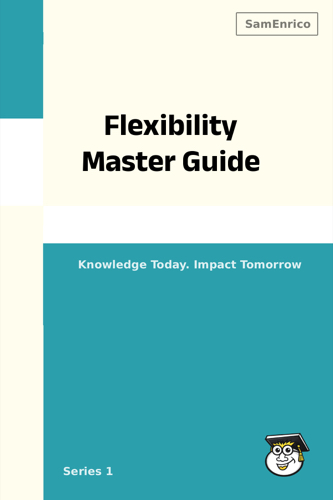
Flexibility Master Guide eBook
Complete reference for all stretching techniques a
Complete reference for all stretching techniques and routines.
Formats
Free sample
Chapter 1: The Stiffness Epidemic--–- On a Tuesday morning in suburban Chicago, forty-three-year-old Mark did something he had done ten thousand times before: he bent down to tie his shoe. This time, something was different. His hand missed the lace by two inches. He tried again, grunting this time, and felt a sharp tug in his lower back. So he did what most modern adults do—he switched to the other shoe, the one on his dominant side, and contorted his body into an awkward sideways crouch.
Both shoes tied, he stood up slowly, one hand braced against the wall, and thought nothing more of it.That evening, Mark’s seven-year-old daughter asked him to sit on the floor and play a board game. He lowered himself carefully, knees cracking, and spent the next twenty minutes shifting uncomfortably, unable to find a position that didn’t make his hips ache. When the game ended, he had to roll onto his side and push himself up with both hands. His daughter had already bounced to her feet three times during the game without thinking about it.Mark is not old. He runs three times a week.
He eats reasonably well. He has no diagnosed medical condition. And yet, by every objective measure, his body is stiffening at a rate that would have alarmed his twenty-five-year-old self. His fingertips graze only his shins when he tries to touch his toes. He cannot sit cross-legged on the floor for more than ninety seconds.
He has not looked over his left shoulder while driving without turning his entire torso in four years. When a doctor asked him to touch his left shoulder blade with his right hand, he discovered he could not reach past the middle of his back.Mark is not the exception. He is the rule.The Quiet Crisis No One Is Measuring Every year, millions of adults lose measurable range of motion in every major joint of their bodies. This loss is not sudden like a heart attack or visible like weight gain. It creeps in like a tide—imperceptible from day to day but devastating when measured year over year.
By age forty, the average sedentary adult has lost approximately fifteen to twenty degrees of hamstring flexibility, thirty percent of thoracic spine rotation, and nearly half of their hip internal rotation compared to their teenage baseline. By age sixty, these losses accelerate, not because of aging itself, but because of accumulated disuse.Here is what the flexibility industry has gotten wrong for decades: they have marketed stretching as a tool for athletes, for the already-fit, for people who run marathons or practice yoga or “care about their bodies.” This marketing has created a false binary—that there are flexible people who stretch and inflexible people who do not, and never the twain shall meet. The truth is far more democratic and far more urgent: every human being, regardless of age, fitness level, or athletic history, requires a minimum functional range of motion to perform basic life tasks without pain or injury. When you fall below that minimum, you do not become “less flexible.” You become disabled in small, accumulating ways that most people mistake for normal aging.They are wrong.The “Creeping Rigor Mortis” Phenomenon Let us name this condition precisely: Creeping Rigor Mortis. It is the gradual stiffening of the body that occurs when muscles and connective tissues are habitually shortened through prolonged positioning—sitting at desks, driving cars, looking down at phones, sleeping in fetal positions—without being regularly returned to their full length.
The term is deliberately provocative because it describes an actual physiological process: muscles that are not stretched through their full range develop cross-links between collagen fibers, lose water content, and become increasingly resistant to elongation. Over time, these muscles behave less like elastic bands and more like stiff ropes.The physiology is straightforward but rarely explained. Every muscle in your body has an optimal resting length—the length at which it can generate maximum force with minimum effort. When a muscle is habitually shortened (as your hip flexors are when you sit eight hours a day), your brain literally forgets how to lengthen it fully. The muscle fibers themselves adapt by reducing the number of sarcomeres (the contractile units) in series, effectively becoming physically shorter.
This is not a metaphor. Your muscles actually lose sarcomeres when you do not use their full range of motion. The reverse is also true: when you regularly stretch a muscle to its full length, you add sarcomeres in series, making the muscle physically longer.This means that stiffness is not an inevitable consequence of aging. It is an inevitable consequence of disuse. Age simply provides more years for disuse to compound.The Three Myths That Keep You Stiff Before we can solve the problem, we must dismantle the cultural beliefs that have prevented most adults from addressing it.Myth Number One: “Stretching is for athletes and gymnasts.”This myth is the single greatest barrier to widespread flexibility practice.
The belief that stretching belongs in gyms and yoga studios—not in offices, living rooms, and airport gates—has excluded the very population that needs it most. Consider the following: an elite marathon runner has exceptional cardiovascular fitness but may have remarkably tight hamstrings and hip flexors from years of repetitive knee drive. A professional football player may have enormous strength but cannot raise his arms overhead without arching his back. Athleticism and flexibility are not correlated. In fact, many athletes are significantly stiffer than sedentary office workers because they repeatedly strengthen muscles in short ranges without balancing with full-range stretching.The truth is that the person who most needs a daily stretching practice is not the twenty-five-year-old Cross Fit enthusiast.
It is the fifty-five-year-old accountant who spends nine hours a day at a desk, the forty-year-old parent who carries children on one hip and groceries on the other, the seventy-year-old retiree who wants to play with grandchildren without fear of falling. Stretching is not a performance enhancement. It is a maintenance requirement, like brushing your teeth or sleeping seven hours. You do not brush your teeth because you plan to eat corn on the cob at a competition. You brush your teeth because the alternative—tooth decay, gum disease, tooth loss—is unacceptable.
Similarly, you stretch not to achieve a party trick like the splits. You stretch to avoid the creeping rigor mortis that turns a simple act of bending over into a calculated risk assessment.Myth Number Two: “If I’m not sore the next day, I didn’t stretch enough.”This myth comes from conflating strength training with flexibility training. In strength training, muscle damage (microtears) is a necessary part of the adaptation process. Soreness is a sign that you have successfully overloaded the muscle. In flexibility training, the opposite is true.
Stretch soreness—especially sharp or burning pain—indicates that you have triggered the stretch reflex (the muscle’s automatic contraction in response to perceived danger) or caused microdamage to connective tissue. Neither is desirable.The most effective stretching feels like a mild to moderate tension—what researchers call “the edge of discomfort.” It should never feel painful. You should never…
This is the end of the free sample. Get the eBook to keep going. Buy now
About this book
Details
- Author
- Samples Lawrence
- Publisher
- SamEnrico
- Language
- English
- Genre
- Non-Fiction, Health & Wellness, Complete
- Released
- 2026-06-10
- Pages (approx.)
- 158
- Available as
- eBook, Audiobook

Read better in the ZLOADR app
Your eBooks on your phone or tablet. Sign in with your SamEnrico account and start reading.
More by Samples Lawrence
 My Foster Care GraduationSamples Lawrence$11.99
 Growth Hormone and Cardiovascular HealthSamples Lawrence$11.99
 Outbreak R&D Priority ResetSamples Lawrence$11.99
 Restaurant Memory LociSamples Lawrence$11.99
 Burnout Proof Morning RoutineSamples Lawrence$11.99
 Anxiety Driven ProcrastinationSamples Lawrence$11.99
 Cocaine Vasculitis GuideSamples Lawrence$11.99
 The Silent Hunt: The Untold Story of the Beast of GévaudanSamples Lawrence$11.99
 The Phantom of the Stock Exchange: Argentina's First Insider Trading Scandal (1930s)Samples Lawrence$11.99
 Growing Abromeitiella (Obsolete)Samples Lawrence$11.99
 How to Start a Antibiotics (wholesale) Business (Beginners Guide)Samples Lawrence$11.99
 How to Produce Window Treatment Replacement PartsSamples Lawrence$11.99
You may also like
 Men's Master GuideGass Viviana$11.99
 Injury Master GuideStuckey Berenice$11.99
 Macronutrient Master GuideTillery Carlita$11.99
 Sleep Master GuideDesantis Dominique$11.99
 PCOS Master GuideOtoole Sierra$11.99
 IBS Master ReferenceBolin Meryl$11.99
 Hormonal Master GuideOswald Elda$11.99
 Food Intolerances Complete GuideTitus Earleen$11.99
 Beginner Fitness MasterSharkey Vinita$11.99
 Napping Complete Health GuideEnnis Laronda$11.99
 Group Fitness MasterHolly Lashawnda$11.99
 Essential Oils Master GuideCoble Lawrence$11.99