
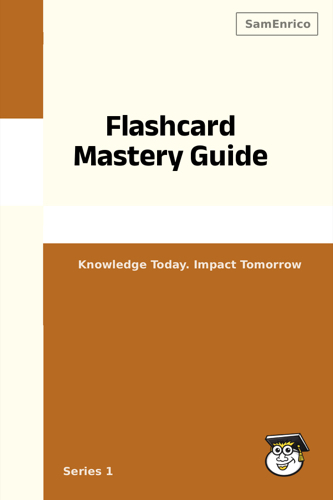
Flashcard Mastery Guide eBook
Design effective cards and use Leitner box system
by Key Gwenn
Design effective cards and use Leitner box system for prioritization.
Formats
Free sample
Chapter 1: The Broken Ritual--–- Every evening, millions of students around the world perform a ritual they believe will save them. They sit down at a desk, pull out a highlighter, and begin painting yellow streaks across paragraphs of a textbook. They read the same sentence three times. They feel the familiar warmth of recognition—yes, I’ve seen this before—and close the book, satisfied. Days later, sitting in an exam or staring at a flashcard app, the information is gone.
Not fuzzy. Not slow. Gone. And they are left with the quiet, crushing question: I studied. Why can’t I remember?This chapter is not about flashcards.
Not yet. Before we build a single card, before we touch a Leitner box or open Anki, we must confront a more fundamental problem. The way most people study is broken. Not inefficient. Not suboptimal.
Broken. And until you understand why your current habits fail, no system—no matter how elegant—will save you. This chapter dismantles the most common study rituals, introduces the century-old science that explains their failure, and reveals the single principle that separates effortless forgetting from durable memory.The Highlighter Delusion Let us begin with a simple experiment you can conduct on yourself. Take a paragraph from a textbook you have never read. Read it once, normally.
Then, without looking back, write down everything you remember. Most people recall perhaps 20 to 30 percent of the key points immediately after reading. Now wait twenty-four hours. Without rereading, try again. The number drops to less than 10 percent.
This is not a failure of intelligence. It is a feature of how human memory evolved.Highlighting feels productive because it requires physical action and visual selection. You are doing something. But research consistently shows that highlighting has little to no benefit over simply reading. In a landmark 2012 study published in the Journal of Educational Psychology, researchers examined ten different study techniques and ranked highlighting among the least effective—rated as "low utility" for most learners.
Why? Because highlighting does not require retrieval. It requires recognition. You look at a sentence, decide it seems important, and mark it. At no point does your brain have to pull that information out of nothing.
The highlighter does the work your memory should be doing.Worse, highlighting creates a dangerous illusion of mastery. When you reread a highlighted passage, the yellow marks make the text visually familiar. Your brain confuses I have seen this before with I know this. Psychologists call this the fluency illusion: the easier information feels to process during study, the less likely you are to remember it later. The highlighted page flows smoothly under your eyes, so you conclude that the knowledge has been transferred to your long-term memory.
It has not. You have simply grown comfortable with the sight of the words.Rereading suffers from the same flaw. Whether you read a chapter once or four times, the gains are marginal after the first pass. In one study, students who reread a text four times performed only slightly better on a subsequent test than those who read it once—and both groups forgot most of the material within a week. The act of rereading does not deepen encoding; it simply repeats exposure.
Your brain, efficient to a fault, assumes that if information is right there in front of you, it need not store it securely. Why would it? The text is available. The brain conserves energy. It will not build a permanent structure for information that appears to be permanently accessible.The Cramming Catastrophe If highlighting and rereading are the daily rituals of the misguided student, cramming is the emergency response of the desperate one.
The night before an exam, fueled by caffeine and anxiety, the crammer attempts to force an entire semester's worth of material into a few hours. And remarkably, it sometimes works—for the next morning. The crammer walks into the exam, retrieves a surprising amount of information, and passes. Then, three days later, they remember almost nothing. They do not see this as a problem because the exam is over.
But the forgetting is not a side effect of cramming; it is the inevitable consequence of how memory consolidates.To understand why, we need to meet Hermann Ebbinghaus, the 19th-century German psychologist who did something both tedious and brilliant. He invented 2,300 nonsense syllables—meaningless combinations like "ZOF" and "WUX"—and spent years memorizing them, then testing himself at various intervals to chart the exact trajectory of forgetting. His results, published in 1885, gave us the Forgetting Curve.Ebbinghaus discovered that forgetting is not linear. It is exponential. Within one hour of learning new material, you forget approximately 50 percent of it.
Within 24 hours, you forget up to 70 percent. After one week, unless you have reviewed the material, you are left with a mere 10 to 20 percent. This curve is not a theory. It has been replicated hundreds of times across different materials, ages, and contexts. It is as close to a law of cognitive psychology as exists.Cramming works against this curve in the worst possible way.
When you cram, you force a large amount of information into short-term memory through sheer repetition, but you give your brain no time to consolidate that information into long-term storage. Consolidation—the process by which short-term memories become stable, long-term ones—requires time and, crucially, sleep. During deep sleep, the hippocampus replays the day's experiences, strengthening neural connections and integrating new information with existing knowledge. Cramming eliminates this time window. You learn at 10 PM and test at 8 AM.
Your brain has had hours, not days, to build durable structures. The result is a memory that is brittle, context-dependent, and short-lived.Worse, cramming produces what cognitive scientists call massed practice—learning concentrated in a single session. Massed practice feels effective during the session because performance improves rapidly. You see your accuracy go from 20 percent to 80 percent in an hour. That immediate progress is rewarding.
But the forgetting curve after massed practice is steep. Within days, the gains vanish. The alternative, which we will explore throughout this book, is distributed practice—spacing learning out over time. Distributed practice feels slower during each session because you spend time re-retrieving information that has begun to fade. That struggle is uncomfortable.
But the forgetting curve after distributed practice is shallow. The information sticks.The Recognition Trap There is a deeper problem beneath highlighting, rereading, and cramming. All three methods rely on a single, flawed cognitive process: recognition. When you reread a highlighted sentence, you recognize it as familiar. When you review your notes, you recognize the concepts.
Recognition is easy, fast, and effortless. It is also nearly useless for building lasting memory.Active recall is the opposite. It requires you to generate an answer from a blank mental state—no cues, no multiple-choice options, no context to trigger recognition. Active recall is hard. It feels slow.
It often fails. And that is precisely why it works.The most famous demonstration of this principle comes from a 1939 study by the psychologist Arthur Gates. Gates had students read a passage, then tested them on it after different study methods. Some students simply reread the passage repeatedly. Others spent time trying…
This is the end of the free sample. Get the eBook to keep going. Buy now
About this book
Details
- Author
- Key Gwenn
- Publisher
- SamEnrico
- Language
- English
- Genre
- Non-Fiction, Self-Help, Flashcard
- Released
- 2026-06-10
- Pages (approx.)
- 134
- Available as
- eBook, Audiobook

Read better in the ZLOADR app
Your eBooks on your phone or tablet. Sign in with your SamEnrico account and start reading.
More by Key Gwenn
 The Mother's Mental IllnessKey Gwenn$11.99
 Mining Safety Superintendent StressKey Gwenn$11.99
 Anger Management Music at WorkKey Gwenn$11.99
 TM for Grief SupportKey Gwenn$11.99
 Senior Will and TrustKey Gwenn$11.99
 Rescue Breathing TechniquesKey Gwenn$11.99
 Plateau Breaker WorkoutKey Gwenn$11.99
 The Eagle and the Tiger: Shivaji’s Guerrilla War of Liberation (1657–1680)Key Gwenn$11.99
 The Booze Wars: How a Rival Distillery Burned to the GroundKey Gwenn$11.99
 How to Produce an Edge LevelerKey Gwenn$11.99
 The Essential Guide to Indie RockKey Gwenn$11.99
 How to Produce PretzelsKey Gwenn$11.99
You may also like
 Hong Kong Handover 1997Dunn Johnnie$11.99
 Zumba For Postnatal Recovery CourseNeal Christian$11.99
 Zumba for BeginnersLadner Nikia$11.99
 YouTube Comment Mining GuideHumes Pandora$12.99
 Worry Box MeditationCarlin Rudy$11.99
 Workplace Stress MeditationNguyen Lynn$11.99
 Workplace Stress and Sleep RepairHawley Ivory$11.99
 Workplace Perfectionism CureDelaney Jeffry$11.99
 Workplace Injustice Anger GuideWallen Isabelle$11.99
 Work Addiction and Burnout LinkGreenwood Ester$11.99
 Women in Yoga and WellnessBeattie Galina$11.99
 Women in Stand Up ComedyChun Evangeline$11.99