
Non-FictionSelf-HelpWorkplace Wellness
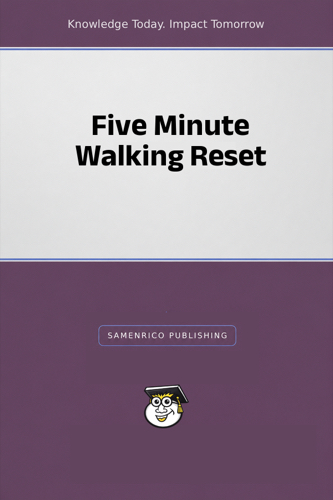
Five Minute Walking Reset eBook
Brief walking meditations for quick stress relief
Brief walking meditations for quick stress relief during work breaks.
Formats
Free sample
Chapter 1: The 2:47 PM Truth...--The cursor blinks at you from the center of the screen. You have been looking at the same sentence for what feels like an hour, though your clock tells you it has only been eleven minutes. The sentence is fine. It was fine when you wrote it. But now you cannot tell.
Your shoulders have crept up toward your ears at some point in the last ninety minutes, and your jaw is clenched so tightly that your back teeth are sending small signals of protest. Your phone buzzes somewhere to your left—an email, probably, or a Slack notification—and you feel a small spike of something that is not quite dread but is not quite nothing either.It is 2:47 PM on a Tuesday.This moment is not a personal failure. It is not evidence that you lack discipline, or that you are secretly lazy, or that everyone else has figured something out that you have not. This moment is a biological signal, as legible and predictable as hunger or thirst. Your brain has reached its cognitive limit.
And like hunger or thirst, it requires a specific kind of fuel to reset.Not coffee. Not willpower. Not a motivational podcast or a scrolling break on your phone.You need to walk.For five minutes.Let me say something that might sound radical: the expectation that you can sit at a screen for eight or nine or ten hours and remain focused, productive, and emotionally regulated is not just unrealistic—it is medically absurd. No human in the history of our species has ever been designed for what you are doing right now. Your ancestors walked five to seven miles a day.
They responded to threats by running or fighting. They spent the majority of their waking hours in physical motion, their eyes scanning middle distances, their bodies in a constant state of low-grade negotiation with the environment.You, by contrast, have been sitting in a chair designed by someone who has never met you, staring at a rectangle of light, responding to stimuli that would have been incomprehensible to your great-grandparents. Your sympathetic nervous system—the ancient alarm system that kept you alive on the savanna—does not know the difference between a predator and a passive-aggressive email. It treats both the same way. Cortisol floods your system.
Adrenaline primes your muscles. Your heart rate increases. Your digestion slows. Your attention narrows to a tunnel.And then you sit there. You do not run.
You do not fight. You just keep typing.This is the fundamental cruelty of the modern workplace. Your body prepares for action, and you give it none. The cortisol accumulates. The adrenaline sits un-metabolized.
By 2:00 PM, you are physiologically primed for a sprint that never comes, which is why you feel both exhausted and wired at the same time. You are tired because you have been working. You are stressed because your body is screaming for a release valve that your schedule does not permit.Until now.The Science of the Small Pause In 2022, researchers at Cornell University published a systematic review of workplace microbreaks. They looked at dozens of studies covering thousands of workers across industries as varied as call centers, surgical suites, software development, and manufacturing. The conclusion was unambiguous: strategic breaks of five minutes or less produced better recovery than longer breaks, and produced significantly better outcomes than no breaks at all.Here is what they found.
Workers who took microbreaks reported lower fatigue, higher vigor, and improved concentration for up to ninety minutes following the break. Those who did not take breaks showed a linear decline in performance starting at around the ninety-minute mark of continuous work. By the fourth hour, their output was roughly half of what it had been in the first hour. They were not working less hard. They were working harder and achieving less.
The relationship between effort and output had decoupled.Seventy-nine percent of employees report significant work-related stress. That number comes from the same research. And here is the part that should stop you cold: most of those employees believe that pushing through is the correct response. They skip breaks. They eat lunch at their desks.
They tell themselves that they will rest when the project is done, or when Friday comes, or when they finally get that promotion that will somehow make everything easier.But the data tells a different story. The people who push through are not getting more done. They are getting less done, more slowly, while suffering more. The grinder is not a hero. The grinder is a person whose nervous system is in a state of chronic low-grade emergency, and whose work product is paying the price.The Attention Economy is the invisible tax you pay every time you switch tasks.
Your brain was not designed to process emails, Slack notifications, spreadsheets, and Zoom calls in rapid succession. Every time you shift from one task to another, you pay a switching cost—a few seconds of mental static, a small depletion of cognitive fuel. By the time you have answered three emails, glanced at a calendar invite, and returned to the document you were writing, you have lost something. Not much. Maybe fifteen seconds.
Maybe thirty.But do that forty times a day, and you have lost ten to twenty minutes of pure cognitive processing power. And that is just the switching cost. The attentional residue—the part of your brain that stays stuck on the previous task even after you have moved on—is harder to measure but more damaging. It is the reason you read the same sentence eleven times. It is the reason you cannot remember what you just read in that email.
It is the reason you feel foggy and slow even though you are trying very hard.Why Five Minutes?You might be thinking: five minutes is not very long. And that is precisely the point.Traditional meditation practices are wonderful. Sitting for twenty minutes with your breath, observing your thoughts without judgment—this is a skill that has been refined over thousands of years. But it is not a skill that most people can access at 2:47 PM on a Tuesday, in a cubicle, with a deadline looming and a phone buzzing. Traditional meditation requires scheduling, solitude, and a mindset that the modern workplace actively destroys.The five-minute walking reset is different.
It does not require you to clear your calendar. It does not require you to find a quiet room. It does not require you to adopt a new belief system or buy a special cushion. It requires you to stand up and walk for three hundred seconds. That is it.But why five minutes?
Why not three? Why not ten?The answer is physiological. Your parasympathetic nervous system—the "rest and digest" system that counteracts your stress response—takes approximately three minutes to begin activating. Anything shorter than that, and you are simply interrupting the stress cascade without reversing it. You will feel a small relief, but it will not last.
By contrast, anything longer than eight minutes begins to incur a different cost: the cost of disengaging from work entirely.…
This is the end of the free sample. Get the eBook to keep going. Buy now
About this book
Details
- Author
- Billings Agatha
- Publisher
- SamEnrico
- Language
- English
- Genre
- Non-Fiction, Self-Help, Workplace Wellness
- Released
- 2026-06-07
- Pages (approx.)
- 112
- Available as
- eBook, Audiobook

Read better in the ZLOADR app
Your eBooks on your phone or tablet. Sign in with your SamEnrico account and start reading.
More by Billings Agatha
 Self Hypnosis For Phobia Relief GuideBillings Agatha$11.99
 Alcohol Free Dream JournalingBillings Agatha$11.99
 Indonesian Chinese EscapeBillings Agatha$11.99
 Lagos Power Outage Pop UpBillings Agatha$11.99
 Stress Immune System ConnectionBillings Agatha$11.99
 Workaholism For Tech WorkersBillings Agatha$11.99
 GWOT Master GuideBillings Agatha$11.99
 Water Dreams In ChildhoodBillings Agatha$11.99
 The Vanishing Act of the Amber RoomBillings Agatha$11.99
 The Golden Harps of Axum: Africa's Royal SymphoniesBillings Agatha$11.99
 The Great Train Robbery That Wasn’t: The Phantom Heist of 1963Billings Agatha$11.99
 Understanding Acute Myeloid Leukemia, SecondaryBillings Agatha$17.99
You may also like
 Hong Kong Handover 1997Dunn Johnnie$11.99
 Zumba For Postnatal Recovery CourseNeal Christian$11.99
 Zumba for BeginnersLadner Nikia$11.99
 YouTube Comment Mining GuideHumes Pandora$12.99
 Worry Box MeditationCarlin Rudy$11.99
 Workplace Stress MeditationNguyen Lynn$11.99
 Workplace Stress and Sleep RepairHawley Ivory$11.99
 Workplace Perfectionism CureDelaney Jeffry$11.99
 Workplace Injustice Anger GuideWallen Isabelle$11.99
 Work Addiction and Burnout LinkGreenwood Ester$11.99
 Women in Yoga and WellnessBeattie Galina$11.99
 Women in Stand Up ComedyChun Evangeline$11.99