
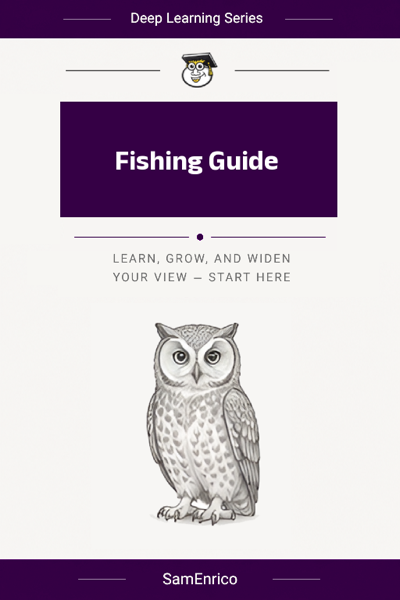
Non-FictionInformativeEducational
Fishing Guide eBook
A Coursebook on Fishing Guide
by Gipson Mila
A Coursebook on Fishing Guide
Formats
Free sample
Chapter 1: The Unlearning Curve--–- The first thing you must understand about fishing is that everything you think you know is probably wrong. Not because you are unintelligent, and not because fishing is especially complicated, but because our culture has spent a century telling the wrong stories about this sport. We have been raised on images of grizzled old men who tie a hook to a stick, toss it into a pond, and haul out a monster bass while smoking a pipe. We have seen cartoons where fish practically jump into the boat. We have heard the phrase “fishing is just sitting around waiting for luck to strike” so many times that we have come to believe it.This is the unlearning curve.
And before you tie a single knot, spool a single reel, or buy a single lure, you must walk it.Because the difference between an angler who catches fish consistently and one who goes home skunked trip after trip is not luck, not magic, and not a secret handed down through generations of good old boys. The difference is mindset. And mindset is the only thing this chapter will teach you.If you master nothing else in this book but the principles that follow, you will already be ahead of ninety percent of beginners. You will understand why some people catch fish when conditions are terrible and others catch nothing when conditions are perfect. You will know why patience is not about waiting, why success is not about catching, and why the most important tool you will ever own is not made of graphite or carbon fiber but lives between your ears.Let us begin by dismantling the single most destructive myth in all of fishing.The Myth of the Lucky Angler Every weekend, on lakes and rivers across the world, a predictable scene unfolds.
Two anglers fish side by side, using similar bait, casting to the same water. One catches fish. The other catches nothing. The unsuccessful angler packs up and says to his friend, “You just got lucky.”He is wrong. Luck exists in fishing, certainly.
A trophy muskie might swim under your boat at the exact moment your lure passes its nose. A migrating school of striped bass might decide to feed in the cove you chose at random. These things happen. But luck is a weather event—unpredictable, uncontrollable, and statistically rare. The angler who catches fish week after week is not lucky.
He is observant. And observation is a skill you can learn.Consider a study conducted by the University of Florida’s fisheries department. Researchers followed two groups of anglers on the same lake over three months. One group was told to “fish however you normally would.” The other group was given a simple checklist of environmental variables to record before each trip: water temperature, barometric pressure trend, wind direction, cloud cover, and time of day. That was it.
No advanced techniques. No expensive gear. Just observation.The second group caught forty-three percent more fish than the first group. Not because they were luckier. Because they were paying attention.
They noticed that when the barometer was falling, fish moved shallow. They noticed that a west wind pushed baitfish to the east shore. They noticed that on overcast days, fish fed longer into the morning. And they adjusted accordingly.The “lucky” angler, by contrast, showed up, threw a line in the water, and hoped. When he caught something, he called it luck.
When he didn’t, he called it a bad day. He never connected his results to his actions because he was not paying attention to his actions.This is the first and most important distinction you will make as an angler: Are you fishing with intention, or are you fishing with hope? Intention means you know why you are casting to a particular spot, using a particular bait, at a particular time. Hope means you are standing by a body of water with a rod and a prayer.The unlearning curve begins when you trade hope for intention. And intention begins with a single question that you will ask yourself before every cast for the rest of your fishing life: Why am I doing this?If you cannot answer that question, stop.
Reel in. Sit down. Observe. Then cast with purpose.The Four Whys of Fishing Before you can fish with intention, you must understand why you are fishing at all. This sounds philosophical, and it is.
But it is also deeply practical. Because your “why” determines everything else: what gear you buy, what techniques you learn, what water you fish, and how you define success.Most anglers never ask themselves this question. They fish because their father fished, or because they want to eat fish, or because they like being outside, or because they saw a video of someone catching a giant bass and thought “I want to do that.” These are not bad reasons. But they are vague reasons. And vague reasons produce vague results.Let me offer you four distinct whys.
Read them carefully. One of them is probably yours.Why One: Sustenance. You fish to eat. You want to put clean, healthy protein on your table. You care about efficiency, about legal harvest, about learning to clean and cook fish properly.
Your success is measured in fillets. There is nothing wrong with this. In fact, it is the oldest and most honorable reason to fish. But it comes with responsibilities: you must learn to target abundant species, to respect size and bag limits, and to dispatch fish humanely. This book will teach you all of these things.Why Two: Sport.
You fish for the fight. You love the moment a fish strikes, the scream of the drag, the flex of the rod, the negotiation between your skill and the fish’s strength. You are likely to practice catch-and-release, not because you are morally superior to the sustenance angler, but because the fish is more valuable to you alive and fighting another day. Your success is measured in pulls on the line, jumps out of the water, and the occasional trophy photograph. This book will teach you how to fight fish without losing them, how to land them efficiently, and how to release them so they survive.Why Three: Peace.
You fish to be on the water. The catching is almost incidental. You love the rhythm of casting, the sound of water against the hull, the solitude, the escape from screens and notifications and obligations. You may go entire trips without caring whether you catch anything. Your success is measured in hours of presence.
This is a completely valid way to fish, and this book will respect it. But even the peace-seeking angler benefits from understanding the water. Because there is a deep peace in competence—in knowing that when you do want to catch a fish, you can.Why Four: Competition. You fish to prove something—to yourself, to your friends, to the fish. You want to be the best angler on the lake.
You study techniques, you buy premium gear, you fish tournaments or friendly wagers. Your success is measured in weight, length, or quantity.…
This is the end of the free sample. Get the eBook to keep going. Buy now
About this book
Details
- Author
- Gipson Mila
- Publisher
- SamEnrico
- Language
- English
- Genre
- Non-Fiction, Informative, Educational
- Released
- 2026-06-02
- Pages (approx.)
- 137
- Available as
- eBook, Audiobook

Read better in the ZLOADR app
Your eBooks on your phone or tablet. Sign in with your SamEnrico account and start reading.
More by Gipson Mila
 Psychoeducation for Explosive ParentsGipson Mila$11.99
 The Beit Yosef CompilerGipson Mila$11.99
 Hostage Negotiation LessonsGipson Mila$11.99
 Growth Hormone Deficiency DiagnosisGipson Mila$11.99
 Panic Disorder Comorbidity CourseGipson Mila$11.99
 The Hypnos Code: Decoding the Ancient Dream Oracle of DelphiGipson Mila$11.99
 Love Letters from the Front: The Secret Correspondence of Vera Brittain and Roland LeightonGipson Mila$11.99
 Understanding Brachydactyly Type BGipson Mila$17.99
 10 Ways to Use Cinnamomum Citriodorum (Recipe Book)Gipson Mila$11.99
 Headless Commerce Five Year ForecastGipson Mila$12.99
 Asian Coding Education LandscapeGipson Mila$12.99
You may also like
 Hong Kong Handover 1997Dunn Johnnie$11.99
 Zumba For Postnatal Recovery CourseNeal Christian$11.99
 Zumba for BeginnersLadner Nikia$11.99
 YouTube Comment Mining GuideHumes Pandora$12.99
 Worry Box MeditationCarlin Rudy$11.99
 Workplace Stress MeditationNguyen Lynn$11.99
 Workplace Stress and Sleep RepairHawley Ivory$11.99
 Workplace Perfectionism CureDelaney Jeffry$11.99
 Workplace Injustice Anger GuideWallen Isabelle$11.99
 Work Addiction and Burnout LinkGreenwood Ester$11.99
 Women in Yoga and WellnessBeattie Galina$11.99
 Women in Stand Up ComedyChun Evangeline$11.99