
Non-FictionSelf-HelpBereavement
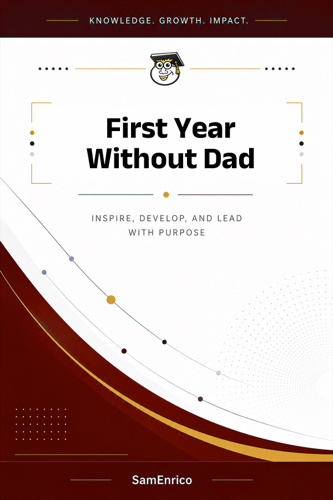
First Year Without Dad eBook
Navigate birthdays, holidays, and anniversaries af
by Daley Inger
Navigate birthdays, holidays, and anniversaries after paternal loss.
Formats
Free sample
Chapter 1: The Lie Down...--You are reading this because someone handed you a book, or because you searched for help at 2 AM, or because a well-meaning friend said “this helped my cousin.” But mostly, you are reading this because the world has gone quiet in a way you never expected. The calls have slowed down. The casseroles have stopped arriving. The funeral is a memory that already feels both ancient and like it happened five minutes ago. And now you are standing in the middle of your kitchen, or your living room, or your father’s garage, holding a piece of paper—a bill, a will, a sympathy card—and you cannot remember what you were supposed to do next.This is not a failure of character.
This is not weakness. This is the neurological and emotional reality of the first thirty days after losing your father. And before we talk about birthdays, holidays, anniversaries, or any of the calendar’s sharp edges, we have to talk about the fog. Because if you try to build a ritual toolbox or plan a “Year-at-a-Glance” assessment while you are still drowning in paperwork and sleeplessness, you will only drown faster.Let me say something that most grief books are afraid to say: in the first thirty days, your only job is to not die. Not to heal.
Not to process. Not to “honor his memory” in a beautiful, Instagram-worthy way. Just to keep your body alive and to let other people carry you when you cannot stand.This chapter is called “The Lie Down” for a reason. It is borrowed and adapted from the work of Megan Devine, who wrote one of the most honest books about grief in the modern era. The Lie Down is not laziness.
It is not giving up. It is a tactical, radical act of survival. When your brain is flooded with cortisol, when you have not slept more than three hours in three days, when the thought of signing one more form makes you want to scream—you are permitted to lie down. That is the task. That is the work of this chapter.The Myth of the Functional Griever Before we go any further, we need to name the lie that our culture tells about grief.
The lie goes like this: a “strong” person goes back to work within a week. A “strong” person handles the estate paperwork without crying. A “strong” person answers every sympathy card, returns every phone call, and hosts the family dinner that Dad used to host.That lie is poison.The truth is that the brain in acute grief—the first thirty to ninety days after a significant loss—operates with the cognitive processing power of someone who has been awake for forty-eight hours straight and has also just run a marathon. Your hippocampus, which is responsible for memory and learning, is flooded with stress hormones that literally shrink its ability to function. Your prefrontal cortex, which handles decision-making and impulse control, is essentially offline.
This is not a metaphor. This is neuroscience.When you cannot remember where you put your keys, when you walk into a room and forget why, when you read the same sentence on a bank form five times and still do not understand it—that is not dementia. That is not you “falling apart.” That is your brain doing exactly what it is supposed to do when it is overwhelmed by loss. It is conserving energy. It is redirecting resources toward survival.
It is, in its own primitive way, trying to keep you alive.So the first thing you need to know about the first thirty days is this: you are not broken. You are operating exactly as a human animal operates after a devastating blow. The problem is not your grief. The problem is that the world keeps demanding that you function as if nothing has changed.The Two Kinds of Tasks: Essential vs. Optional One of the most paralyzing aspects of the first month is the sheer volume of things that seem to require your immediate attention.
The funeral home needs a decision about the headstone. The bank needs the death certificate. His phone is still ringing. His email is still piling up. The electric bill is due.
And somewhere, in the back of your mind, you think you are supposed to be “processing your feelings” or “starting the grief work.”Stop.Here is a distinction that will save your sanity: essential tasks versus optional tasks.Essential tasks are the ones that have legal, financial, or health consequences if you do not do them within a specific timeframe. These include:Registering the death and obtaining multiple certified copies of the death certificate (at least ten to fifteen copies—every institution will want an original).Notifying Social Security (if he was receiving benefits) and his employer.Securing his home and belongings (changing locks if necessary, retrieving valuables).Arranging the funeral or memorial service (if you are the responsible party).Accessing enough cash to cover immediate expenses (funeral homes often require payment before the service).Notifying his bank and credit card companies—not to close accounts yet, but to report the death and freeze fraud risk.That is the essential list. Notice what is not on it. Not on the list: sorting through his closet. Not on the list: answering every sympathy card.
Not on the list: making a photo slideshow. Not on the list: returning every phone call from distant cousins who “just want to check in.” Not on the list: making any major life decisions about selling his house, moving, quitting your job, or changing your name.Optional tasks are everything else. And optional does not mean unimportant. It means they do not have a deadline that will hurt you or his estate if you wait. You can sort his closet in three months.
You can answer sympathy cards when you have the emotional bandwidth. You can make the photo slideshow for the one-year memorial. You can let the phone calls go to voicemail and respond with a group text that says, “Thank you for reaching out. I will be in touch when I am able.”The single biggest mistake that grieving people make in the first thirty days is treating optional tasks as essential. They exhaust themselves trying to “do it all” because they believe that being busy is the same as being strong.
It is not. Being busy is often a way to avoid the Lie Down. And avoiding the Lie Down in the first month leads to a crash in the second month that is far worse than the initial grief.The Lie Down Method: A Tactical Guide The Lie Down Method is simple in concept but difficult in practice, because everything in our culture tells you that lying down is failure. Here is how to do it correctly.Step One: Recognize the signal to lie down. The signal is not just exhaustion.
It is a specific kind of cognitive and emotional collapse. You will know it when the following happen: you cannot complete a sentence. You put the milk in the cupboard and the cereal in the fridge. You…
This is the end of the free sample. Get the eBook to keep going. Buy now
About this book
Details
- Author
- Daley Inger
- Publisher
- SamEnrico
- Language
- English
- Genre
- Non-Fiction, Self-Help, Bereavement
- Released
- 2026-06-07
- Pages (approx.)
- 144
- Available as
- eBook, Audiobook

Read better in the ZLOADR app
Your eBooks on your phone or tablet. Sign in with your SamEnrico account and start reading.
More by Daley Inger
 Remote Work Simulated CommuteDaley Inger$11.99
 The Retirement Housing Risk ManagerDaley Inger$11.99
 Active Listening for Museum DocentsDaley Inger$11.99
 Phone Call Anxiety GuideDaley Inger$11.99
 Wildland Firefighter BurnoutDaley Inger$11.99
 Personal Branding for ArchitectsDaley Inger$11.99
 The Tiffany Blue Curse: How a Jewelry Empire Fell from GraceDaley Inger$11.99
 The Alchemist's Ledger: How a Forgotten Genius Invented the FutureDaley Inger$11.99
 Service Providers Guide to Wire JewelryDaley Inger$11.99
 How to Produce Waste ContainmentDaley Inger$11.99
 Tongue Position RegulationDaley Inger$12.99
 Remote Worker Layoff GuideDaley Inger$12.99
You may also like
 Hong Kong Handover 1997Dunn Johnnie$11.99
 Zumba For Postnatal Recovery CourseNeal Christian$11.99
 Zumba for BeginnersLadner Nikia$11.99
 YouTube Comment Mining GuideHumes Pandora$12.99
 Worry Box MeditationCarlin Rudy$11.99
 Workplace Stress MeditationNguyen Lynn$11.99
 Workplace Stress and Sleep RepairHawley Ivory$11.99
 Workplace Perfectionism CureDelaney Jeffry$11.99
 Workplace Injustice Anger GuideWallen Isabelle$11.99
 Work Addiction and Burnout LinkGreenwood Ester$11.99
 Women in Yoga and WellnessBeattie Galina$11.99
 Women in Stand Up ComedyChun Evangeline$11.99