
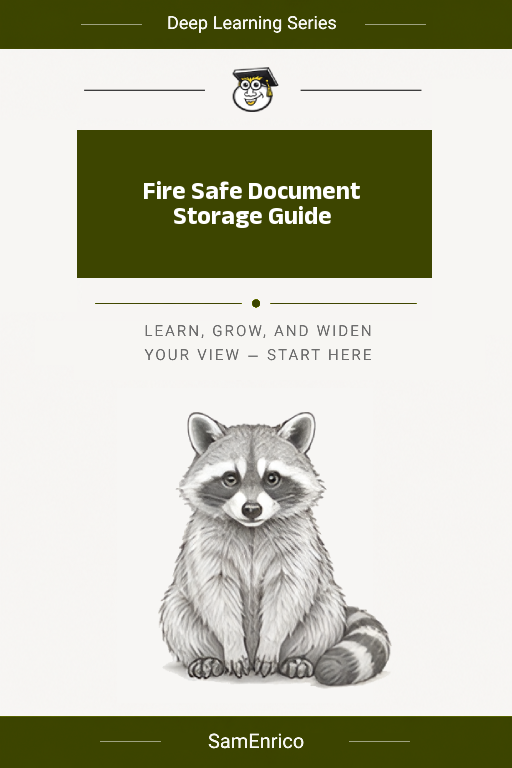
Fire Safe Document Storage Guide eBook
Keep critical records in UL rated fireproof cabine
by Bell Willard
Keep critical records in UL rated fireproof cabinet or cloud backup for 1 hour 1700 degree protection.
Formats
Free sample
Chapter 1: The 20-Minute Lie--The first time I stood in the ashes of a family’s entire history, I learned something that changed my understanding of fire forever. It was a Tuesday afternoon in suburban Ohio. The call came in as a “structure fire – possible electrical.” By the time the trucks arrived, the house was already breathing fire through every window. The family stood across the street in bathrobes, shivering despite the July heat. The mother kept repeating the same sentence: “My babies’ birth certificates.
My babies’ birth certificates.” Her babies were twenty-two and nineteen years old, away at college. But the documents that proved they existed were inside that inferno, tucked into a wooden desk drawer she had always thought was “safe enough.”Six hours later, after the hotspots were drowned and the investigators picked through the wreckage, I watched her sift through a soggy, charred pile of what used to be a filing cabinet. The metal had warped and twisted like licorice. Paper had turned to black confetti that dissolved at the slightest touch. Her birth certificates were gone.
Her social security cards were gone. The deed to the house she had just finished paying off—gone. The only reason she knew her own name at the insurance adjuster’s office the next day was because she had a driver’s license in her wallet, which she had grabbed on her way out the door.That family did nothing wrong. They were responsible people. They had smoke detectors.
They had a fire extinguisher in the kitchen. They had even talked about buying a “fire safe” from the office supply store but decided it was too expensive at two hundred and forty dollars. The fire cost them four months of their lives, seven thousand dollars in document replacement fees, and an uncountable amount of emotional anguish. The safe would have cost less than their monthly cable bill.This book exists because that family’s story is not rare. It is normal.
And that is the problem.The Myth of Slow Fire Hollywood has sold us a dangerous lie. Watch any movie or television show depicting a house fire, and you will see the same sequence: a flame licks up a curtain, the family wakes up groggily, they have time to grab a photo album and a pet, they walk outside, and then the roof collapses dramatically ten minutes later. The implication is that fire is patient. It gives you time. It announces itself politely before destroying everything you own.The truth is exactly the opposite.Modern homes are not made of the old-growth timber that fueled those historic three-hour burns your grandparents told you about.
Today’s homes are built with lightweight engineered wood, petroleum-based foams, synthetic fabrics, and a staggering volume of plastics. A typical living room contains a polyurethane foam sofa, a nylon carpet with polypropylene backing, a television made of ABS plastic, and curtains treated with flame retardants that actually increase smoke toxicity when burned. This combination is not just flammable—it is explosive.In 2018, the National Institute of Standards and Technology conducted a series of controlled burns comparing homes built with modern materials versus those built with materials from 1950. The results were staggering. The 1950s home took thirty-three minutes to reach flashover—the point at which the entire room ignites simultaneously.
The modern home reached flashover in three minutes and forty seconds. That is not a typo. From a small flame to a fully involved room fire took less time than it takes to brew a pot of coffee.Consider the following data points, which will frame every decision you make in this book:Fire department average response time in suburban areas: 6 to 11 minutes from the moment the call is received.Time from first alarm to firefighter entry and search: an additional 20 to 40 minutes, depending on staffing and hydrant distance.Peak temperature inside a modern house fire: 1,500 to 2,000 degrees Fahrenheit.Time until heat alone kills paper documents in an unprotected space: approximately 2 minutes.Time until a standard hard drive becomes permanently unreadable: 4 minutes at 160 degrees, far below the temperature of a fire.The mathematics of loss are brutal. Even if the fire department arrives in six minutes, your documents have already been exposed to temperatures that turn paper to ash and melt digital media into slag. The idea that you will “grab the important stuff on your way out” assumes that you are awake, aware, oriented, and not panicked.
Fire statistics show that most fatal fires occur between 11 p.m. and 7 a.m. You will not be grabbing anything. You will be lucky to wake up at all.This chapter exists to shatter the twenty-minute myth. You do not have twenty minutes.
You do not have ten minutes. You have, at best, the time it takes to roll out of bed, hit the floor, and crawl to an exit. Your documents will not be coming with you unless they are already protected inside a container that can survive what your home cannot.The Science of “Fireproof” – Why That Word Is a Marketing Trap Let me be unambiguous: there is no such thing as a fireproof safe. If you see that word on a product label, put the box back on the shelf and walk away. The seller is lying to you, either out of ignorance or deliberate deception.
The laws of thermodynamics are not suspended for consumer products.Every material has a failure point. Steel melts at approximately 2,500 degrees Fahrenheit. Concrete spalls and crumbles at 1,200 degrees. Even the ceramic fibers used in high-end safes eventually break down under sustained heat. The goal is not to be fireproof—an impossible standard—but rather fire-resistant for a specified duration under specified conditions.This is where Underwriters Laboratories comes into the picture.
UL is an independent safety science company that has been testing fire resistance since 1894. Their UL 72 standard is the gold standard for fire-resistant containers in North America. When a product bears a UL 72 label, it means that representative samples were placed in a furnace, heated to a specific temperature for a specific time, and then dropped from a specific height to simulate falling through a burning floor, and finally allowed to cool naturally. The interior temperature of the container was monitored throughout. The product passed only if the interior remained below a certain threshold.The two thresholds that matter to you are Class 350 and Class 125.Class 350 means that during the test, the interior of the container never exceeded 350 degrees Fahrenheit.
This is safe for paper documents because paper begins to char and become brittle around 400 degrees. A Class 350 safe will keep your birth certificates, deeds, and contracts legible after a fire. However, 350 degrees is far above the failure point of electronics. Hard drives typically fail at 160 degrees. USB drives have plastic housings that melt around 200 degrees.
Optical discs warp and delaminate at similar temperatures. Storing digital media in a Class 350 safe is like storing ice cream in a warming drawer. It will look intact from the outside, but the contents will be destroyed.Class 125 is the standard for digital media. During testing, the interior must remain below 125 degrees Fahrenheit. This is cool enough to preserve…
This is the end of the free sample. Get the eBook to keep going. Buy now
About this book
Details
- Author
- Bell Willard
- Publisher
- SamEnrico
- Language
- English
- Genre
- Non-Fiction, Crisis Management
- Released
- 2026-05-28
- Pages (approx.)
- 149
- Available as
- eBook, Audiobook

Read better in the ZLOADR app
Your eBooks on your phone or tablet. Sign in with your SamEnrico account and start reading.
More by Bell Willard
 Listening In Journalism GuideBell Willard$11.99
 Job Loss Relationship Stress GuideBell Willard$11.99
 The Warehouse Labor CampBell Willard$11.99
 School Based Mental HealthBell Willard$11.99
 Interruption Management Complete GuideBell Willard$11.99
 Joyful Morning Rituals HandbookBell Willard$11.99
 The Tattoo on the WristBell Willard$11.99
 Nutrition for MemoryBell Willard$11.99
 Serena Williams QueenBell Willard$11.99
 The Forgotten Storm: The Battle of Cape St. George and the Pacific Naval WarBell Willard$11.99
 Soul on the Run: The Untold Saga of the First Black Fugitive Slave in the NorthBell Willard$11.99
 How to Start a Hobby in EntertainingBell Willard$11.99
You may also like
 Hong Kong Handover 1997Dunn Johnnie$11.99
 Zumba For Postnatal Recovery CourseNeal Christian$11.99
 Zumba for BeginnersLadner Nikia$11.99
 YouTube Comment Mining GuideHumes Pandora$12.99
 Worry Box MeditationCarlin Rudy$11.99
 Workplace Stress MeditationNguyen Lynn$11.99
 Workplace Stress and Sleep RepairHawley Ivory$11.99
 Workplace Perfectionism CureDelaney Jeffry$11.99
 Workplace Injustice Anger GuideWallen Isabelle$11.99
 Work Addiction and Burnout LinkGreenwood Ester$11.99
 Women in Yoga and WellnessBeattie Galina$11.99
 Women in Stand Up ComedyChun Evangeline$11.99