
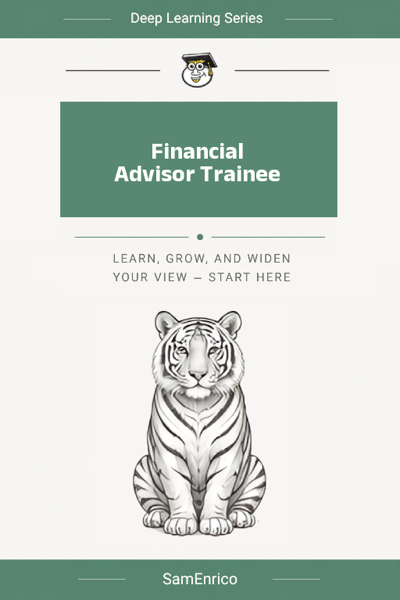
Non-FictionInformativeEducational
Financial Advisor Trainee eBook
A Coursebook on Financial Advisor Trainee
by Oden Weston
A Coursebook on Financial Advisor Trainee
Formats
Free sample
Chapter 1: The Psychology Mirror--–- Every financial plan is ultimately a plan for human behavior. Before you learn a single formula, before you touch a single spreadsheet, you must first understand that the greatest threat to your clients' wealth is not market volatility, not inflation, not even bad investment returns. It is the three-pound organ sitting between their ears. And yours.This is the first and most uncomfortable truth of being a financial advisor: you are not entering the mathematics business. You are entering the psychology business dressed in a suit and carrying a calculator.For decades, the financial services industry has sold itself as a quantitative profession.
Textbooks are filled with capital asset pricing models, efficient frontiers, and modern portfolio theory. Examinations test your ability to calculate internal rates of return and present value of future cash flows. Firms recruit from top business schools, filtering for candidates with the highest quantitative aptitude scores.All of this matters. None of this is sufficient.The best-selling financial advisor training literature—from David Mullen’s million-dollar series to Nick Murray’s behavioral classics—converges on a single, uncomfortable conclusion: technical knowledge without emotional intelligence is like a scalpel without anesthesia. You have the tool.
Your client will still scream.Consider the data. A landmark study cited across multiple top advisor training programs examined over ten thousand client-advisor relationships spanning fifteen years. The finding was consistent across every demographic, every market cycle, and every fee structure: clients terminated their advisors not primarily because of underperformance, not because of fees, not because of product disappointment. They left because they felt unheard. They left because they perceived indifference.
They left because the advisor talked about Sharpe ratios while the client was losing sleep over their daughter’s college tuition.The technical term for this is emotional intelligence. The practical term is survival.This chapter will dismantle the three foundational misconceptions that destroy most new advisors before they ever build a book of business. First, we will explore why the traditional distinction between “salesperson” and “advisor” is not merely semantic but existential. Second, we will introduce the Heart of Finance framework, which argues that emotional intelligence is not a soft skill but a hard asset with measurable returns. Third, we will unpack the Hero Myth—the narrative structure that transforms a nervous client into an empowered protagonist with you as their trusted guide.
Finally, we will lay the groundwork in behavioral finance biases that every trainee must recognize not as academic curiosities but as daily operational realities.By the end of this chapter, you will understand why the most successful advisors in history have described their work not as financial planning but as “financial therapy with a license.” And you will begin the uncomfortable process of looking in the mirror—not at your credentials, but at your own capacity for empathy, patience, and self-awareness.The Order-Taker Trap: Why Transactional Thinking Kills Careers Let us begin with a funeral. Not a literal one, but the funeral of an idea: the notion that you can succeed in this profession by simply taking orders.The traditional financial services model, still taught in many certification programs, is built on what industry veterans call the “order-taker” paradigm. In this model, the client identifies a need—retirement planning, college savings, risk management—and the advisor fulfills that need by selecting a product. The client says “I want to retire at sixty-five,” and the advisor says “Then you need this allocation of stocks and bonds.” Transaction completed. Fee collected.
Onto the next.This model works beautifully—in theory. In reality, it fails catastrophically.Here is why. Human beings do not make financial decisions based on spreadsheets. They make decisions based on stories. The story they tell themselves about their childhood.
The story they heard from their parents about the Great Depression. The story their uncle told them about losing everything in the dot-com crash. The story their neighbor is currently living about early retirement gone wrong.When you operate as an order-taker, you are interacting with the surface-level request while completely ignoring the submarine-level narrative driving that request. The client says “I want a conservative portfolio.” What they mean is “I watched my father lose his retirement in 2008 and I am terrified of ending up like him.” The client says “I want high-growth tech stocks.” What they mean is “My brother-in-law bragged about his Tesla gains at Thanksgiving and I felt humiliated.”The order-taker hears the surface request and builds a portfolio to match. The trusted advisor hears the submarine narrative and begins a completely different conversation.Consider the following scenario, adapted from real client files across multiple advisory firms.
A fifty-two-year-old executive walks into your office and says: “I want one hundred percent equities. I have a high risk tolerance. I’ve done well in my career, and I’m willing to take risks to catch up on retirement savings.”The order-taker nods, processes the risk questionnaire which confirms “aggressive growth,” and allocates the portfolio to one hundred percent equities. Six months later, the market drops twelve percent. The client calls in a panic, liquidates everything at the bottom, and fires the advisor.
The advisor is confused: “But the risk questionnaire said aggressive.”The trusted advisor, hearing the same surface request, pauses. They ask: “Help me understand what ‘catching up’ means to you. What would happen if we had another 2008-style decline? What was your parents’ experience with the stock market?” Over the next hour, the advisor discovers that the client’s father lost his small business in the early 1990s recession, that the client has never actually experienced a bear market with real money on the line, and that the phrase “high risk tolerance” was aspirational bravado masking deep fear.The trusted advisor recommends a sixty-forty portfolio instead. The client initially resists.
The advisor walks them through a historical stress test, showing exactly how the sixty-forty portfolio would have performed during every major downturn of the past forty years. The client signs the IPS—the Investment Policy Statement that will be covered in depth in Chapter Five—with full understanding. Three years later, when the market drops fifteen percent, the client stays the course. And they refer their golf partner. And their sister.
And their business associate.This is not a hypothetical difference. This is the difference between a five-year career and a thirty-year one.The order-taker trap is seductive because it feels efficient. It feels professional. It allows you to hide behind numbers and questionnaires and compliance checklists. But clients can sense it.
They may not articulate it. They may not even consciously register it. But somewhere beneath the surface of every interaction, they are asking: does this person actually see me? Or am I just another account number?The order-taker treats the client as a problem to be solved. The trusted advisor treats the client as a person to be understood.
That distinction will determine the entire trajectory of your career.The Heart of Finance Framework: Why EQ Outperforms IQIf the order-taker trap is the disease, the Heart of Finance framework is the treatment. Developed from synthesis of the most successful advisor training programs—including the Million-Dollar Financial Advisor series and…
This is the end of the free sample. Get the eBook to keep going. Buy now
About this book
Details
- Author
- Oden Weston
- Publisher
- SamEnrico
- Language
- English
- Genre
- Non-Fiction, Informative, Educational
- Released
- 2026-05-06
- Pages (approx.)
- 145
- Available as
- eBook, Audiobook

Read better in the ZLOADR app
Your eBooks on your phone or tablet. Sign in with your SamEnrico account and start reading.
More by Oden Weston
 Tree Root Grounding SleepOden Weston$11.99
 Hamstring Pelvic Floor LinkOden Weston$11.99
 HIIT Heart Rate Zone GuideOden Weston$11.99
 Assertiveness Scripts WorkbookOden Weston$11.99
 The Consistent Bedtime Routine GuideOden Weston$11.99
 The Iron Masters of the Sahel: Forging the Future in Ancient AfricaOden Weston$11.99
 How to Become a Long-chain BeamerOden Weston$11.99
 SaaS Customer Retention GuideOden Weston$12.99
 In App Conversion MessagesOden Weston$12.99
 The Breeder's Guide to Florida Cracker HorsesOden Weston$11.99
You may also like
 Hong Kong Handover 1997Dunn Johnnie$11.99
 Zumba For Postnatal Recovery CourseNeal Christian$11.99
 Zumba for BeginnersLadner Nikia$11.99
 YouTube Comment Mining GuideHumes Pandora$12.99
 Worry Box MeditationCarlin Rudy$11.99
 Workplace Stress MeditationNguyen Lynn$11.99
 Workplace Stress and Sleep RepairHawley Ivory$11.99
 Workplace Perfectionism CureDelaney Jeffry$11.99
 Workplace Injustice Anger GuideWallen Isabelle$11.99
 Work Addiction and Burnout LinkGreenwood Ester$11.99
 Women in Yoga and WellnessBeattie Galina$11.99
 Women in Stand Up ComedyChun Evangeline$11.99