
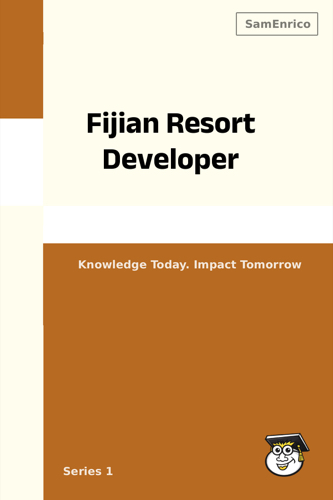
Fijian Resort Developer eBook
Build island style retreats in coastal US.
by Penn Hellen
Build island style retreats in coastal US.
Formats
Free sample
Chapter 1: The Coconut Economics...--–- The first time Maya Chen watched a guest pay $890 for a hut with no air conditioning, no television, and a roof made of dried palm leaves, she thought the booking system had glitched. She was standing behind the reception desk of a small resort in the Yasawa Islands, Fiji, three months into a consulting job that was supposed to be her last. Thirty-seven years old, burned out from a decade of opening luxury hotels for multinational brands, she had told herself this Fiji assignment was a farewell tour. She would help this family-owned resort improve their revenue management, collect her fee, and then retire to somewhere quiet—maybe Vermont, maybe nowhere at all. Instead, she spent her first week watching guests arrive stressed, pale, and glued to their phones, and then transform over seventy-two hours into people who laughed at dinner, walked barefoot to breakfast, and cried actual tears when it was time to leave.
Not because the rooms were fancy. They weren't. Because something else was happening, something her Harvard Business School case studies had never prepared her for. The resort was selling permission to be human again.That guest with the $890 hut? He was a neurosurgeon from Dallas.
He had flown fourteen hours, taken a propeller plane, then a speedboat. His room had no door—just a gap in the thatch. He slept to the sound of waves and woke to a staff member named Semi placing a coconut outside his mat. On his last night, he told Maya: "I haven't slept through the night in eleven years. Until now." He booked a return visit before he left the dock.Maya went back to her consulting notes and realized something uncomfortable.
Everything she had been trained to do—optimize, standardize, maximize efficiency—was exactly wrong for this context. The Fijian resort wasn't succeeding despite its inefficiencies. It was succeeding because of them. The thatch roof leaked in heavy rain. The Wi-Fi only worked near the main bure.
The menu changed based on what the fishing boats brought in that morning. And guests loved every single imperfection because those imperfections were proof of authenticity. You cannot fake a leaky roof. You cannot outsource the smell of salt and frangipani. You cannot manufacture the moment a guest realizes that nobody here is performing hospitality—they are simply extending their own way of life to a stranger.This chapter is about that realization.
It is about why the Fijian model of resort development—low on formality, high on connection—is not a niche product for backpackers or hippies. It is a superior economic model for a specific and growing segment of the American traveler: people who are exhausted by performative luxury and hungry for genuine escape. We will deconstruct the revenue streams of successful South Pacific resorts, translate those lessons to the US coastal market, and introduce the concept that will appear throughout this book: that the most profitable thing you can build is not a hotel room but an emotional container for transformation.The Myth of the Upgrade Before we go any further, let us name the lie that most resort developers are still telling themselves. The lie is this: guests want more. More square footage.
More thread count. More buttons on the thermostat. More options on the pillow menu. The entire luxury hospitality industry has been built on a treadmill of incremental upgrades, each one costing more than the last and delivering diminishing returns. A marble bathroom cost a fortune to install and adds maybe fifty dollars to the average daily rate.
A Michelin-starred restaurant requires a chef who demands a six-figure salary and produces food that most guests are too intimidated to enjoy. A spa with fourteen treatment rooms sits empty on Tuesday afternoons while staff stand around folding towels.Here is what the data actually shows, drawn from Brian E.M. King's Creating Island Resorts and a decade of post-occupancy surveys across the South Pacific. When guests at Fijian-style resorts are asked what they would change, the top answers are almost never about physical amenities. They say: "Longer stay." "More time with staff." "Fewer other guests." "Better weather, but I know you can't control that." They do not say: "Bigger bathroom." "More TV channels." "A minibar with better nuts."The most expensive thing a resort can offer is not a suite.
It is emptiness. It is the absence of choice, the absence of stimulation, the absence of the endless demands that fill a normal life. When a guest pays $890 for a hut with no door, they are not paying for the hut. They are paying for the experience of not having to decide anything. The resort decides.
The tide decides. The fisherman decides what is for dinner. And in that surrender, something precious happens: the guest remembers what it feels like to be a person rather than a performer.This is what we will call, throughout this book, the Escape Premium. It is the amount a traveler will pay above the market rate for a property that credibly delivers disconnection. In Fiji, that premium can be 300-400% above a comparable hotel room in Nadi, the main city.
In the US coastal market, we have already seen the same dynamic play out in places like the Outer Banks, where a weathered cottage with no pool can out-earn a brand-new Hampton Inn during peak season, and in the Florida Keys, where the most sought-after properties are often the oldest, quirkiest, and least renovated.Luxury Fatigue: A Market in Crisis Let us talk about the American luxury traveler of 2026. This person is between thirty-five and sixty years old. They have status with at least two hotel loyalty programs. They have stayed in enough Four Seasons properties to know that the pillows are standardized across the chain. They have eaten enough tasting menus to feel a vague sense of dread when the seventh course arrives.
They are not ungrateful. They are simply bored.This condition has a name in the hospitality industry: luxury fatigue. It is the point at which the accumulation of premium experiences ceases to produce pleasure and begins to produce a kind of low-grade anxiety. If every hotel has a rainfall shower, then no rainfall shower is special. If every restaurant serves sous-vide something, then the technique becomes invisible.
The luxury traveler is trapped in a hedonic treadmill, paying more each year for experiences that feel increasingly identical.The evidence for luxury fatigue is everywhere, if you know where to look. Search for "overrated luxury hotel" on any travel forum and you will find thousands of comments from people who felt nothing. Read the one-star reviews of the world's most expensive resorts and you will notice a pattern: they are not about broken air conditioners or bad food. They are about a sense of emptiness, of being processed through a machine that promised transformation and delivered efficiency. "The staff were polite but robotic." "Everything was perfect and I didn't care." "It felt like a very expensive airport lounge."This is the opening that the Fijian model exploits.
Where conventional luxury says "we will anticipate your every need," the Fijian model says "we will be here when you…
This is the end of the free sample. Get the eBook to keep going. Buy now
About this book
Details
- Author
- Penn Hellen
- Publisher
- SamEnrico
- Language
- English
- Genre
- Non-Fiction, Biography, Fijian
- Released
- 2026-06-06
- Pages (approx.)
- 133
- Available as
- eBook, Audiobook

Read better in the ZLOADR app
Your eBooks on your phone or tablet. Sign in with your SamEnrico account and start reading.
More by Penn Hellen
 Emotional Regulation For AutoimmunePenn Hellen$11.99
 Asexual Partner Self WorthPenn Hellen$11.99
 Sexual Addiction and Medication ManagementPenn Hellen$11.99
 The Siege of Antwerp: A City Divided in Flames (1585)Penn Hellen$11.99
 Loquat HarvestingPenn Hellen$11.99
 Learn to Play the GusliPenn Hellen$11.99
 Brazilian Meeting Etiquette GuidePenn Hellen$12.99
 How to Start a Piano Wire Made of Steel Business (Beginners Guide)Penn Hellen$11.99
You may also like
 Hong Kong Handover 1997Dunn Johnnie$11.99
 Zumba For Postnatal Recovery CourseNeal Christian$11.99
 Zumba for BeginnersLadner Nikia$11.99
 YouTube Comment Mining GuideHumes Pandora$12.99
 Worry Box MeditationCarlin Rudy$11.99
 Workplace Stress MeditationNguyen Lynn$11.99
 Workplace Stress and Sleep RepairHawley Ivory$11.99
 Workplace Perfectionism CureDelaney Jeffry$11.99
 Workplace Injustice Anger GuideWallen Isabelle$11.99
 Work Addiction and Burnout LinkGreenwood Ester$11.99
 Women in Yoga and WellnessBeattie Galina$11.99
 Women in Stand Up ComedyChun Evangeline$11.99