
Non-FictionHealth & WellnessCouples
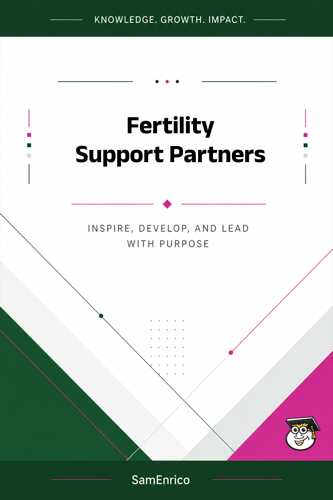
Fertility Support Partners eBook
Teaches couples navigating male factor infertility
by Lauer Kenna
Teaches couples navigating male factor infertility together.
Formats
Free sample
Chapter 1: The Silent Half– In a small, windowless examination room, a couple receives news that will quietly reshape their marriage. The doctor points to a number on a lab report—a number that seems impossibly low—and uses words like “oligospermia” and “subfertility.” The man stares at the paper. The woman stares at the man. Neither speaks. In the parking lot, he will say, “It’s my fault.” She will say, “No, it’s not.” And then they will drive home in silence, each carrying a weight they do not know how to share.This moment, repeated thousands of times every day across the world, is the silent half of the infertility epidemic.
And it is the reason this book exists.The Statistic We Whisper Male factor infertility contributes to approximately 40 to 50 percent of all couples struggling to conceive. Let that number land. In nearly half of all cases where a couple cannot get pregnant, the male partner’s reproductive health is a significant contributor. Yet, when was the last time you heard a man casually mention that he and his wife are seeing a fertility specialist because of his sperm count? When was the last time a television show depicted a male character grappling with abnormal morphology or low motility?The answer, of course, is almost never.Female infertility has become a familiar narrative.
We have words for it. We have support groups, documentaries, and celebrity memoirs. We have protocols and acronyms and a shared cultural understanding that when a woman struggles to conceive, it is a tragedy worthy of empathy and attention. But male factor infertility remains largely unspoken—a secret whispered in urology waiting rooms, a confession made only to a close friend after three drinks, a source of shame so profound that it can dismantle a man’s sense of self without anyone ever knowing.This silence is not accidental. It is the product of generations of cultural conditioning that ties male worth to virility, potency, and the ability to “perform” both sexually and reproductively.
A man who cannot father a child is, in the deepest and most destructive corners of the collective psyche, not quite a man at all. This is, of course, completely untrue. But try telling that to a man staring at a lab report that says he has zero sperm. Try telling that to a husband who watches his wife endure IVF injections while secretly believing that his body has failed them both.This chapter is not about the medical details of male factor infertility—we will cover those thoroughly in Chapter 2. This chapter is about the moment of diagnosis.
The shattering. The first twenty-four hours after you learn that the problem is not “just stress” or “bad timing” but something physiological, something measurable, something that has a name and a number and a parking lot conversation you will replay in your mind for years.This chapter is about reframing that moment from “his fault” to “our diagnosis.” And it begins with a radical proposition: You are not broken. Your relationship is not broken. You are facing a medical condition as a team, and how you navigate the first day will determine how you navigate the entire journey ahead.The Anatomy of a Diagnosis Let us walk through the moment together. Not the idealized version where both partners respond perfectly, but the real version—messy, painful, and confusing.The call comes.
Or the portal message appears. Or the doctor delivers the news in person. However it arrives, the content is the same: one or more parameters on the semen analysis are abnormal. Low count. Poor motility.
Unusual morphology. High DNA fragmentation. Or, in the most devastating cases, azoospermia—no sperm at all.In that instant, two parallel realities unfold.His reality: A cascade of shame so immediate and so visceral that it feels physical. His mind races through a highlight reel of perceived failures: every time he was too tired for sex, every glass of whiskey he should not have had, every hot bath he took, every year he waited to start a family. He thinks, “I did this.” He thinks, “She deserves someone who works properly.” He thinks, “I am less than a man.” Some of these thoughts are conscious.
Most are not. But they are all present, swirling beneath a stoic expression that he has been trained to maintain since childhood.Her reality: A complicated grief that has no single name. She is sad for him—deeply, achingly sad that the person she loves is hurting. She is scared for their future—will they ever have a biological child together? She is confused—how is this possible when everything seemed fine?
And underneath it all, buried beneath layers of love and loyalty, she may feel something she is terrified to admit: frustration. Not at him, exactly, but at the situation. At the unfairness. At the fact that her body is ready, and his is not. She feels guilty for feeling frustrated.
She hides it. And the hiding creates distance.This is the anatomy of a diagnosis. Two people, same room, same piece of paper, two completely different internal experiences. Neither is wrong. Neither is selfish.
Both are human. The question is not whether these feelings exist—they do—but whether you can acknowledge them together or whether they will drive you apart.The Blame Game: How It Starts and How to Stop It Blame is insidious. It does not announce itself with trumpets and accusations. It arrives in small, quiet moments that feel almost innocent.She says, “Maybe if you had seen a doctor sooner…” She does not mean it as an attack. She means it as a desperate attempt to make sense of something senseless.
But he hears: “This is your fault.”He says nothing. He retreats to his phone, his work, the garage. He does not mean to shut her out. He means to protect her from his shame. But she hears: “You are alone in this.”The blame game is not a game at all.
It is a pattern of reactive communication that emerges when two people are in pain and do not have a shared language for that pain. Without intervention, it becomes a feedback loop: she feels abandoned by his silence, he feels attacked by her questions, and the original diagnosis—already difficult—becomes a source of marital conflict that outlasts any medical treatment.The Blame Game Interrupt In the first twenty-four hours after diagnosis, you have an opportunity to interrupt this pattern before it solidifies. The Blame Game Interrupt is a simple, three-part technique that any couple can use, regardless of how they typically communicate.Step One: Name the Pattern. Before you can stop blaming each other, you have to acknowledge that you are doing it. This is not about assigning fault for the blaming.
It is about observation without judgment. One partner says, “I think we are starting to blame each other. Can we pause?”Step Two: Reframe the Diagnosis. Replace “your fault” with “our diagnosis.” This is not a semantic trick. It is a fundamental shift in who is responsible for what.
His body has a medical condition. That condition is now a shared problem because you share a goal—building a family…
This is the end of the free sample. Get the eBook to keep going. Buy now
About this book
Details
- Author
- Lauer Kenna
- Publisher
- SamEnrico
- Language
- English
- Genre
- Non-Fiction, Health & Wellness, Couples
- Released
- 2026-06-06
- Pages (approx.)
- 131
- Available as
- eBook, Audiobook

Read better in the ZLOADR app
Your eBooks on your phone or tablet. Sign in with your SamEnrico account and start reading.
More by Lauer Kenna
 Strength Training Testosterone BoostLauer Kenna$11.99
 Life Settlement Housing GuideLauer Kenna$11.99
 Nutrition for Healing After AlcoholismLauer Kenna$11.99
 NVC For Codependency GuideLauer Kenna$11.99
 Franchising Your Local Brand Across Borders Patent EnforcementLauer Kenna$11.99
 Meth Recovery MeditationLauer Kenna$11.99
 Pre Test Jitters GuideLauer Kenna$11.99
 The Shining Excalibur of the Moonlit CourtLauer Kenna$11.99
 The Great Circus Trial: Barnum vs. The World (1871)Lauer Kenna$11.99
 How to Become a Process-area SupervisorLauer Kenna$11.99
 How to Produce Acrylic StainLauer Kenna$11.99
 A Collector's Handbook to the De Soto CkLauer Kenna$11.99
You may also like
 Hong Kong Handover 1997Dunn Johnnie$11.99
 Zumba For Postnatal Recovery CourseNeal Christian$11.99
 Zumba for BeginnersLadner Nikia$11.99
 YouTube Comment Mining GuideHumes Pandora$12.99
 Worry Box MeditationCarlin Rudy$11.99
 Workplace Stress MeditationNguyen Lynn$11.99
 Workplace Stress and Sleep RepairHawley Ivory$11.99
 Workplace Perfectionism CureDelaney Jeffry$11.99
 Workplace Injustice Anger GuideWallen Isabelle$11.99
 Work Addiction and Burnout LinkGreenwood Ester$11.99
 Women in Yoga and WellnessBeattie Galina$11.99
 Women in Stand Up ComedyChun Evangeline$11.99