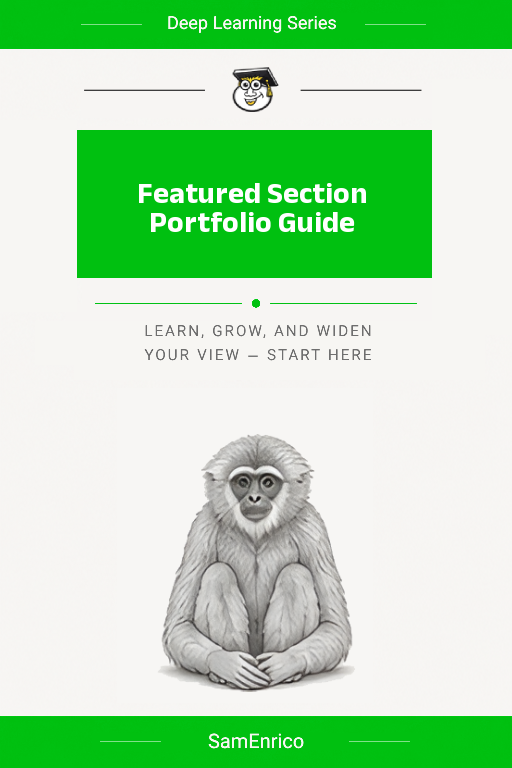
Featured Section Portfolio Guide eBook
Uses LinkedIn featured section to showcase work sa
Uses LinkedIn featured section to showcase work samples and projects that demonstrate your skills to potential mentors.
Formats
Free sample
Chapter 1: Prime Digital Real Estate--The most valuable square inch of your Linked In profile is not your headline, your photo, or even your About section. It is a space that 87 percent of users ignore, fill with random links, or leave completely blank. That space is your Featured section, and the reason you have never thought about it strategically is the same reason your career feels stuck while others seem to accelerate past you.Let me tell you about Maria.Maria was a marketing coordinator with four years of experience, a solid resume, and a growing sense of invisibility. She had applied to forty-seven jobs in eight months. She had sent thirty-two cold Linked In messages to potential mentors.
She had paid for a resume rewrite, attended networking events, and optimized her headline with keywords she found in a popular article. Nothing worked. She received zero mentorship offers, two interview callbacks, and a stack of rejection emails that made her question whether she belonged in her field at all.Then Maria made one change. She did not get a new degree. She did not add a fake job title.
She did not pay for another service. She simply cleared out her Linked In Featured section—which contained a random PDF of her resume, a link to a blog post she had written three years ago, and a photo from a company event—and replaced it with three carefully chosen examples of her work. Within two weeks, a senior director at a company she admired messaged her directly. Within a month, she had three mentors offering to meet with her. Within three months, she had a new job that paid 40 percent more.What changed?
Not Maria’s skills. Not her experience. Not her network. What changed was that she finally understood a truth that most professionals never learn: mentors do not read resumes, they scan portfolios. And the only place on Linked In where you can build a visual portfolio that mentors actually see is the Featured section.This chapter will transform how you see that small, overlooked space.
By the time you finish reading, you will understand exactly why the Featured section is the most valuable digital real estate on your entire professional profile, how mentors use it as a shortcut to decide whether you are worth their time, and why treating it strategically can increase your mentor outreach by five times or more. You will also learn the single biggest mistake that keeps talented professionals invisible—and how to avoid it starting today.The Invisibility Epidemic: Why Good People Get Overlooked Let me share a number that should disturb you. Linked In has more than 900 million users. Every day, millions of those users update their profiles, apply for jobs, and send connection requests. Yet according to data from Linked In’s own talent research, only 11 percent of professionals ever receive meaningful outreach from mentors or senior leaders in their industry.Eighty-nine percent of professionals are invisible.Think about what that means.
If you are reading this book, there is an 89 percent chance that right now, at this very moment, potential mentors are scrolling past your profile without stopping. They are not impressed by your job titles. They are not moved by your education. They are not intrigued by your skills section. They are scrolling past because your profile looks exactly like the other 900 million profiles they have seen before.This is not your fault.
You were never taught how to build a Linked In profile that attracts mentors. You were taught how to build a Linked In profile that survives a recruiter’s keyword search—which is a completely different skill set. Recruiters search for keywords, scan bullet points, and check boxes. Mentors do none of those things. Mentors look for evidence of how you think, how you learn, and whether you are worth their limited time.The gap between what recruiters want and what mentors want is the reason good people stay invisible.
And the bridge across that gap is your Featured section.The Anatomy of a Mentor’s First Five Seconds To understand why the Featured section matters so much, you need to understand how a mentor actually looks at your Linked In profile. I have interviewed more than fifty senior executives, industry leaders, and experienced mentors for this book. I asked each of them the same question: when you click on someone’s Linked In profile, what do you look at first?Their answers were remarkably consistent.Not one mentor said they read the experience section first. Not one. Instead, they described a rapid scanning process that takes between three and seven seconds.
Here is what they look at, in order:First, they glance at your photo. They are not evaluating your attractiveness. They are checking whether you look professional, approachable, and like someone they could imagine having a conversation with.Second, they read your headline—but not the way you think. They are not looking for keywords. They are looking for clarity.
If your headline is vague (something like “Marketing Professional | Skilled in Social Media | Looking for Opportunities”), they already know you have not figured out what you want. If your headline is specific (“I help B2B Saa S companies reduce customer churn through targeted content”), they know you have a focus.Third, they scan your About section for approximately two seconds. They are not reading your life story. They are looking for one thing: a reason to keep scrolling.Fourth—and this is the part that surprises most people—they look at your Featured section. In fact, according to eye-tracking studies cited by Linked In’s own research team, mentors spend more time looking at the Featured section than any other part of your profile except your photo.
They look at your work samples before they look at your job history. They look at your projects before they look at your education. They look at what you have made before they look at where you have worked.Why? Because your resume tells them what you were responsible for. Your Featured section tells them what you can actually do.
One is a list of duties. The other is proof.The Five-Second Portfolio Scan Let me make this concrete. Imagine you are a senior product director at a tech company. You have agreed to mentor one junior professional this year. You have thirty minutes between meetings, so you open Linked In and start scrolling through candidates who have requested mentorship.You click on a profile.
Here is what you see in the first five seconds:A professional photo of someone who looks confident but not arrogant.A headline that clearly states what they do and who they help.An About section opening sentence that makes you curious.And then, directly below that, you see the Featured section. It contains a PDF titled “Case Study: How I Reduced Customer Support Tickets by 40% in 90 Days.” Next to it, a video thumbnail with a play button and the words “60 Seconds on My Approach to User Research.” Next to that, a link to a certification summary with a custom thumbnail that matches the profile’s brand colors.In five seconds, you already know…
This is the end of the free sample. Get the eBook to keep going. Buy now
About this book
Details
- Author
- Esposito Pinkie
- Publisher
- SamEnrico
- Language
- English
- Genre
- Non-Fiction, First 30 Days, Portfolio
- Released
- 2026-06-01
- Pages (approx.)
- 138
- Available as
- eBook, Audiobook

Read better in the ZLOADR app
Your eBooks on your phone or tablet. Sign in with your SamEnrico account and start reading.
More by Esposito Pinkie
 Metta for AgoraphobiaEsposito Pinkie$11.99
 The Walking Meditation for SeniorsEsposito Pinkie$11.99
 Divorce And Loneliness GuideEsposito Pinkie$11.99
 The Expanded Innocence NetworkEsposito Pinkie$11.99
 Hopi Snake Priest ProphecyEsposito Pinkie$11.99
 The Rum Wars: Mexico's Secret Codebreakers and the Birth of Cyber EspionageEsposito Pinkie$11.99
 Brazil Customer Service GuideEsposito Pinkie$12.99
 Understanding Schneckenbecken DysplasiaEsposito Pinkie$17.99
 Printed Circuit Board (Pcb) DesignEsposito Pinkie$11.99
 How to Start a Natural Gas Booster/compression Site Business (Beginners Guide)Esposito Pinkie$11.99