
Non-FictionHealth & WellnessPatient Experience
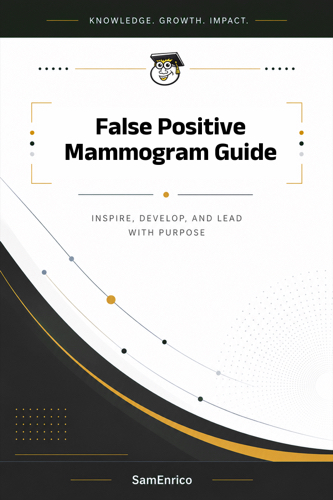
False Positive Mammogram Guide eBook
Cope with recall anxiety and understand next steps
Cope with recall anxiety and understand next steps after abnormal finding.
Formats
Free sample
Chapter 1: The Phone That Changes Everything...--–- The Tuesday it happened, I was making pasta. Not good pasta—the kind from a box, with sauce from a jar, because it had been a long week and it was only Tuesday. My daughter was doing homework at the kitchen table, my husband was still stuck in traffic, and the dog was staring at me with the specific judgment that only a well-fed Labrador can muster. The phone rang. Caller ID said the breast center.
I almost let it go to voicemail. I had been there two weeks ago for my routine mammogram, my fourth one since turning forty, and nobody had said anything unusual when I left. The tech had smiled. She had said, "You'll get a letter in the mail." That was the protocol: no news was good news. So when the phone rang and the caller ID said the breast center, my brain did something strange.
It didn't jump to cancer. It jumped to scheduling. "Probably just confirming my next appointment," I told myself. I answered.The voice on the other end was warm but careful. That was my first clue—the carefulness.
People who call with routine news don't sound careful. They sound bored. This woman sounded like she had practiced what she was about to say. "Your mammogram showed an area that needs a closer look. We'd like you to come back for additional images."I remember the exact pause that followed.
It was maybe three seconds, but it felt like someone had reached into my chest and stopped my heart. The pasta water was boiling. My daughter was asking me something about fractions. The dog had given up on me and was now lying on my feet, which he only does when he senses something is wrong. I said, "Okay." That was all.
Just "okay." Then I wrote down the appointment time—three days later—and hung up.For the next ten minutes, I stood in my kitchen, stirring pasta that was definitely overcooking, and I felt nothing. Not courage. Not calm. Nothing. It was the strangest sensation: my body was still moving, still performing the motions of being a mother and a cook and a person, but my mind had gone somewhere else.
Somewhere cold and white and quiet. When my husband walked in twenty minutes later, I was sitting at the kitchen table, staring at a cold bowl of pasta, and my daughter was eating cereal for dinner because nobody had told her otherwise."What happened?" he asked. And I said, "They found something on my mammogram." And then I burst into tears.The Physiology of Panic: Why Your Body Betrays You What I didn't know then—what I desperately needed someone to tell me in that first hour—is that my reaction was not weakness. It was biology. The moment the human brain perceives a threat to survival, it activates the sympathetic nervous system.
The amygdala, that small almond-shaped cluster of neurons deep in the brain, sounds an alarm. It doesn't wait for evidence. It doesn't weigh probabilities. It just sounds the alarm, because two million years of evolution have taught the human body one thing above all else: it is better to panic at a false alarm than to ignore a real one.Within seconds of hearing the phrase "needs a closer look," my hypothalamus had signaled my pituitary gland, which had signaled my adrenal glands. Cortisol and adrenaline flooded my bloodstream.
My heart rate jumped from seventy to one hundred and twenty beats per minute. My blood pressure spiked. My breathing became shallow and rapid—not because I was hyperventilating, but because my body was redirecting oxygen to my large muscles in case I needed to run. (Run where? From what?
The phone call? The mammogram? Evolution doesn't care about logic. It only cares about survival.)My pupils dilated. My hearing sharpened.
My digestive system shut down entirely—which is why I couldn't eat that pasta, and why so many women report nausea after a callback. Blood flow was redirected away from my stomach and toward my limbs. My mouth went dry. My palms started to sweat. And my higher cognitive functions—the parts of my brain responsible for reasoning, for probability assessment, for remembering that ninety percent of callbacks turn out to be nothing—were temporarily suppressed.
This is not a metaphor. This is neurology. The prefrontal cortex, where rational thought lives, is literally less active during an acute stress response. You cannot think clearly because your brain has decided that thinking is a luxury it cannot afford.I tell you all of this not to scare you, but to absolve you. You are not crazy.
You are not weak. You are not failing at being a calm, rational person. You are a mammal with a functioning nervous system, and your body is doing exactly what it evolved to do. The problem is that the threat it is responding to is not a predator in the grass. It is a phone call about a medical test—a test that, statistically speaking, is far more likely to be wrong than right.
Your body doesn't know that. Your body just knows that something is wrong, and it is preparing you to fight or flee. You cannot fight a mammogram result. You cannot flee from a phone call. So the energy has nowhere to go.
It becomes anxiety. It becomes terror. It becomes the feeling that you are falling and there is no ground.The First Grounding Technique: Box Breathing In that first hour, while you are still shaking, while you are still replaying the phone call in your head, while you are already imagining telling your children or your parents or your partner that you have cancer (even though you don't know that yet), you need something to interrupt the spiral. You cannot think your way out of a physiological response. You cannot reason with your amygdala.
But you can breathe your way out.Box breathing is a technique used by Navy SEALs, emergency room physicians, and disaster responders. It works because it forces your parasympathetic nervous system—the "rest and digest" system—to activate. It is simple. It is free. And you can do it anywhere, including in the parking lot of the breast center while you are trying not to cry.Here is how it works: Inhale for four seconds.
Hold for four seconds. Exhale for four seconds. Hold for four seconds. Repeat. That is one box.
Do five boxes. By the third box, your heart rate will begin to slow. By the fifth, your hands will stop shaking. This is not a placebo. This is the vagus nerve—the longest nerve in your autonomic nervous system—sending a signal to your brain that the danger has passed.
The danger hasn't actually passed, of course. You still have a callback. You still have uncertainty. But your body doesn't know that. Your body only knows that the breathing pattern has changed, and a changed breathing pattern usually means safety.
So it stands down.I learned box breathing from a therapist years ago, for a different kind of anxiety. I never thought…
This is the end of the free sample. Get the eBook to keep going. Buy now
About this book
Details
- Author
- Easter Mitchel
- Publisher
- SamEnrico
- Language
- English
- Genre
- Non-Fiction, Health & Wellness, Patient Experience
- Released
- 2026-06-06
- Pages (approx.)
- 138
- Available as
- eBook, Audiobook

Read better in the ZLOADR app
Your eBooks on your phone or tablet. Sign in with your SamEnrico account and start reading.
More by Easter Mitchel
 Georgian Mafia Post SovietEaster Mitchel$11.99
 Pinterest VA For Fashion BrandsEaster Mitchel$11.99
 The Ear Pain Meditation GuideEaster Mitchel$11.99
 Binge Eating in Men WorkbookEaster Mitchel$11.99
 The Lost Kingdom of the Deep: Unraveling the Secrets of the Sunken City of Muara JawaEaster Mitchel$11.99
 The Grand Illusion: How Conrad Hilton Built an Empire on Charm and ChaosEaster Mitchel$11.99
 STEM Degree Country CompareEaster Mitchel$12.99
 IP Assignment For StartupsEaster Mitchel$12.99
 A Beginners Guide to Australia (Volume 1)Easter Mitchel$11.99
 Understanding Compartment SyndromeEaster Mitchel$17.99
 Front of House OfficerEaster Mitchel$11.99
You may also like
 Hong Kong Handover 1997Dunn Johnnie$11.99
 Zumba For Postnatal Recovery CourseNeal Christian$11.99
 Zumba for BeginnersLadner Nikia$11.99
 YouTube Comment Mining GuideHumes Pandora$12.99
 Worry Box MeditationCarlin Rudy$11.99
 Workplace Stress MeditationNguyen Lynn$11.99
 Workplace Stress and Sleep RepairHawley Ivory$11.99
 Workplace Perfectionism CureDelaney Jeffry$11.99
 Workplace Injustice Anger GuideWallen Isabelle$11.99
 Work Addiction and Burnout LinkGreenwood Ester$11.99
 Women in Yoga and WellnessBeattie Galina$11.99
 Women in Stand Up ComedyChun Evangeline$11.99