
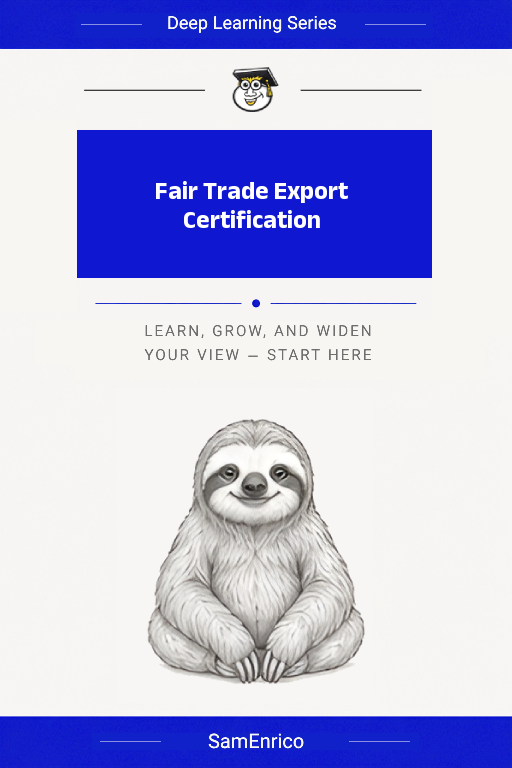
Non-FictionBusiness BriefFair Trade
Fair Trade Export Certification eBook
Details Fairtrade International, Fair Trade USA, a
Details Fairtrade International, Fair Trade USA, and WFTO certification for exporters of coffee, cocoa, tea, and handicrafts.
Formats
Free sample
Chapter 1: The Exporters Dilemma--–- The container had been sitting at the Port of Mombasa for seventeen days. Inside were 20,000 kilograms of specialty-grade coffee from a cooperative in the Aberdare Highlands of Kenya. The beans had been hand-sorted three times. The moisture content was precisely 11.2 percent. The cupping score was 86 points—well into specialty territory.
The coffee was perfect. And it was going nowhere.The buyer, a mid-sized roaster in Seattle, had refused to release payment. The reason was not the quality of the coffee, not the price, not the shipping terms. The reason was a single missing signature on a single piece of paper. Specifically, the cooperative’s Fairtrade Premium Committee meeting minutes from November had been signed by only four of the five elected members.
One woman had been absent because her child was sick. The auditor, during a routine surveillance inspection, had flagged this as a minor Non-Conformity. The cooperative had ninety days to fix it. They fixed it within a week. But the buyer’s compliance department, following an internal policy stricter than the certifier’s requirements, had frozen all payments until the corrective action was approved by FLOCERT.
That approval took six weeks. By the time the coffee cleared customs, the Seattle roaster had switched to a different supplier.This story, told to me by a cooperative manager in Nyeri, is not exceptional. It is not a cautionary tale about a freak accident or an overzealous auditor. It is a routine example of how Fair Trade export certification actually works for small and medium-sized exporters. The promise of certification is access to premium markets and stable prices.
The reality is an unforgiving bureaucracy where a missing signature can idle a container for a month, where the cost of annual audits can exceed the premium earned, and where the rules change faster than exporters can adapt.This book is written for the exporter who has lived this story or fears living it. For the cooperative manager who spends more time filling out FLOCERT spreadsheets than managing coffee quality. For the handicraft fair trade organization that has spent three years trying to understand the difference between WFTO’s Guarantee System and Fair Trade USA’s Apparel & Home Goods standard. For the tea estate owner who has watched certification fees eat up 40 percent of the Fairtrade Premium before a single dollar reaches the workers. For the cocoa farmer cooperative that passed its audit but lost its buyer because the chocolate company switched to a direct trade model overnight.The thesis of this chapter—and of this book—is simple but brutal: Fair Trade export certification is not a moral achievement.
It is a market access strategy with its own costs, risks, and trade-offs. The exporter who treats certification as a stamp of ethical virtue will fail. The exporter who treats certification as a rigorous, expensive, sometimes irrational but occasionally profitable business decision has a chance. This book will equip you to be the second exporter.But before we can build that equipment, we must understand the terrain. What exactly is Fair Trade certification?
Who are the major players? Why does an exporter need to choose between three competing systems? And most importantly, how do these systems differ in ways that materially affect your bottom line, your audit burden, and your market access? This chapter answers those foundational questions. Subsequent chapters will take you inside each certifier’s operations, teach you how to survive an audit, and show you how to market your certified products without triggering a lawsuit or a greenwashing scandal.What Fair Trade Certification Actually Is (And Is Not)Let us begin with a definition.
Fair Trade certification is a third-party verification system that attests that a product—or, in the case of WFTO, an organization—has been produced and traded according to a set of social, economic, and environmental standards. The certifier does not produce anything, does not buy anything, and does not guarantee that the product will sell. The certifier only verifies compliance. The exporter pays for this verification. The buyer uses it as evidence of ethical sourcing.
The consumer, theoretically, trusts it.This sounds straightforward. It is not. The complication arises from two facts. First, there is no single Fair Trade standard. There are three major certifiers with overlapping but incompatible rules.
Second, certification is not a one-time event. It is a perpetual cycle of documentation, audits, corrective actions, and renewal fees. The exporter does not get a certificate and then focus on farming or weaving. The exporter gets a certificate and then hires a compliance officer, because the paperwork never stops.What Fair Trade certification is not is equally important. It is not a guarantee of poverty alleviation.
The Fairtrade Minimum Price, which we will explore in depth in Chapter 7, is often barely above the cost of production. The Fairtrade Premium, which is supposed to fund community development projects, is often consumed by administrative overhead. Many certified producers remain poor. Certification is also not a guarantee of market access. A certified coffee cooperative still needs to find a buyer, still needs to negotiate a price, and still needs to ship the product.
The certificate opens some doors. It does not open all doors.Perhaps most controversially, Fair Trade certification is not a substitute for structural economic change. It does not challenge the fundamental power imbalance between Global South producers and Global North buyers. It does not redistribute land. It does not reform commodity exchanges.
It does not cancel debt. It operates entirely within the existing capitalist framework, attempting to make it slightly less exploitative. For critics on the left, this is a fatal flaw. For pragmatists, it is the only game in town.The Three Certifiers: A Strategic Overview The exporter choosing a certification path faces three options: Fairtrade International (FLO), Fair Trade USA (FTUSA), and the World Fair Trade Organization (WFTO). Each has different origins, different governance structures, different standards, and different market acceptance.
Choosing incorrectly can cost years and tens of thousands of dollars.Fairtrade International (FLO) is the oldest and largest of the three. Headquartered in Bonn, Germany, FLO operates in over seventy countries and certifies coffee, cocoa, tea, bananas, sugar, flowers, and a handful of other commodities. FLO does not certify handicrafts. Its standards are designed for smallholder cooperatives, though it also has a Hired Labor standard for plantations. FLO uses a commercial auditor called FLOCERT, which charges fees based on the volume and complexity of the operation.
The FLO label is dominant in Europe, where consumer recognition exceeds 80 percent in some countries. In North America, the FLO label is present but less dominant, partly because of the FTUSA split.The core strength of FLO is its Minimum Price mechanism, which we will examine in Chapter 7. This price floor protects producers when commodity markets crash—a genuine benefit. The core weakness of FLO is its bureaucratic rigidity. The cooperative governance requirements are extensive and prescriptive.
The audit process is adversarial. The corrective action system is punitive. Small cooperatives often struggle to keep up.Fair Trade USA (FTUSA) is the American breakaway. After leaving FLO in 2011, FTUSA developed its own standards, which are more flexible than FLO’s in several…
This is the end of the free sample. Get the eBook to keep going. Buy now
About this book
Details
- Author
- Ledbetter Luella
- Publisher
- SamEnrico
- Language
- English
- Genre
- Non-Fiction, Business Brief, Fair Trade
- Released
- 2026-05-30
- Pages (approx.)
- 128
- Available as
- eBook, Audiobook

Read better in the ZLOADR app
Your eBooks on your phone or tablet. Sign in with your SamEnrico account and start reading.
More by Ledbetter Luella
 Creator Health Insurance GuideLedbetter Luella$11.99
 SaaS Security BreachesLedbetter Luella$11.99
 OUD Medications in PregnancyLedbetter Luella$11.99
 The Binge Eating Recovery WorkbookLedbetter Luella$11.99
 Executive Imposter SyndromeLedbetter Luella$11.99
 The Ghost of Pablo Escobar: Cursed Gold and Cartel Paranormal EncountersLedbetter Luella$11.99
 Search Console Breadcrumbs ReportLedbetter Luella$12.99
 Understanding PreeclampsiaLedbetter Luella$17.99
 Commercial Sales RepresentativeLedbetter Luella$11.99
 How to Become a Compo CasterLedbetter Luella$11.99
You may also like
 Hong Kong Handover 1997Dunn Johnnie$11.99
 Zumba For Postnatal Recovery CourseNeal Christian$11.99
 Zumba for BeginnersLadner Nikia$11.99
 YouTube Comment Mining GuideHumes Pandora$12.99
 Worry Box MeditationCarlin Rudy$11.99
 Workplace Stress MeditationNguyen Lynn$11.99
 Workplace Stress and Sleep RepairHawley Ivory$11.99
 Workplace Perfectionism CureDelaney Jeffry$11.99
 Workplace Injustice Anger GuideWallen Isabelle$11.99
 Work Addiction and Burnout LinkGreenwood Ester$11.99
 Women in Yoga and WellnessBeattie Galina$11.99
 Women in Stand Up ComedyChun Evangeline$11.99