
Non-FictionSelf-HelpEngineering
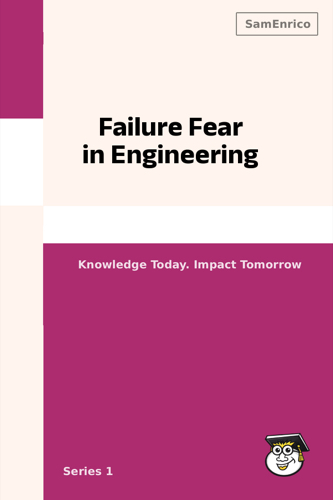
Failure Fear in Engineering
Design prototypes that might fail without catastro
Design prototypes that might fail without catastrophic thinking.
Formats
About this book
Free sample
Chapter 1: The Right Answer Trap--–- Every engineer remembers the first time they hid a failure. For Sarah, a third-year mechanical engineering student, it happened during a thermodynamics final. She had spent forty-five minutes deriving an equation for entropy generation across a turbine. Halfway through, she realized her initial assumption about incompressible flow was wrong. But instead of restarting, she fudged the numbers.
She reversed a sign. She made the answer come out clean. She passed. And she learned something that no syllabus ever stated explicitly: In engineering, being wrong is dangerous. Being caught being wrong is catastrophic.This chapter argues that traditional engineering education is the primary source of failure phobia.
From freshman calculus to senior design reviews, engineers are rewarded for arriving at the single correct answer and penalized for divergence—a conditioning so deep that it persists decades into professional careers. The chapter contrasts this with artistic disciplines (e.g., painting, music) where the process of "wrong" attempts is considered valuable learning. It introduces the core reframe that runs throughout this book: a prototype is not a miniature version of the final product; rather, a prototype is a question posed to reality. By the end of this chapter, you will understand why your fear of failure is not a personality flaw but a trained response—and why unlearning that training is the most urgent engineering challenge of our time.The Making of a Perfectionist: How Engineering School Breaks Your Risk Appetite Engineering education is a triumph of rigor and a disaster of psychology. Consider the typical assessment structure: from Statics to Signals and Systems, the grading curve rewards the student who arrives at the single correct numerical answer within a narrow tolerance.
In most programs, partial credit is a consolation prize, not a pedagogical tool. A student who tries a novel approach and fails spectacularly receives a zero. A student who copies a formula from the textbook and produces the expected answer receives an A. The message is unmistakable: convergence is virtue; divergence is error.This is not an accident. Engineering curricula were designed in the mid-twentieth century…
This is the end of the free sample. Get the eBook to keep going. Buy now
Contents
- Chapter 1
- Chapter 2
- Chapter 3
- Chapter 4
- Chapter 5
- Chapter 6
- Chapter 7
- Chapter 8
- Chapter 9
- Chapter 10
- Chapter 11
- Chapter 12
Details
- Author
- Spalding Richard
- Publisher
- SamEnrico
- Language
- English
- Genre
- Non-Fiction, Self-Help, Engineering
- Released
- 2026-06-10
- Pages (approx.)
- 148
- Available as
- eBook, Audiobook

Read better in the ZLOADR app
Your eBooks on your phone or tablet. Sign in with your SamEnrico account and start reading.
More by Spalding Richard
 McClintock Missouri Botanical Garden GuideSpalding Richard$11.99
 The Workaholic's Sleep RecoverySpalding Richard$11.99
 Luke Bryan Country Boy MemoirSpalding Richard$11.99
 Cataract Surgery Dementia ReductionSpalding Richard$11.99
 Whispers in the Empty Quarter: The Djinn’s Last BargainSpalding Richard$11.99
 Echoes of the Dreamtime: Aboriginal Cosmology and the Black Hole ConnectionSpalding Richard$11.99
 Understanding Friedreich Ataxia Congenital GlaucomaSpalding Richard$17.99
 Accounting AnalystSpalding Richard$11.99
 AI Workflow Orchestration GuideSpalding Richard$12.99
 Escalator Clause ContractsSpalding Richard$12.99
 How to Become a Screw-machine TenderSpalding Richard$11.99
You may also like
 Hong Kong Handover 1997Dunn Johnnie$11.99
 Zumba For Postnatal Recovery CourseNeal Christian$11.99
 Zumba for BeginnersLadner Nikia$11.99
 YouTube Comment Mining GuideHumes Pandora$12.99
 Worry Box MeditationCarlin Rudy$11.99
 Workplace Stress MeditationNguyen Lynn$11.99
 Workplace Stress and Sleep RepairHawley Ivory$11.99
 Workplace Perfectionism CureDelaney Jeffry$11.99
 Workplace Injustice Anger GuideWallen Isabelle$11.99
 Work Addiction and Burnout LinkGreenwood Ester$11.99
 Women in Yoga and WellnessBeattie Galina$11.99
 Women in Stand Up ComedyChun Evangeline$11.99