
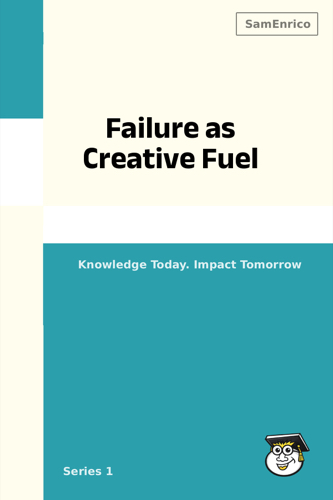
Failure as Creative Fuel eBook
Reframes mistakes as learning opportunities.
by Lerma Kyong
Reframes mistakes as learning opportunities.
Formats
Free sample
Chapter 1: The Hidden Economy--–- The first time I watched someone physically recoil from a mistake, I was sitting in a fluorescent-lit conference room in Seattle, watching a senior software engineer present a prototype that had failed. He had spent three weeks building a new feature. It didn't work. The room was quiet. His shoulders rose toward his ears.
His voice, which had been steady moments before, went up an octave. He started explaining—not the data, not the assumptions, not what he had learned, but why it wasn't really his fault. The timeline was too short. The requirements had changed. Someone else had approved the wrong dependency.
He was building a prison for himself, brick by brick, with every excuse.I watched him do something that I have since seen a thousand times in a thousand different rooms. He was not defending his work. He was defending his right to exist in that room. And in doing so, he was throwing away the only thing of value that his failure had produced: information.That moment stayed with me because it was not dramatic. It was not a billion-dollar collapse or a public humiliation.
It was a Tuesday. And yet, in that quiet conference room, something important happened. The team learned nothing. The prototype was abandoned. The same mistake would be made again six months later by a different engineer who had not been in the room to learn the lesson that no one wrote down.
The failure had happened. The fuel had been produced. And everyone had walked past it like trash on the sidewalk.This book is about learning to stop walking past the fuel.The Myth That Kills Creativity There is a phrase that has done more damage to creative work than any other single sentence. You have heard it in movies, in leadership seminars, in motivational posters taped to office walls. It comes in a few variations, but the core is always the same: "Failure is not an option."Let me be clear about what this phrase actually means when it lands on a human nervous system.
It does not mean "we will try our best to succeed." It means "if you fail, you will have failed at being a person who belongs here." It means "failure is something we do not tolerate." It means "make sure you succeed, or else."The phrase comes from NASA. It was spoken by flight director Gene Kranz during the Apollo 13 crisis, and in that context, it made perfect sense. They had three astronauts in a damaged spacecraft with limited oxygen, and the alternative to success was death. In that specific, high-stakes, life-or-death context, "failure is not an option" is a reasonable operational constraint.But somewhere along the way, this phrase escaped from mission control and colonized every corner of corporate and creative life. It now hangs over product launches, marketing campaigns, software updates, art projects, book drafts, and pitch meetings.
It has become a general-purpose motto for people who have never faced a situation where failure actually meant death. And it is quietly strangling the very creativity it claims to protect.Here is what the research shows, stripped of any comforting language. When human beings perceive that failure is not an option, they do not try harder. They try safer. They take fewer risks.
They hide their experiments. They stop telling anyone when something goes wrong until it is too late to fix it. They produce work that is competent, predictable, and utterly uninteresting. They produce the kind of work that keeps the lights on but never changes anything.And here is the deeper problem. The people who work under a "failure is not an option" regime do not actually fail less.
They just get better at hiding their failures. The mistakes still happen. The prototypes still break. The assumptions still turn out to be wrong. But instead of surfacing those failures when they are small and fixable, they get buried until they become catastrophes.
Then everyone stands around a smoking crater, looking confused, saying "How did no one see this coming?"The answer is that people saw it coming. They saw it three months ago. But they did not say anything, because failure was not an option, and admitting that a small failure was already happening felt too close to becoming the failure itself.Your Brain on Failure To understand why "failure is not an option" backfires so spectacularly, you need to understand what actually happens inside your skull when you encounter a mistake. This is not a metaphor. This is not a self-help platitude.
This is neurochemistry.When you fail at something that matters to you—when you make a public mistake, when your project falls short, when someone criticizes your work—your brain treats it as a physical threat. Not a conceptual threat. Not an abstract disappointment. A genuine, full-throttle, survival-oriented threat. Your amygdala, a small almond-shaped structure deep in your brain that has been keeping humans alive for hundreds of thousands of years, activates the same fight-or-flight response it would activate if you were being chased by a predator.Cortisol floods your system.
Your heart rate increases. Your breathing changes. And crucially, your prefrontal cortex—the part of your brain responsible for insight, nuance, creative problem-solving, and long-term planning—downgrades its activity. Your brain has decided that you are in danger, and when you are in danger, you do not need creativity. You need speed.
You need to run, or fight, or freeze.This is the most cruel irony in the entire neuroscience of creativity. The very moment you most need access to creative insight—when something has gone wrong and you need to figure out a new path forward—your brain is chemically suppressing the exact neural circuits required to do that. You are not being lazy. You are not being weak. You are being biology.The software engineer in the conference room was not a coward.
He was a mammal whose brain was trying to protect him from social expulsion. And in that moment, his brain was right to be afraid. Because many workplaces have indeed built environments where failure is punished, where mistakes are recorded, where the person who speaks up about a problem becomes the person associated with the problem. His amygdala was not malfunctioning. It was doing exactly what evolution designed it to do.
The problem was the environment, not his neurology.This is the first and most important reframe of the entire book, so I want you to sit with it for a moment. Your fear of failure is not a character flaw. It is a survival mechanism that your brain inherited from ancestors who really did face life-or-death consequences for being expelled from the tribe. The problem is that you are not being chased by a lion. You are being asked to give a presentation.
Your brain has not gotten the memo. And until you understand this disconnect, you will keep fighting against your own physiology instead of working with it.Failures Versus Mistakes Before we go any further, we need to get precise about our language. Most people use the words "failure" and "mistake" interchangeably. They are not…
This is the end of the free sample. Get the eBook to keep going. Buy now
About this book
Details
- Author
- Lerma Kyong
- Publisher
- SamEnrico
- Language
- English
- Genre
- Non-Fiction, Self-Help, Failure
- Released
- 2026-06-06
- Pages (approx.)
- 121
- Available as
- eBook, Audiobook

Read better in the ZLOADR app
Your eBooks on your phone or tablet. Sign in with your SamEnrico account and start reading.
More by Lerma Kyong
 Prostate Health Tracking JournalLerma Kyong$11.99
 Perinatal Anger ManagementLerma Kyong$11.99
 Strategic Group Mapping GuideLerma Kyong$11.99
 Insurance Industry LayoffLerma Kyong$11.99
 Joy for IntrovertsLerma Kyong$11.99
 Define Problem StatementLerma Kyong$11.99
 DEH Evan HansenLerma Kyong$11.99
 Codebreakers of the Digital Age: The Untold Story of the First Smartphone HackersLerma Kyong$11.99
 The Verdict of the Sphinx: Oedipus' Forgotten TrialLerma Kyong$11.99
 How to Produce Communication CablesLerma Kyong$11.99
 Influencer Partnership StrategyLerma Kyong$12.99
 African Business Phone Number BlueprintLerma Kyong$12.99
You may also like
 Hong Kong Handover 1997Dunn Johnnie$11.99
 Zumba For Postnatal Recovery CourseNeal Christian$11.99
 Zumba for BeginnersLadner Nikia$11.99
 YouTube Comment Mining GuideHumes Pandora$12.99
 Worry Box MeditationCarlin Rudy$11.99
 Workplace Stress MeditationNguyen Lynn$11.99
 Workplace Stress and Sleep RepairHawley Ivory$11.99
 Workplace Perfectionism CureDelaney Jeffry$11.99
 Workplace Injustice Anger GuideWallen Isabelle$11.99
 Work Addiction and Burnout LinkGreenwood Ester$11.99
 Women in Yoga and WellnessBeattie Galina$11.99
 Women in Stand Up ComedyChun Evangeline$11.99