
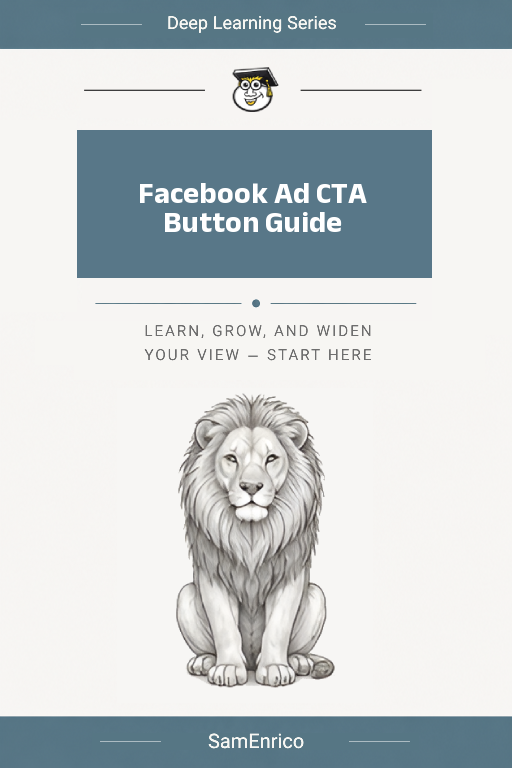
Facebook Ad CTA Button Guide eBook
Choose the right call-to-action button for your ca
Choose the right call-to-action button for your campaign goal.
Formats
Free sample
Chapter 1: The Two-Second Cliff--–- The average Facebook user spends just 1.7 seconds looking at an ad before deciding whether to scroll past or engage. In that blink of an eye, a single element determines the fate of your entire campaign: the Call-to-Action button. This chapter exposes why the CTA is the most undervalued asset in Facebook advertising and how changing one word can double your conversion rate overnight.The Scroll Stops Here – Or Does It?Let me tell you about a $47,000 mistake.I was brought in to audit a mid-sized e-commerce brand selling artisanal leather goods. They had a beautiful website, stunning product photography, and a monthly Facebook ad budget of 47,000.Theiradsweregettingclicks—thousandsofthem.Theircostperclick(CPC)wasarespectable47,000. Their ads were getting clicks—thousands of them.
Their cost per click (CPC) was a respectable 47,000.Theiradsweregettingclicks—thousandsofthem.Theircostperclick(CPC)wasarespectable0.85. Their creative team was proud. Their media buyer was complacent.Their revenue from Facebook ads over six months: $12,000.That’s a return on ad spend (ROAS) of 0.25. For every dollar they spent, they got back twenty-five cents. They were burning money so fast they could have lit it on fire and stayed warmer.I asked to see their ads.
Beautiful images. Clever copy. Good targeting. And every single ad had the same Call-to-Action button: Learn More.I asked the founder why. He looked at me like I’d asked him to explain gravity.
“Because,” he said, “people need to learn about our products before they buy. They’re expensive. It’s a consideration purchase.”I nodded. Then I asked him a different question: “When someone clicks Learn More, where do they land?”He pulled up the landing page. It was their product catalog—thirty different leather bags, wallets, and belts.
No discount. No urgency. No clear next step. Just a grid of products with prices ranging from 89to89 to 89to450.Here’s what was happening: Facebook users were scrolling, seeing a beautiful leather bag, clicking Learn More out of curiosity, landing on a catalog page, feeling overwhelmed, and bouncing. Every single time.I made one change.
Not the creative. Not the targeting. Not the budget.I changed the CTA button from Learn More to Shop Now.Same ad. Same image. Same copy.
Same landing page.Within 72 hours, their CTR dropped slightly—from 2.1% to 1.8%. Their CPC increased from 0.85to0.85 to 0.85to1.10. Their media buyer panicked. He called me and said, “You ruined our campaign. Fewer clicks.
Higher costs.”I told him to wait.One week later, their revenue from Facebook ads had increased from 2,000permonthto2,000 per month to 2,000permonthto18,000 per month. Their ROAS went from 0.25 to 2.3. They were now making $2.30 for every dollar spent.What happened? Learn More attracted curious clickers who had no intention of buying. Shop Now attracted buyers.
The click volume dropped, but the quality of each click skyrocketed. People who clicked Shop Now had already decided they might purchase. They were self-selecting into the bottom of the funnel.That one word—“Shop” instead of “Learn”—was worth $16,000 per month.This book exists because most Facebook advertisers are making the same mistake. They spend 90% of their time on creative, copy, and targeting. They spend 10 seconds on the CTA button.
That’s like building a Ferrari and putting bicycle tires on it.The 1.7-Second Reality Check Let me show you what I mean with a simple experiment.Open your own Facebook feed right now. Scroll at your normal speed. Count how long you pause on any given ad before you decide to keep scrolling.If you’re like the average user, you’re spending between one and two seconds per ad. According to a 2023 study by the advertising analytics platform Adalytics, the median attention span for a Facebook in-feed ad is just 1.7 seconds. For mobile users—which account for 98.5% of Facebook’s daily active users—that number drops to 1.4 seconds.In 1.4 seconds, your brain processes the image (first 0.3 seconds), scans the headline (next 0.5 seconds), registers the primary text (next 0.4 seconds), and then—if anything has caught your attention—looks for the next action.That next action is almost always the CTA button.Facebook’s own eye-tracking studies (published in their internal “Creative Excellence” white paper, leaked in 2022) show that users who stop scrolling spend 62% of their remaining attention on the CTA button and the area immediately around it.
They are not reading your carefully crafted primary text. They are not analyzing your image for hidden details. They are looking for one thing: what happens if I click this?If the CTA button is vague, generic, or mismatched to their intent, they scroll. If it’s clear, specific, and aligned with what they want, they click.This is not opinion. This is behavioral psychology backed by billions of data points.The Push vs.
Pull Framework To understand why some CTAs work and others fail, you need to understand a fundamental distinction in consumer psychology: Push CTAs versus Pull CTAs.Push CTAs assume the user is ready to take action. They are direct, transactional, and low-friction. Examples include:Shop Now Buy Now Sign Up Book Now Call Now Get Offer Push CTAs work when the user’s intent is high. They have already decided they want what you’re offering, and they’re looking for the fastest way to get it. Push CTAs remove obstacles.
They say, “You’re ready. I believe you. Here’s the door.”Pull CTAs assume the user needs more information before taking action. They are indirect, educational, and curiosity-driven. Examples include:Learn More Watch Video Read More See Offers Get Quote Contact Us Pull CTAs work when the user’s intent is low.
They are not ready to buy, but they might be willing to learn. Pull CTAs lower the barrier to entry. They say, “You don’t have to commit. Just take one small step.”The single biggest mistake advertisers make is using Pull CTAs when they should be using Push CTAs—or vice versa.The leather goods company was using Learn More (a Pull CTA) on cold traffic that had never seen their products before. That’s actually the correct framework for cold traffic.
The problem was their landing page. They promised a learning experience (“Learn More”) but delivered a sales catalog. The CTA pulled users in, but the landing page pushed them away. That mismatch—which we’ll cover in depth in Chapter 10—destroyed their conversion rate.But here’s the counterintuitive insight: sometimes, a Push CTA on cold traffic outperforms a Pull CTA, even though the psychology says otherwise.Why? Because Learn More has become meaningless.The Semantic Satiation of "Learn More"Words lose their power through overuse.
Psychologists call this semantic satiation—the phenomenon where repeated exposure to a word or phrase causes it to temporarily lose its meaning.“Learn More” is one of the most semantically satiated phrases in digital advertising.Between 2015 and 2020, Facebook’s own data shows that Learn More was the default CTA for over 70% of all ads. It was the safe choice. The default. The “I don’t know what else to put” button.Then something happened. Users stopped reading it.In a 2021 study published in the Journal of Marketing Research, researchers analyzed 12,000 Facebook ads across 40 industries.
They found that Learn More had the lowest attention capture of any CTA button—lower even than generic buttons like See…
This is the end of the free sample. Get the eBook to keep going. Buy now
About this book
Details
- Author
- Sinclair Adena
- Publisher
- SamEnrico
- Language
- English
- Genre
- Non-Fiction, First 30 Days
- Released
- 2026-05-30
- Pages (approx.)
- 145
- Available as
- eBook, Audiobook

Read better in the ZLOADR app
Your eBooks on your phone or tablet. Sign in with your SamEnrico account and start reading.
More by Sinclair Adena
 Financial Contract Term ExtractionSinclair Adena$11.99
 Turning the MindSinclair Adena$11.99
 World Geography PalaceSinclair Adena$11.99
 Self Esteem for Financial AdvisorsSinclair Adena$11.99
 Anger Management for OCD at WorkSinclair Adena$11.99
 Champollion BiographySinclair Adena$11.99
 Mindful Breathing For KidsSinclair Adena$11.99
 Treasure Diver's Ethics GuideSinclair Adena$11.99
 Legacy Without BurnoutSinclair Adena$11.99
 The Green Book of Greenwood: How a Black-Owned Insurance Empire Defied the OddsSinclair Adena$11.99
 The Frozen Plague Hunters: Arctic Spice Routes and the Birth of Pandemic ScienceSinclair Adena$11.99
 Silent Witness: The Trial That Shook the VaticanSinclair Adena$11.99
You may also like
 Hong Kong Handover 1997Dunn Johnnie$11.99
 Zumba For Postnatal Recovery CourseNeal Christian$11.99
 Zumba for BeginnersLadner Nikia$11.99
 YouTube Comment Mining GuideHumes Pandora$12.99
 Worry Box MeditationCarlin Rudy$11.99
 Workplace Stress MeditationNguyen Lynn$11.99
 Workplace Stress and Sleep RepairHawley Ivory$11.99
 Workplace Perfectionism CureDelaney Jeffry$11.99
 Workplace Injustice Anger GuideWallen Isabelle$11.99
 Work Addiction and Burnout LinkGreenwood Ester$11.99
 Women in Yoga and WellnessBeattie Galina$11.99
 Women in Stand Up ComedyChun Evangeline$11.99