
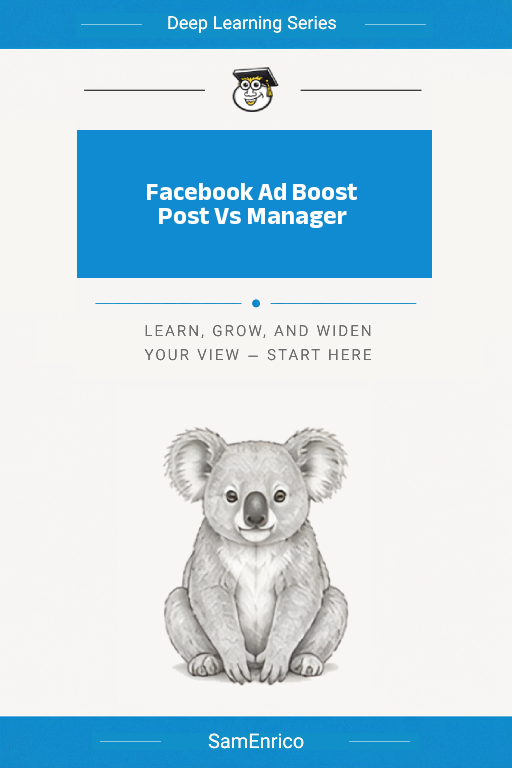
Facebook Ad Boost Post Vs Manager eBook
Compare boosting posts versus using Ads Manager fo
Compare boosting posts versus using Ads Manager for your first campaign.
Formats
Free sample
Chapter 1: The Dopamine Dealer--–- The blue button is not your friend. It never was. It sits there on every post, glowing with innocent promise, inviting you to spend just five dollars to reach thousands of people. And thousands of people will see your post. They will like it.
Some will even comment. You will feel a rush of validation, a warm glow of progress. That feeling is the drug. The blue button is the dealer. And like any good dealer, the first hit is cheap.Let me tell you about my first hit.
I had just launched a small online store selling handmade leather goods. I posted a photo of a new wallet—beautiful stitching, warm lighting, a carefully staged coffee cup in the background. Within an hour, twelve people had liked it. Organic reach was dead, everyone said, but twelve likes felt like a party. Then I saw it: the blue button.
“Boost Post,” it said. For ten dollars, Facebook promised to show my wallet to over a thousand people. Ten dollars. A thousand people. That was ten cents per thousand impressions.
I clicked before I finished the thought.The next morning, I woke up to notifications. One hundred and forty-seven likes. Twenty-three comments. Eleven shares. My heart raced.
I refreshed the page. More likes. People were typing “gorgeous” and “take my money” and “where can I buy this?” I felt like a genius. I had cracked the code. I boosted every post for the next two weeks.
I spent four hundred dollars. I got over two thousand likes. I made exactly zero sales.Zero.That was the moment I understood something that most people never do. Facebook had sold me attention, not results. They had shown my wallet to people who liked pretty pictures but had no intention of buying.
The algorithm optimized for what I asked for—engagement—and it delivered beautifully. I asked for likes. I got likes. I did not ask for sales, so Facebook did not give me sales. The blue button gave me exactly what I paid for, and I paid for the wrong thing.This chapter is about that moment of realization.
It is about understanding why the Boost button feels so good and performs so poorly. It is about the psychology of the easy button, the economics of attention, and the first step toward actually making money on Facebook instead of just collecting digital trophies.The Great Paralysis Before we go any further, let me acknowledge where you are right now. You are standing at a crossroads, and both paths look equally terrifying. To your left is the Boost button. It is simple.
It is fast. It asks nothing of you except a credit card and a post. You have probably already clicked it once or twice. Maybe you got lucky. Maybe you wasted twenty dollars and told yourself it was a learning experience.To your right is Ads Manager.
It looks like a spaceship cockpit designed by a committee of data scientists who have never spoken to another human being. There are columns and drop-downs and toggles and terms like “campaign budget optimization” and “attribution window” and “cost per result.” The first time you open Ads Manager, your cursor hovers over the “Create” button for a good three minutes while your brain whispers: maybe the blue button is fine.I have trained over five thousand business owners and marketers. Nine out of ten of them abandon Ads Manager before launching their first campaign. They click around for ten minutes, close the tab, and go back to boosting. The complexity is not just intimidating—it is paralyzing.
And Facebook knows this. They designed the Boost button specifically to capture people like you and me who want to advertise but do not want to become professional media buyers.Here is the truth that Facebook will never tell you: the Boost button is not a simplified version of Ads Manager. It is a completely different product with different goals, different economics, and different outcomes. Using Boost because Ads Manager is scary is like using a bicycle because a car is complicated. Yes, the bicycle is simpler.
No, you cannot drive it on the highway.The philosophical difference could not be more stark. Boost is content-first. You start with a post you already made—a photo, a video, a link—and you pay Facebook to show it to more people. Your existing post is the center of the universe. Everything else is secondary.
Ads Manager is goal-first. You start with a business objective—sales, leads, app installs, store traffic—and then you create the creative, audience, and budget to achieve that objective. The post serves the goal. The goal does not serve the post.This difference determines everything. When you start with a post, you are optimizing for whatever that post naturally does well.
If your post is funny, Facebook will show it to people who like funny things. If your post is beautiful, Facebook will show it to people who appreciate aesthetics. If your post has a link to your store, Facebook will show it to people who click links. But none of those behaviors—laughter, appreciation, curiosity—are the same as pulling out a credit card and buying something.The Myth of the Money Pit Seasoned marketers have a nickname for the Boost button. They call it the Money Pit.
Not because it always loses money—sometimes it does not—but because it swallows cash without producing the one thing that matters: business results. A money pit is a hole you keep throwing money into because you believe, against all evidence, that the next dollar will be the one that fills it up.Why do so many marketers hate the Boost button? It is not snobbery. It is not gatekeeping. It is simple math.
Here is what happens when you boost a post:First, you choose your audience. You have four options: location, age, gender, and interests. That is it. No website visitors. No previous purchasers.
No people who watched your video for more than three seconds. No lookalikes. You are limited to the same demographic targeting that was cutting-edge in 2012. For a local coffee shop trying to reach people within two miles, this is fine. For an e-commerce store selling niche products to a specific customer profile, it is useless.Second, you choose your objective.
You have four options: engagement, reach, messages, or profile visits. Notice what is missing. Sales is not there. Leads are not there. Retargeting is not there.
You cannot tell Facebook “I want people to buy this product.” You can only tell Facebook “I want people to look at this post, or send me a message, or visit my profile.” Even the “messages” objective only optimizes for people starting a conversation—not people who will actually buy after that conversation.Third, you choose your budget. Facebook suggests a range based on your page size and past activity. You set it and forget it. That is the entire setup process. Thirty seconds from start to finish.Now let me show you what happens to that money.
Facebook takes your budget and enters an auction on your behalf. Their algorithm’s job is simple: find the people most…
This is the end of the free sample. Get the eBook to keep going. Buy now
About this book
Details
- Author
- Higginbotham Mica
- Publisher
- SamEnrico
- Language
- English
- Genre
- Non-Fiction, First 30 Days
- Released
- 2026-06-01
- Pages (approx.)
- 159
- Available as
- eBook, Audiobook

Read better in the ZLOADR app
Your eBooks on your phone or tablet. Sign in with your SamEnrico account and start reading.
More by Higginbotham Mica
 SaaS Contract AI Abstraction GuideHigginbotham Mica$11.99
 Hyksos InvasionHigginbotham Mica$11.99
 Project Management PalaceHigginbotham Mica$11.99
 Police Officer Stress ReductionHigginbotham Mica$11.99
 Shame Resilience DBTHigginbotham Mica$11.99
 Wreck Penetration LogHigginbotham Mica$11.99
 Anger Management for Bipolar at WorkHigginbotham Mica$11.99
 The Group Breathing CircleHigginbotham Mica$11.99
 Rewiring Limiting BeliefsHigginbotham Mica$11.99
 The Serpent’s Curse: Kaliya’s Poisoned WatersHigginbotham Mica$11.99
 The Last Transmission: The Titanic’s Forgotten Radio OperatorsHigginbotham Mica$11.99
 The Last Stand of the Bletchley Breakers: Cracking the Code of the Unbreakable ContractHigginbotham Mica$11.99
You may also like
 Hong Kong Handover 1997Dunn Johnnie$11.99
 Zumba For Postnatal Recovery CourseNeal Christian$11.99
 Zumba for BeginnersLadner Nikia$11.99
 YouTube Comment Mining GuideHumes Pandora$12.99
 Worry Box MeditationCarlin Rudy$11.99
 Workplace Stress MeditationNguyen Lynn$11.99
 Workplace Stress and Sleep RepairHawley Ivory$11.99
 Workplace Perfectionism CureDelaney Jeffry$11.99
 Workplace Injustice Anger GuideWallen Isabelle$11.99
 Work Addiction and Burnout LinkGreenwood Ester$11.99
 Women in Yoga and WellnessBeattie Galina$11.99
 Women in Stand Up ComedyChun Evangeline$11.99