
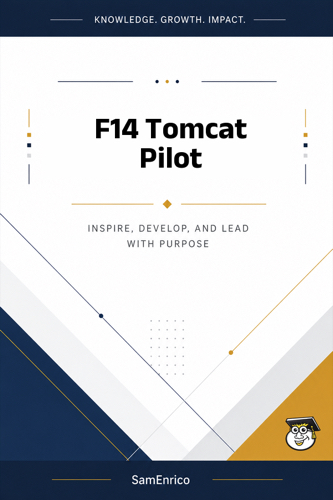
F14 Tomcat Pilot eBook
undefined
undefined
Formats
Free sample
Chapter 1: The Last Cat Shot...--The JBD – Jet Blast Deflector – rose behind the F-14 Tomcat like a steel wall painted in streaks of burnt rubber and hydraulic fluid. Lieutenant Mike "Sundown" Mc Kenna sat strapped into the front cockpit of tail number 103, his gloved hands resting lightly on the throttle and stick, his eyes scanning the instrument panel one final time. The HUD glowed green with flight data: heading, speed, altitude – zero knots, twenty-six feet above the Indian Ocean, which was the height of the flight deck of the USS Theodore Roosevelt (CVN-71). Behind him, his Radar Intercept Officer of eight years, Lieutenant Commander David "Brother" Santos, was running through his own checklist. The AN/AWG-9 radar was spinning up, the weapons systems were indicating ready, and the fuel gauges showed full tanks."Pre-takeoff checklist complete," Brother said over the intercom.
His voice was calm, almost bored. Eight years of flying together had eliminated any need for formalities. "All systems green. Ready to launch when you are."Sundown didn't answer immediately. He was staring at the catapult officer – the "shooter" – who stood in a yellow jersey twenty feet off the nose of the Tomcat.
The shooter's arm was raised, fingers extended, waiting for the signal to drop. Beyond the shooter, the bow of the carrier stretched toward a horizon that was already beginning to glow with the orange-pink light of dawn. The Indian Ocean was calm today – a rare gift. But Sundown knew that a calm ocean didn't mean a calm mission."Shooter, 103," Sundown called over the radio. "Ready for launch."The shooter's arm dropped.
The catapult officer pointed down the deck. And then the world compressed.The catapult shot was always a violent miracle. In less than two seconds, the steam-powered catapult hurled sixty-eight thousand pounds of fighter jet, fuel, weapons, and two human beings from zero to one hundred fifty knots. Sundown's body slammed back into the ejection seat as the G-forces pressed him into the padding. The deck blurred beneath him.
The bow of the ship rushed toward him. And then – just as the laws of physics suggested he should fall into the ocean – the wings bit into the air, and the F-14 climbed."Gear up," Sundown said, pulling the landing gear lever. The thump of the wheels retracting into the fuselage was followed by a sudden silence as the hydraulic pumps finished their work. "Positive rate. Climbing to angels ten.""Gear up, confirmed," Brother replied.
"Radar is live. No surface contacts. No air contacts. All quiet."Sundown glanced over his shoulder at the shrinking silhouette of the Roosevelt. The carrier was already turning into the wind to launch the next aircraft.
In a few hours, the flight deck would be a ballet of screaming jets, running crewmen, and the constant thunder of catapults and arresting gear. But right now, at dawn, everything was still. The Tomcat climbed through scattered clouds, and Sundown felt the familiar, almost religious sense of peace that came with altitude.But this was not a training flight. This was not a routine patrol. This was his final combat deployment.
And somewhere below that peaceful ocean, in the mountains of Afghanistan, Taliban fighters were waiting for the sound of jet engines.The Weight of a Call Sign Every naval aviator earns a call sign. Some are earned through heroism. Most are earned through stupidity. Sundown's call sign came from his first night carrier landing, when he had flown so low and slow that the Landing Signal Officer had screamed over the radio, "You're going to put us in the ocean, Mc Kenna! You're going down like the sun!" The name stuck.
For twelve years, he had been Sundown – a reminder that every landing was a battle against gravity, fatigue, and his own occasional overconfidence.He had joined the Navy in 1992, fresh out of the University of Texas with a degree in aerospace engineering. His father had been a cargo pilot for Fed Ex, not a fighter jock, but the old man had instilled in him a love of aviation that bordered on obsession. Sundown's bedroom as a teenager was plastered with posters of the F-14 Tomcat – the variable-sweep wings swept back, the twin tails cutting through the sky like shark fins. When he watched Top Gun for the first time in 1986, he was twelve years old, and he knew exactly what he wanted to do with his life.But the path from a twelve-year-old dreaming in a bedroom to a thirty-six-year-old strapped into the cockpit of an F-14 was brutal. The Naval Aviation pipeline had a 90% attrition rate from initial application to Wings of Gold.
Sundown had survived Officer Candidate School in Newport, Rhode Island – twelve weeks of screaming drill instructors, sleepless nights, and a constant, gnawing fear that he was not good enough. He had survived Aviation Preflight Indoctrination in Pensacola, Florida, where he learned to recognize the first signs of hypoxia in the altitude chamber and memorized the aerodynamic principles that kept multi-million-dollar aircraft from falling out of the sky.He had survived primary flight training in the T-6 Texan II, learning to loop, roll, and spin at the edge of the envelope. He had survived the selection board – the moment when a panel of senior aviators decided that he would fly jets instead of helicopters or cargo planes. And he had survived advanced training in the T-45 Goshawk, learning the terrifying art of catching a wire on a carrier deck.But surviving the pipeline was only the beginning. Flying the Tomcat was a different kind of challenge entirely.The Machine That Could Kill You The F-14 Tomcat was not a forgiving aircraft.
Unlike modern fly-by-wire fighters that used computers to prevent pilots from making fatal mistakes, the Tomcat was a hybrid of hydraulic and mechanical controls. Every control surface was connected to the stick and rudder pedals through cables and pushrods. When Sundown pulled back on the stick, he could feel the resistance of the elevators fighting against the air rushing past at six hundred knots. There was no computer to smooth out his mistakes. If he pulled too hard, the wings would stall.
If he pulled too soft, the enemy would kill him.The engines were another matter entirely. The Pratt & Whitney TF30 turbofans were underpowered by modern standards and notoriously temperamental. If Sundown moved the throttle too quickly, the engines would compressor stall – a violent event characterized by a loud bang, a sudden yaw to one side, and a loss of thrust that could send the Tomcat tumbling toward the ocean. The corrective action was counterintuitive: retarding the throttle slowly, letting the airflow stabilize, then advancing again. Chop the throttle, and the engine could surge, ingesting its own turbine blades.Sundown had experienced his first compressor stall during a training mission in 1998.
He was flying at twenty thousand feet, practicing a high-G turn, when the right engine let out a bang that sounded like a car backfiring directly outside his window. The Tomcat yawed violently to the right. The cockpit filled with the smell of burning fuel. His RIO at the time – a lieutenant named "Crash" (call signs were never flattering) – screamed, "What the hell was…
This is the end of the free sample. Get the eBook to keep going. Buy now
About this book
Details
- Author
- Meredith Martine
- Publisher
- SamEnrico
- Language
- English
- Genre
- Non-Fiction, Biography / Navy
- Released
- 2026-06-07
- Pages (approx.)
- 131
- Available as
- eBook, Audiobook

Read better in the ZLOADR app
Your eBooks on your phone or tablet. Sign in with your SamEnrico account and start reading.
More by Meredith Martine
 Career Transition for NeurodivergentMeredith Martine$11.99
 Upwork Portfolio Building CourseMeredith Martine$11.99
 Exam Anxiety Performance GuideMeredith Martine$11.99
 Scott Peterson Credit Card UseMeredith Martine$11.99
 Vacation Without Work GuideMeredith Martine$11.99
 Ford Edsel FailureMeredith Martine$11.99
 GST Registration for Wholesale Distributors Action PlanMeredith Martine$11.99
 Citation Rules Bibliography Formatting WorkbookMeredith Martine$11.99
 The Silent Coup: How a Tech Mogul Outmaneuvered Wall StreetMeredith Martine$11.99
 The Spice King’s Gambit: A Lost Portuguese Navigator’s Survival in the Spice IslandsMeredith Martine$11.99
 The Grand Banquet of Timbuktu: Where Scholars Dined with Gold and KnowledgeMeredith Martine$11.99
 Network Security AnalystMeredith Martine$11.99
You may also like
 Hong Kong Handover 1997Dunn Johnnie$11.99
 Zumba For Postnatal Recovery CourseNeal Christian$11.99
 Zumba for BeginnersLadner Nikia$11.99
 YouTube Comment Mining GuideHumes Pandora$12.99
 Worry Box MeditationCarlin Rudy$11.99
 Workplace Stress MeditationNguyen Lynn$11.99
 Workplace Stress and Sleep RepairHawley Ivory$11.99
 Workplace Perfectionism CureDelaney Jeffry$11.99
 Workplace Injustice Anger GuideWallen Isabelle$11.99
 Work Addiction and Burnout LinkGreenwood Ester$11.99
 Women in Yoga and WellnessBeattie Galina$11.99
 Women in Stand Up ComedyChun Evangeline$11.99