
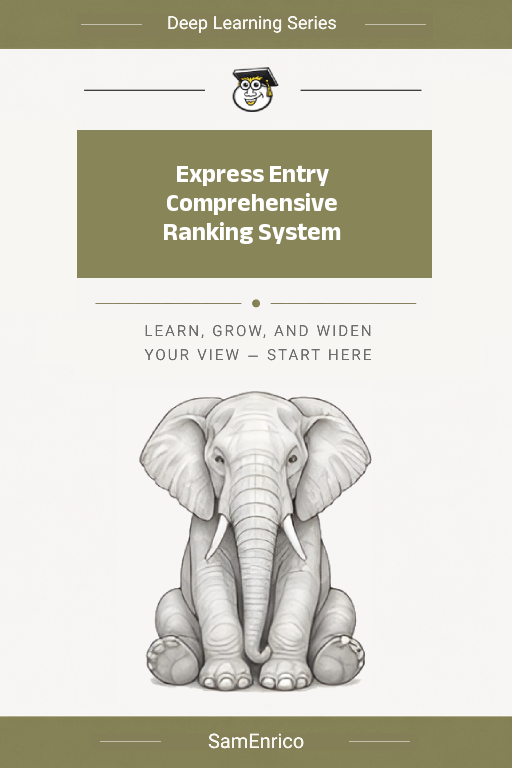
Express Entry Comprehensive Ranking System eBook
Maximize your CRS score as a Canadian graduate, ca
by Vang Breann
Maximize your CRS score as a Canadian graduate, calculating points for age, education, work experience, and language proficiency before entering the pool.
Formats
Free sample
Chapter 1: The Canadian Advantage--–- Every year, tens of thousands of foreign nationals submit their Express Entry profiles believing they are competing on a level playing field. They are wrong. The Comprehensive Ranking System (CRS) is not a neutral arbiter of human capital. It is a carefully calibrated machine that rewards certain backgrounds, penalizes others, and—most critically for you—assigns a hidden multiplier to anyone who has already spent years inside Canada’s education system and labor market. This chapter reveals why being a Canadian graduate is not merely a line on your résumé but a structural advantage that can add over one hundred points to your score before you even type your first entry into the pool.If you have ever scrolled through online immigration forums, you have likely encountered a demoralizing refrain: “CRS cutoffs are at 490.
I have a Master’s degree and three years of foreign experience, and I still cannot get an Invitation to Apply (ITA).” What those posts rarely acknowledge is that the authors are usually offshore candidates with no Canadian education, no Canadian work experience, and no Post-Graduation Work Permit (PGWP). Their CRS math operates under a different set of rules. Your math does not.The premise of this entire book rests on a single, non-negotiable truth: Canadian graduates play a different game. The points that cost a foreign applicant years of additional foreign work experience or an expensive Labor Market Impact Assessment (LMIA) are often available to you simply by showing up—by completing your degree, working legally under your PGWP, and timing your pool entry correctly. But this advantage is not automatic.
It is possible to waste it. This chapter deconstructs the CRS from the ground up, showing you exactly where your home field advantage lives and how to protect it.The Great Leveling: What Changed in March 2025Before we dive into point allocations, you need to understand a seismic policy shift that fundamentally altered the competitive landscape for Canadian graduates. In March 2025, Immigration, Refugees and Citizenship Canada (IRCC) eliminated the 50-to-200-point bonus for arranged employment backed by a Labor Market Impact Assessment. For nearly a decade, that LMIA bonus had distorted the CRS, rewarding candidates who could convince an employer to navigate a costly and time-consuming bureaucracy. The rationale was straightforward: IRCC wanted to prioritize candidates with a guaranteed job offer.
The unintended consequence was that foreign nationals with significant financial resources could effectively purchase 200 points by paying for an LMIA processing fee and legal representation.Canadian graduates, many of whom were already working under open PGWPs that did not require LMIAs, were at a distinct disadvantage in that system. An employer who had already hired a PGWP holder had little incentive to then apply for an LMIA—a process that can take six months and requires proving no Canadian or permanent resident was available for the role. The result was that Canadian graduates often found themselves competing against offshore candidates who had never set foot in Canada but had secured an LMIA-backed job offer through a global recruitment firm.The March 2025 elimination of the LMIA bonus changed everything. Today, the maximum points for a job offer are zero unless that offer is supported by a Provincial Nominee Program (PNP) or falls into an extremely narrow set of exceptions (such as NOC 00 senior management roles with a valid LMIA issued before the cutoff). For the vast majority of Canadian graduates, this means you no longer need to fight for an LMIA.
Your PGWP-supported Canadian work experience now stands on its own merit, and the 200-point advantage that offshore candidates once held is gone.This is not a minor detail. This is the foundation of your strategy. Every subsequent chapter in this book assumes that you are not chasing LMIA points. If you encounter online advice written before March 2025 that tells you to “find an employer willing to do an LMIA,” discard it immediately. That path is closed.
Your focus instead will be on the levers that actually work for Canadian graduates: Canadian work experience, language proficiency, dual credentials, provincial nominations, and category-based draws.The Four Pillars of CRS: A Canadian Graduate’s Map The CRS awards points across four broad categories. Think of these not as a shopping list but as a system of interlocking gears: turning one gear affects the others. The official names can be dry, so we will rename them in a way that reflects your strategic priorities.Pillar One: Core Human Capital (maximum 500 points for a single applicant; 460 for an applicant with an accompanying spouse)This pillar includes your age, level of education, official language proficiency (English and/or French), and Canadian work experience. For a single Canadian graduate under 30, this is where the majority of your points will come from. The maximum of 500 is achievable only if you have a Ph D, CLB 9 or higher in both English and French, and three or more years of Canadian work experience.
Few people will hit that ceiling, and you do not need to. The typical ITA cutoff hovers between 480 and 500, meaning you can be competitive with a Core Human Capital score in the low 400s provided you supplement it with points from other pillars.Pillar Two: Spouse or Common-Law Partner Factors (maximum 40 points)If you have an accompanying spouse or common-law partner, their education, language skills, and Canadian work experience can add up to 40 points. Critically, the maximum Core Human Capital score for a married applicant drops from 500 to 460, because IRCC assumes that a couple will share financial and settlement responsibilities. The net effect is that including a spouse is beneficial only if that spouse brings significant human capital of their own. Chapter 3 provides a full decision matrix.Pillar Three: Skill Transferability (maximum 100 points)This is the most misunderstood pillar and the one where Canadian graduates have the greatest hidden advantage.
Skill Transferability points are not awarded for having skills in isolation. They are awarded for combinations of skills. For example, having a university degree is worth something. Having a university degree and CLB 9 in English is worth considerably more because the combination suggests you can apply that education in a professional, English-dominant workplace. Similarly, having Canadian work experience is valuable.
Having Canadian work experience and strong official language proficiency is exponentially more valuable because it signals integration into the labor market.The maximum 100 points in this pillar come from two subcategories:Education + Language (50 points maximum): Awarded for combinations of post-secondary credentials and CLB 9 or higher.Foreign Work Experience + Language (50 points maximum): Awarded for combinations of foreign work experience and CLB 9 or higher, or Canadian work experience and CLB 9 (a separate pathway).For Canadian graduates, the most lucrative combination is Canadian work experience (at least one year) plus CLB 9, which automatically unlocks 50 Skill Transferability points. This is the hidden multiplier mentioned at the start of this chapter. A foreign applicant with the same education and language scores but no Canadian work experience cannot access these 50 points. You can.Pillar Four: Additional Points (maximum 600 points)This pillar includes provincial nominations (600 points), qualifying job offers from a PNP (not standalone LMIA), a first-degree Canadian sibling (15 points), strong French language…
This is the end of the free sample. Get the eBook to keep going. Buy now
About this book
Details
- Author
- Vang Breann
- Publisher
- SamEnrico
- Language
- English
- Genre
- Non-Fiction, Student's Shortcut
- Released
- 2026-06-01
- Pages (approx.)
- 153
- Available as
- eBook, Audiobook

Read better in the ZLOADR app
Your eBooks on your phone or tablet. Sign in with your SamEnrico account and start reading.
More by Vang Breann
 Parks Arrest RecordVang Breann$11.99
 The Retirement Housing Utility AuditVang Breann$11.99
 The Open Book Exam GuideVang Breann$11.99
 Sam Sheppard 1999 DNA TestVang Breann$11.99
 Goal Setting For BurnoutVang Breann$11.99
 Pet Loss and BirthdayVang Breann$11.99
 Nap Guided Audio GuideVang Breann$11.99
 Morning Routine for Night OwlsVang Breann$11.99
 The Jade Phoenix and the Celestial Weaver: A Love Forbidden by the HeavensVang Breann$11.99
 The Golden Quill of Leopold Sédar Senghor: Africa's Poet-PresidentVang Breann$11.99
 How to Start a Anti-pollution Vessel Service Business (Beginners Guide)Vang Breann$11.99
 How to Produce Vehicle BASE Rack SystemsVang Breann$11.99
You may also like
 Hong Kong Handover 1997Dunn Johnnie$11.99
 Zumba For Postnatal Recovery CourseNeal Christian$11.99
 Zumba for BeginnersLadner Nikia$11.99
 YouTube Comment Mining GuideHumes Pandora$12.99
 Worry Box MeditationCarlin Rudy$11.99
 Workplace Stress MeditationNguyen Lynn$11.99
 Workplace Stress and Sleep RepairHawley Ivory$11.99
 Workplace Perfectionism CureDelaney Jeffry$11.99
 Workplace Injustice Anger GuideWallen Isabelle$11.99
 Work Addiction and Burnout LinkGreenwood Ester$11.99
 Women in Yoga and WellnessBeattie Galina$11.99
 Women in Stand Up ComedyChun Evangeline$11.99