
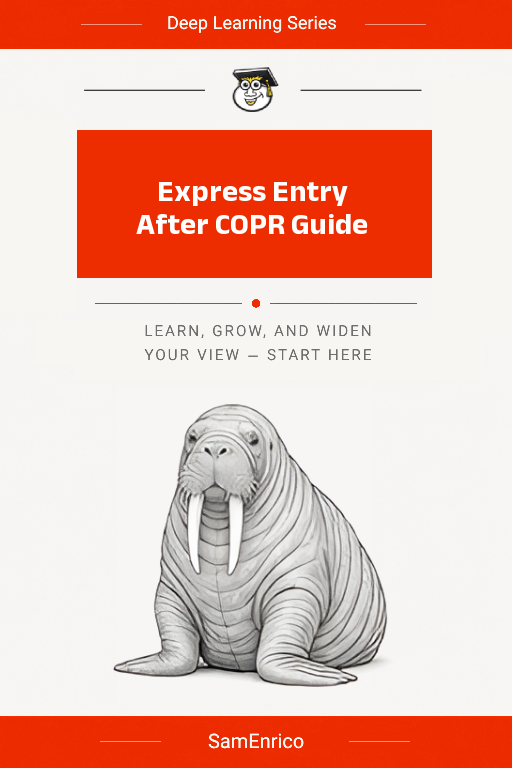
Express Entry After COPR Guide eBook
Complete landing formalities and receive your perm
Complete landing formalities and receive your permanent resident card.
Formats
Free sample
Chapter 1: The COPR Autopsy--–- Ahmed stared at his laptop screen in disbelief. The email from his immigration consultant arrived at 11:47 PM, timestamped with the kind of urgency that never precedes good news. "Ahmed, I am very sorry to inform you that your Confirmation of Permanent Residence has expired. You will need to restart the Express Entry process from the beginning."Eighteen months. Fifteen thousand dollars in legal fees, language tests, educational credential assessments, and medical exams.
Countless sleepless nights checking the IRCC portal for updates. A job offer that had already been rescinded because he couldn't provide a start date. And now, this.The reason? Ahmed had received his COPR with an expiry date of March 15th. He found a flight for March 28th that saved him $400.
He thought waiting two weeks was a smart financial decision. He was wrong. When he finally arrived at Pearson International Airport in Toronto, the border services officer took one look at his documents, shook his head, and said, "Sir, your COPR expired thirteen days ago. I cannot land you as a permanent resident."Ahmed's story is not rare. It is not an outlier.
According to internal IRCC data obtained through access-to-information requests, approximately 6% of all approved Express Entry applicants never land as permanent residents because their COPR expires before they present it at a port of entry. That represents nearly 8,000 people per year who receive the golden ticket and then watch it turn to dust in their hands.This chapter exists to ensure you are not one of them.The Single Most Important Document You Will Ever Hold The Confirmation of Permanent Residence, commonly referred to as the COPR (form numbers IMM 5688 for most applicants, or IMM 5292 for older applications), is not merely a piece of paper. It is the legal instrument that transforms you from a foreign national into a Canadian permanent resident. It carries more legal weight than the stamp in your passport, more authority than the approval letter in your IRCC account, and more consequence than any document you have submitted thus far in your immigration journey.Think of the COPR as your key to a vault. The vault contains your new life: the right to work without a permit, access to healthcare, the ability to sponsor family members, and a direct path to Canadian citizenship.
But keys are useless if they arrive after the vault has been sealed. And the COPR has a hard expiry date that no amount of pleading, legal maneuvering, or sympathetic circumstances can override.The document itself is deceptively simple. It is a one-page form printed on what looks like security paper, complete with a barcode, your photograph, and a handful of data fields. But within those fields lies every piece of information that IRCC and the Canada Border Services Agency (CBSA) will use to verify your identity and grant you entry. A single error in any of these fields can render the document invalid, delay your landing by months, or—in worst-case scenarios—require you to reapply from scratch.Anatomy of the COPR: What the Numbers and Codes Actually Mean Before we discuss how to verify your COPR, we must understand what you are looking at.
The COPR contains approximately twenty distinct data fields, but only eight of them are mission-critical. Let us dissect each one.Family Name and Given Name: This seems obvious, but the devil is in the details. Your family name must match your passport exactly, including any hyphens, spaces, or special characters. If your passport says "El-Sayed" and your COPR says "El Sayed" (with a space instead of a hyphen), you have a problem. If your passport lists your given names as "Maria Jose" and your COPR lists "Maria" only, you have a problem.
The rule is brutal but simple: the CBSA officer will compare your COPR to your passport. If they do not match character for character, you will not be landed.Passport Number and Country of Issue: Your COPR is tied to a specific passport. If you renew your passport after receiving your COPR but before landing, the COPR becomes invalid. There is no process to transfer a COPR from an old passport to a new one. You must land using the exact passport whose number appears on the COPR.
If that passport expires before your landing date, the COPR expires with it—because the hard expiry rule considers both the medical exam date and the passport expiry date, whichever comes first.Date of Birth: This field must match your passport exactly. It sounds simple, but date format confusion is surprisingly common. Canada uses the YYYY-MM-DD format. If your country uses DD-MM-YYYY, a date like 04/05/1990 could be interpreted as April 5th or May 4th. The COPR will have the Canadian format.
Verify that the year, month, and day are correct.Unique Client Identifier (UCI): This is your eight or ten-digit number that follows you throughout your entire relationship with IRCC. It appears on every document you will ever receive from the department. The UCI on your COPR should match the UCI on your approval letter, your medical exam request, and any previous work or study permits. If it does not, IRCC may have created two separate files for you, which is a logistical nightmare to resolve.Document Number: Each COPR has a unique document number, typically starting with a letter followed by numbers. This number is what IRCC uses to track your specific landing transaction.
Write it down. Keep it separate from the document itself. If your COPR is lost or stolen, this number is the only way IRCC can verify its existence and issue a replacement (though replacements for lost COPRs are extremely rare and take months).COPR Category: This code tells you which immigration program approved you. Common codes include: SW-1 (Skilled Worker, Federal Skilled Worker Program), CEC-1 (Canadian Experience Class), PNP-1 (Provincial Nominee Program), and FST-1 (Federal Skilled Trades Program). This category determines certain rights and obligations upon landing, including whether you are tied to a specific province (PNP applicants must intend to reside in the nominating province) or whether you have a specific employment requirement.Dependent Information: If you have accompanying dependents, each one will have their own COPR (including infants and young children—yes, even a two-week-old baby needs their own document).
The number of dependents listed on the principal applicant's COPR must match the number of COPRs in your possession. If you have three dependents but only four COPRs (one for you, three for them), you are missing one. If you have a dependent who is not listed, they cannot land with you and will need their own immigration process.Hard Expiry Date: This is the most important field on the entire document. The expiry date is printed clearly, usually in the upper right corner. It is the date by which you must present your COPR at a Canadian port of entry.
There are no extensions. There are no exceptions. There is no appeal process. If you arrive on the day after the expiry date, you will be refused landing, and your permanent residence application will be considered abandoned. You will need to start over from the Express Entry pool.The 5-Point…
This is the end of the free sample. Get the eBook to keep going. Buy now
About this book
Details
- Author
- Frazier Andre
- Publisher
- SamEnrico
- Language
- English
- Genre
- Non-Fiction, Student's Shortcut
- Released
- 2026-06-01
- Pages (approx.)
- 147
- Available as
- eBook, Audiobook

Read better in the ZLOADR app
Your eBooks on your phone or tablet. Sign in with your SamEnrico account and start reading.
More by Frazier Andre
 Rainforest Canopy VisualizationFrazier Andre$11.99
 The Affirmation Journal Prompt GuideFrazier Andre$11.99
 Men and Social ComparisonFrazier Andre$11.99
 The Disabled Sibling CaregiverFrazier Andre$11.99
 Gambling Peer Pressure GuideFrazier Andre$11.99
 The School Entry Vaccine ListFrazier Andre$11.99
 Sudden Infant Death SyndromeFrazier Andre$11.99
 Imposter Syndrome And AnxietyFrazier Andre$11.99
 Cold Exposure ResilienceFrazier Andre$11.99
 The Ghosts of Shiroyama: The Last Stand of the SamuraiFrazier Andre$11.99
 Whispers in the Lamp: The Djinn’s Unseen MentorshipFrazier Andre$11.99
 Soulful Foundations: The Untold Story of Motown’s Secret Studio SessionsFrazier Andre$11.99
You may also like
 Hong Kong Handover 1997Dunn Johnnie$11.99
 Zumba For Postnatal Recovery CourseNeal Christian$11.99
 Zumba for BeginnersLadner Nikia$11.99
 YouTube Comment Mining GuideHumes Pandora$12.99
 Worry Box MeditationCarlin Rudy$11.99
 Workplace Stress MeditationNguyen Lynn$11.99
 Workplace Stress and Sleep RepairHawley Ivory$11.99
 Workplace Perfectionism CureDelaney Jeffry$11.99
 Workplace Injustice Anger GuideWallen Isabelle$11.99
 Work Addiction and Burnout LinkGreenwood Ester$11.99
 Women in Yoga and WellnessBeattie Galina$11.99
 Women in Stand Up ComedyChun Evangeline$11.99