
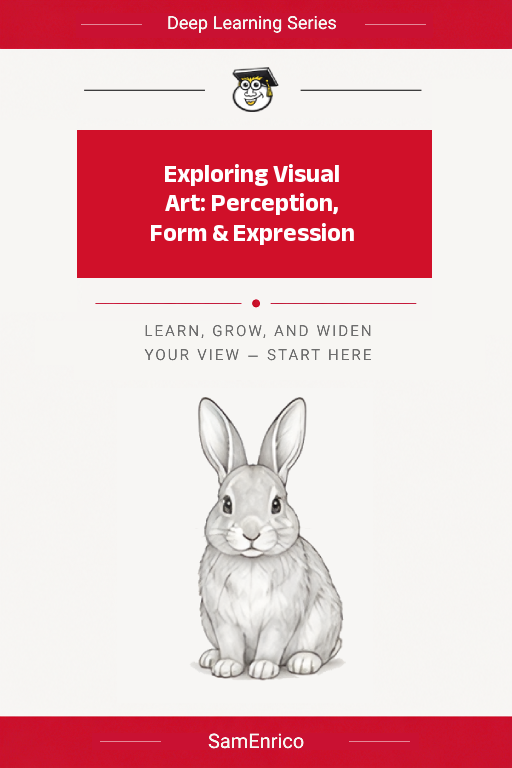
Exploring Visual Art: Perception, Form & Expression Audiobook
This publication, published by SamEnrico, covers E
by Drury Sari
This publication, published by SamEnrico, covers Exploring Visual Art: Perception, Form & Expression
Formats
Free sample
Chapter 1: The Active Lie...--–- Every morning, you wake up believing that you see the world as it really is. The coffee mug on your nightstand appears brown, round, and still. Your hand reaches out, fingers curl around the handle, and you lift it to your lips without a single conscious thought about how you managed to locate the mug, judge its distance, or coordinate your grip. This effortless fluency is the brain's greatest magic trick—and its most effective lie. You do not see the world.
You see a construction, a prediction, a carefully edited simulation that your brain builds from fragments of sensory data and massive dollops of expectation. The mug is not "brown" in any absolute sense; brown is the label your visual cortex assigns to a specific reflectance pattern under specific lighting. The mug is not "still"; your eyes are constantly making tiny saccadic movements, and your brain stitches the resulting snapshots into the illusion of stability. The mug is not even "there" in the way you think it is; what reaches your retina is a two-dimensional projection that your brain retroactively inflates into three dimensions using unconscious guesswork. This chapter dismantles the camera metaphor once and for all.
Your eye is not a lens. Your brain is not a hard drive. Perception is not recording. It is interpretation, prediction, and creative construction—and understanding this distinction is the single most important step toward visual literacy.The Myth of the Faithful Camera Every introductory art textbook warns against the "camera fallacy"—the mistaken belief that vision works like photography, with light entering the lens, exposing the film, and producing a faithful copy of the scene. But this fallacy is not merely an academic error.
It is the foundational misconception that prevents people from understanding how art works, why optical illusions fool us, and why two people can look at the same painting and see radically different things. The camera fallacy makes you a passive receiver of visual data. It suggests that seeing is easy, automatic, and truthful. It implies that what you see is what is there—no more, no less. All of these implications are false.The human eye does not work like a camera for at least five fundamental reasons.
First, the retina is not uniform like film. It has a tiny central pit called the fovea—about the size of the thumbnail at…
This is the end of the free sample. Get the Audiobook to keep going. Buy now
About this book
Details
- Author
- Drury Sari
- Publisher
- SamEnrico
- Language
- English
- Genre
- Non-Fiction, Informative, Educational
- Released
- 2026-05-08
- Pages (approx.)
- 135
- Available as
- eBook, Audiobook

Listen in the VoxFlicks app
Audiobooks and audio dramas wherever you go. Sign in with your SamEnrico account and press play.
More by Drury Sari
 Shooting Scene ReconstructionDrury Sari$11.99
 First Generation ImposterDrury Sari$11.99
 Psychiatric Survivor Rights LeaderDrury Sari$11.99
 The Startup Backup PlanDrury Sari$11.99
 Shape Peg System For Visual LearnersDrury Sari$11.99
 Judy Garland Beyond DorothyDrury Sari$11.99
 Pomodoro for ADHD MindsDrury Sari$11.99
 Distraction Free Listening EnvironmentDrury Sari$11.99
 The Visionaries of Stone: How Christopher Wren Rebuilt LondonDrury Sari$11.99
 The Curse of the Black Pharaoh: The Forgotten Tomb of SobekhotepDrury Sari$11.99
 How to Produce Porous Clay TileDrury Sari$11.99
 How to Produce Drain OpenerDrury Sari$11.99