
Non-FictionInformativeEducational
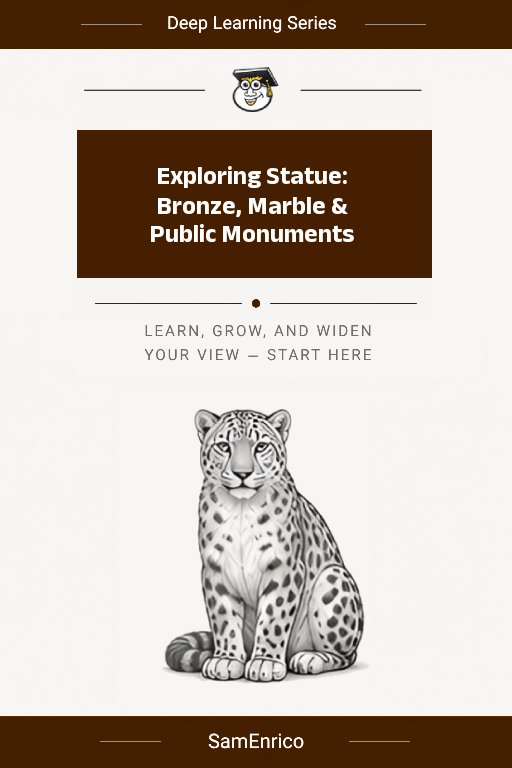
Exploring Statue: Bronze, Marble & Public Monuments
This publication, published by SamEnrico, covers E
This publication, published by SamEnrico, covers Exploring Statue: Bronze, Marble & Public Monuments
Formats
About this book
Free sample
Chapter 1: The Grammar of Stone...–- Every statue is a lie. That is the first thing you must understand. Not a malicious lie, necessarily—but a lie nonetheless. A statue freezes a single moment in time, arrests a gesture mid-motion, captures a face that will never blink, never age, never betray uncertainty. It says: This person was heroic.
This cause was just. This moment mattered. But statues do not emerge from quarries with those meanings embedded in their grain. Meaning is applied, like paint, by the hands that commission, the chisel that carves, and the eyes that behold across centuries. To learn the grammar of stone is to learn how to read those applied meanings—and, just as importantly, how to see what the statue is trying to hide.The Fundamental Difference: Painting vs.
Sculpture If you have spent years in museums looking at paintings, you have cultivated a particular skill: the ability to stand still. Paintings are designed to be viewed at. You approach a canvas, you stop at an optimal distance, and the painting reveals itself within the frame. The composition is fixed. The light is controlled.
The perspective is calculated for a single vantage point. You are a stationary eye before a stationary world.Sculpture demands the opposite. You must move. A statue is not a window into an imaginary space; it is an object occupying your actual space. It has a front, a back, a left side, a right side, a top, a bottom—and every angle tells a different story.
The profile of a nose that looks noble from the front may appear hooked from the side. A hand that seems to reach toward heaven from one angle may appear to push something away from another. The sculptor knows this. The sculptor works in the round, constantly turning the clay or circling the stone, because the statue is not finished until it works from every direction.Consider Auguste Rodin’s The Thinker. From the front, you see a man hunched in contemplation, his chin pressed against his knuckles, his brow furrowed with the weight of philosophy.…
This is the end of the free sample. Get the eBook to keep going. Buy now
Contents
- Chapter 1
- Chapter 2
- Chapter 3
- Chapter 4
- Chapter 5
- Chapter 6
- Chapter 7
- Chapter 8
- Chapter 9
- Chapter 10
- Chapter 11
- Chapter 12
Details
- Author
- Gallagher Casandra
- Publisher
- SamEnrico
- Language
- English
- Genre
- Non-Fiction, Informative, Educational
- Released
- 2026-05-08
- Pages (approx.)
- 117
- Available as
- eBook, Audiobook

Read better in the ZLOADR app
Your eBooks on your phone or tablet. Sign in with your SamEnrico account and start reading.
More by Gallagher Casandra
 Imposter Affirmation GuideGallagher Casandra$11.99
 Biotech Talent ClustersGallagher Casandra$11.99
 Student Time Blocking GuideGallagher Casandra$11.99
 New Parent Time BlockingGallagher Casandra$11.99
 The Best Startup Accounting SoftwareGallagher Casandra$11.99
 Deep Work For ResearchersGallagher Casandra$11.99
 Hypnosis Audio Equipment GuideGallagher Casandra$11.99
 The Shadow of the Ottoman: Istanbul's First Serial Killer and the Birth of Forensic ScienceGallagher Casandra$11.99
 The Jazz Oracle: How Florence Mills Defied Segregation and Stole the SpotlightGallagher Casandra$11.99
 How to Produce a Dragline ExcavatorGallagher Casandra$11.99
 Show Don't Tell Essay TechniqueGallagher Casandra$12.99
 Research Proposal Budget GuideGallagher Casandra$12.99
You may also like
 Hong Kong Handover 1997Dunn Johnnie$11.99
 Zumba For Postnatal Recovery CourseNeal Christian$11.99
 Zumba for BeginnersLadner Nikia$11.99
 YouTube Comment Mining GuideHumes Pandora$12.99
 Worry Box MeditationCarlin Rudy$11.99
 Workplace Stress MeditationNguyen Lynn$11.99
 Workplace Stress and Sleep RepairHawley Ivory$11.99
 Workplace Perfectionism CureDelaney Jeffry$11.99
 Workplace Injustice Anger GuideWallen Isabelle$11.99
 Work Addiction and Burnout LinkGreenwood Ester$11.99
 Women in Yoga and WellnessBeattie Galina$11.99
 Women in Stand Up ComedyChun Evangeline$11.99