
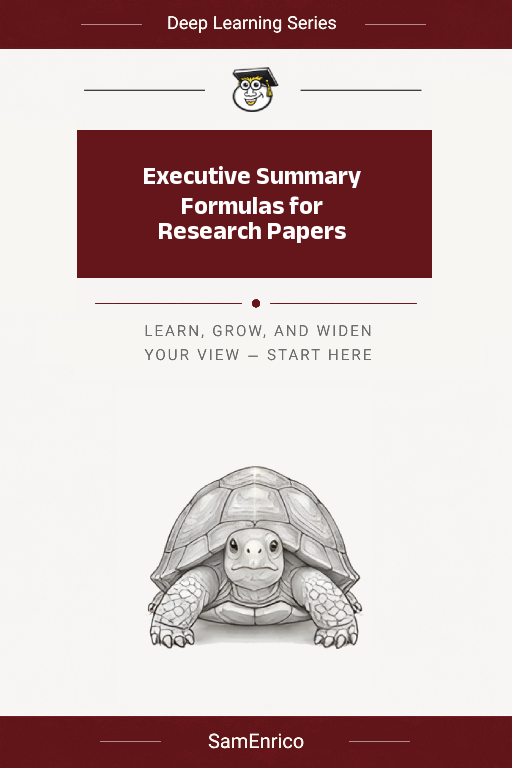
researchAcademic TranslationResearch Communication
Executive Summary Formulas for Research Papers eBook
Convert academic abstracts into executive-style su
Convert academic abstracts into executive-style summaries for industry sponsors or leadership. Translate statistical significance into business materiality and move methodology details into an optional appendix.
Formats
Free sample
Chapter 1: The Ten-Million-Dollar Comma--–- Dr. Elena Vasquez had spent eighteen months designing the perfect randomized controlled trial. She had controlled for selection bias, attrition, and every conceivable confounder. Her p-value was 0.003. Her confidence intervals were tight.
She presented her findings to the Chief Product Officer of a Fortune 500 retailer with the quiet pride of someone who had done everything right. The CPO listened for ninety seconds, nodded twice, and said: “This is very interesting.” Then he asked a question that would haunt Elena for the rest of her career: “So what?”The room went silent. Elena had prepared for questions about methodology, about external validity, about replication. She had not prepared for “so what.” She stammered through a restatement of her statistical significance. The CPO smiled politely, thanked her for her time, and moved to the next agenda item.
Her eighteen months of rigorous research were never mentioned again. Six months later, a consulting firm delivered the same finding—translated into projected annual savings of 10.4million—andreceiveda10.4 million—and received a 10.4million—andreceiveda2 million implementation contract.Elena’s story is not unusual. It happens every day in laboratories, analytics departments, and research divisions across the world. Brilliant, rigorous, statistically impeccable research dies not because it is wrong, but because it is unreadable to the people who control the budgets. The problem is not the research.
The problem is the abstract.The Peer-Review Trap Academic abstracts are written for a very specific audience: peer reviewers. Peer reviewers are methodologists. They want to know your sample size, your statistical test, your p-value, your confidence intervals, and your control variables. They want to see that you have been careful, skeptical, and appropriately modest in your claims. These are admirable goals for the peer-review process.
They are catastrophic goals for executive communication.Consider the standard structure of an academic abstract. It typically opens with a background statement, then describes the methods, then reports the results with p-values or confidence intervals, and finally offers a tentative interpretation. Here is a representative example from a real (but anonymized) published paper:*“Background: Prior research has suggested a relationship between shift length and error rates in manufacturing settings. Methods: We conducted a longitudinal observational study of 47 production lines over 14 months, using mixed-effects regression to control for line-level heterogeneity. Results: After controlling for shift type, worker experience, and seasonal demand, we found a statistically significant positive association between shifts exceeding 10 hours and error rates (β = 0.34, p < 0.01, 95% CI [0.21, 0.47]).
Conclusions: These findings suggest that extended shifts may be associated with increased errors, though further research is needed to establish causality.”*This abstract is perfectly fine for a peer-reviewed journal. A methodologist reading it would understand exactly what the researchers did, what they found, and how much confidence to place in the finding. But now imagine you are a Vice President of Manufacturing who has forty-seven other documents to read before a 2:00 PM board meeting. What do you take away from this abstract? If you are honest, you take away almost nothing of use.The VP does not care about mixed-effects regression.
The VP does not care about line-level heterogeneity. The VP does not care about your confidence intervals. The VP cares about one question: Should I change my shift policies, and if so, what will it cost or save me? That question is not answered in the abstract above. It is not even asked.The Fatal Gap: Statistical Significance ≠ Business Materiality This brings us to the central diagnostic concept of this entire book: the gap between statistical significance and business materiality.
These two concepts are often treated as synonyms in academic training. They are not synonyms. They are not even close relatives.Statistical significance tells you that an observed effect is unlikely to have occurred by random chance alone, given your sample size and assuming your model is correctly specified. It is a mathematical statement about probability. It says nothing about whether the effect matters to a human organization trying to make money, save time, reduce risk, or gain competitive advantage.Business materiality tells you whether an effect is large enough to change a business decision.
It is a judgment call that depends on context, costs, and consequences. A finding can be statistically significant at p < 0.001 and yet be completely immaterial to a business. A finding can fail conventional significance thresholds (say, p = 0.09) and yet be highly material if the potential upside is enormous.Let us make this concrete with two examples.Example 1: Statistically Significant but Immaterial Imagine you run an A/B test on a website’s checkout button color. You have a sample size of 10 million visitors per variant. You find that changing the button from blue to green increases conversion rates by 0.05 percent.
The effect is statistically significant at p < 0.0001 because your sample is enormous. But the business impact? The average order value is 50.Theannualtrafficis100millionvisitors.Theliftgeneratesanadditional50. The annual traffic is 100 million visitors. The lift generates an additional 50.Theannualtrafficis100millionvisitors.Theliftgeneratesanadditional25,000 per year in revenue.
However, implementing the change costs $50,000 in developer time and QA testing. The return on investment is negative. The finding is statistically flawless and commercially useless. It belongs in the appendix—or more likely, in the trash.Example 2: Material but Not Statistically Significant Imagine you are a pharmaceutical company deciding whether to invest in a new drug candidate. An early-stage trial with 200 patients shows a 15 percent reduction in disease progression, but the p-value is 0.09—just above the conventional 0.05 threshold.
A statistician would say the result is not statistically significant. But the potential market for this drug is 2billionperyear.Thecostofrunningadefinitive Phase3trialis2 billion per year. The cost of running a definitive Phase 3 trial is 2billionperyear.Thecostofrunningadefinitive Phase3trialis50 million. The expected value of continuing development, even with the uncertain p-value, is positive. The finding is materially important even though it fails the arbitrary 0.05 cutoff.The materiality litmus test, which we will develop fully in Chapter 3, asks a simple question: Would a 10 percent change in the magnitude of this finding change the business decision?
If the answer is no, the finding is immaterial regardless of its p-value. If the answer is yes, the finding is material regardless of its p-value.The Cost of Confusion When researchers confuse statistical significance with business materiality, the costs are not theoretical. They are measured in wasted time, missed opportunities, and damaged careers.Cost 1: Buried Insights The most common cost is the buried insight. A researcher finds something genuinely useful—a way to reduce customer churn, a predictor of equipment failure, a pricing strategy that lifts margins—but buries the business implication under layers of methodological detail. The executive reads three sentences, sees no answer to “so what?” and moves on.
The insight dies in the appendix.In our consulting practice, we have reviewed more than five hundred executive summaries written by researchers for industry sponsors. In more than 60 percent of cases, the most commercially valuable finding was not in the first three sentences. In nearly 30 percent of cases, it was not in the first paragraph. And in 12 percent of cases, the commercially valuable finding was not in the executive summary at all—it was buried in a table on page seven.Cost 2: The “Interesting, But So What?” Rejection The…
This is the end of the free sample. Get the eBook to keep going. Buy now
About this book
Details
- Author
- Dickens Cassi
- Publisher
- SamEnrico
- Language
- English
- Genre
- research, Academic Translation, Research Communication
- Released
- 2026-05-29
- Pages (approx.)
- 151
- Available as
- eBook, Audiobook

Read better in the ZLOADR app
Your eBooks on your phone or tablet. Sign in with your SamEnrico account and start reading.
More by Dickens Cassi
 Tension Headache ReliefDickens Cassi$11.99
 Overcoming Plateaus HypnosisDickens Cassi$11.99
 The Late Career LegacyDickens Cassi$11.99
 Self Esteem During SeparationDickens Cassi$11.99
 Land Lease Retirement CommunitiesDickens Cassi$11.99
 The Silk Road to the Amazon: Ibn Battuta’s Lost ExpeditionDickens Cassi$11.99
 The Unseen Hand: How a 19th-Century Lawsuit Changed the WorldDickens Cassi$11.99
 Understanding Facial Dysmorphism Shawl Scrotum Joint Laxity SyndromeDickens Cassi$17.99
 Procurement Outsourcing GuideDickens Cassi$12.99
 How to Become a Molding-machine OperatorDickens Cassi$11.99
 Painter and DecoratorDickens Cassi$11.99
You may also like
 Scientific Research On TM GuideMartens Nathanial$11.99
 Research Proposal Methodology Section MasteryPauley Debroah$11.99
 Research Proposal Appendix CompilationRaines Tyisha$11.99
 Academic Researcher Distraction GuideFord Virgil$11.99
 TM Research and ScienceCovert Nicki$11.99
 Social Anxiety Research ReviewRoberge Cole$11.99
 Research Proposal Significance Section GuideBock Tory$12.99
 Research Proposal Reviewer PsychologyLugo Tawanda$11.99
 Research Proposal Research Questions DesignLara Robbi$11.99
 Research Proposal References and CitationsPatten Shanice$11.99
 Research Proposal Mixed Methods DesignCameron Omega$11.99
 Research Proposal Data Management PlanAnderson Roberto$12.99