
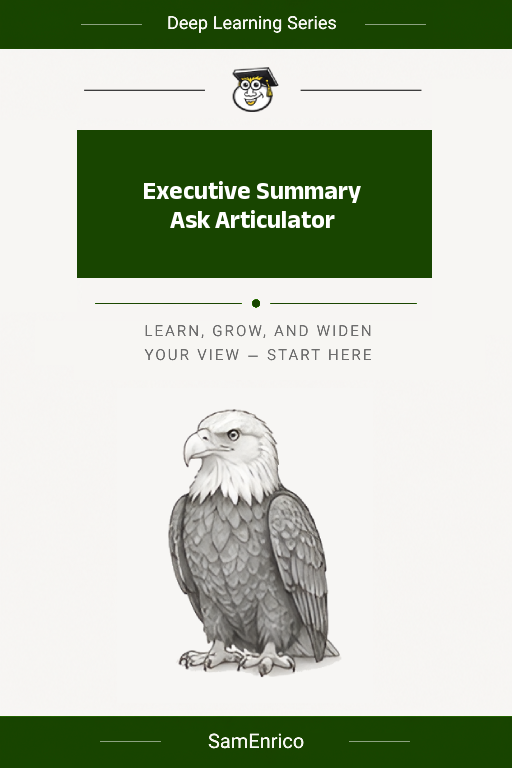
Non-FictionProfessional's Cheat SheetDecision Support
Executive Summary Ask Articulator eBook
Frame your specific request for resources, approva
by Stein Dalia
Frame your specific request for resources, approvals, or decisions so clearly that executives can respond with a single yes or no.
Formats
Free sample
Chapter 1: The Narrative Trap--– You are about to make a request. You have been working on this for weeks. You have the data, the slides, the logic, the passion. You walk into the executive’s office—or more likely, you join the video call—and you begin. You start at the beginning, because that is where stories start.
“Three months ago, we noticed a trend in customer behavior…” You explain the background, the context, the research, the alternatives you considered, the one you chose, and finally, finally, you arrive at what you actually need. “So if you could just approve this budget reallocation, we can move forward.”The executive looks at you. They say, “Let me think about it.”And nothing happens. For days. Weeks.
Maybe forever.You have just lost to the Narrative Trap.This chapter is not about how to write better emails or build better slide decks. It is about something more fundamental: the gap between how humans naturally communicate and how executives actually decide. That gap is where careers go to die. Not because your ideas are bad. Not because executives are mean or distracted or stupid.
Because you and the executive are playing two different games. You are playing the “tell a complete story” game. They are playing the “make a decision as fast as possible with minimal risk” game. Those games are not the same. They are not even compatible.The good news is that the fix is simple.
Not easy—simple. You do not need more charisma, more data, or more political savvy. You need a different structure. You need to learn to ask differently. This book is that structure.
And it starts with understanding why your current approach is failing so dramatically.The $1.2 Trillion Silence Let us begin with a number that should make you uncomfortable: $1.2 trillion.That is the estimated annual cost of workplace miscommunication in the Fortune 500 alone. Let that number sit for a moment. One point two trillion dollars. Not spent on salaries, not spent on products, not spent on innovation. Spent on rework, clarification meetings, follow-up emails, and stalled projects.
Spent on the gap between what someone meant to ask and what someone else heard.Where does this number come from? It is a synthesis of two credible streams of research. First, Gallup’s State of the American Workplace estimates that actively disengaged employees cost the U.S. economy approximately 500billionannually.Asignificantdriverofthatdisengagementisunclearexpectations—peoplewhodonotknowwhatisbeingaskedofthem,orwhohavelearnedthataskingforclarityispunishedratherthanrewarded.Second,Mc Kinseyresearchonknowledgeworkproductivityestimatesthatemployeesspendnearly20percentoftheirtime—onefulldayperweek—searchingforinformationorclarifyingmisunderstoodrequests.Thataddsuptoroughly500 billion annually. A significant driver of that disengagement is unclear expectations—people who do not know what is being asked of them, or who have learned that asking for clarity is punished rather than rewarded.
Second, Mc Kinsey research on knowledge work productivity estimates that employees spend nearly 20 percent of their time—one full day per week—searching for information or clarifying misunderstood requests. That adds up to roughly 500billionannually.Asignificantdriverofthatdisengagementisunclearexpectations—peoplewhodonotknowwhatisbeingaskedofthem,orwhohavelearnedthataskingforclarityispunishedratherthanrewarded.Second,Mc Kinseyresearchonknowledgeworkproductivityestimatesthatemployeesspendnearly20percentoftheirtime—onefulldayperweek—searchingforinformationorclarifyingmisunderstoodrequests.Thataddsuptoroughly700 billion in wasted labor. Together, these two streams point to a $1.2 trillion problem. (Full methodology and citations are available in Appendix A.)But numbers this large are hard to feel. So let us make it smaller.
Let us make it personal.Think about the last request you made that went nowhere. Maybe you asked for budget. Maybe you asked for a hiring exception. Maybe you asked for a strategic pivot. You wrote an email.
You built a deck. You scheduled a meeting. You presented your case. And the executive said, “Let me think about it,” or “Can you send me more information?” or “Let’s circle back next quarter.” And then nothing.Now calculate what that cost you. Not in dollars—in time.
How many hours did you spend preparing? How many hours did you spend waiting? How many hours did you spend in follow-up meetings that only created more questions? How many opportunities died while you waited? How many nights did you lie awake wondering what you did wrong?That is the cost of the Narrative Trap.
And you have been paying it for years.Why Your Brain Betrays You Here is the cruel irony: you are not bad at communicating. You are actually quite good at it. You have been trained your entire life to communicate in a specific way—a way that works beautifully in some contexts and fails catastrophically in others.Think about how you learned to communicate. In school, you wrote five-paragraph essays. Introduction, three supporting paragraphs, conclusion.
You told stories around the dinner table. “Guess what happened to me today?” Then you narrated the events in chronological order. You were rewarded for being thorough, for providing context, for building to a climax. These are the communication patterns of human connection. They are warm, human, and utterly wrong for executive decision-making.Executives do not process information the way the rest of us do.
They cannot afford to. The average senior executive receives over 150 emails per day. They attend six to eight hours of meetings. They are pulled in twenty different directions by twenty different people, each of whom believes their request is the most urgent. Their cognitive load is not merely high—it is unsustainable.Neuroscience tells us why this matters.
The human brain has two primary modes of processing information. Daniel Kahneman, in his seminal work Thinking, Fast and Slow, calls them System 1 and System 2. System 1 is fast, intuitive, automatic, and energy-efficient. It is the brain’s default mode. System 2 is slow, deliberate, analytical, and exhausting.
It requires conscious effort.Here is what you need to know: executives live in System 1. They have to. If they engaged System 2 for every decision, they would never get through a single day. They rely on pattern recognition, heuristics, and rapid filtering to survive. When you approach an executive with a request, you are not asking for their attention.
You are asking for their cognitive energy. And cognitive energy is the scarcest resource in the executive suite.Your unfocused narrative—your three months of background, your context, your alternatives—forces the executive to engage System 2. They have to hold multiple pieces of information in working memory. They have to infer what you are actually asking for. They have to filter signal from noise.
This is effortful. And the brain, being an efficient machine, resists effort. It looks for an escape.That escape is called “Let me think about it.”The executive is not being rude. They are not trying to frustrate you. Their brain is protecting them from cognitive overload.
They are outsourcing the effort back to you. And because you have given them no clear structure for saying yes, they default to the safer option: saying no, disguised as delay.The Parking Lot Principle Let me introduce a metaphor that will run through this entire book: the Parking Lot Principle.Imagine you are driving to a grocery store. You pull into the parking lot. The lines are clearly painted. There are arrows indicating direction.
Spaces are marked. You know exactly where to park. You pull in, turn off the engine, and walk to the store. The whole process takes maybe fifteen seconds of active decision-making.Now imagine the same parking lot with no lines. No…
This is the end of the free sample. Get the eBook to keep going. Buy now
About this book
Details
- Author
- Stein Dalia
- Publisher
- SamEnrico
- Language
- English
- Genre
- Non-Fiction, Professional's Cheat Sheet, Decision Support
- Released
- 2026-06-01
- Pages (approx.)
- 135
- Available as
- eBook, Audiobook

Read better in the ZLOADR app
Your eBooks on your phone or tablet. Sign in with your SamEnrico account and start reading.
More by Stein Dalia
 The Emotion Diary Card CourseStein Dalia$11.99
 Plane Hijacking SurvivorStein Dalia$11.99
 Boardroom Presentation Calm GuideStein Dalia$11.99
 Digital Age Parental Anger TriggersStein Dalia$11.99
 Panic Disorder Medication ManualStein Dalia$11.99
 The Last Broadcast: The Mysterious Case of the War of the Worlds PanicStein Dalia$11.99
 Neon Oracle: The AI That Dreamed the FutureStein Dalia$11.99
 Understanding Brachioskeletogenital SyndromeStein Dalia$17.99
 Workday Remote HR Intern GuideStein Dalia$12.99
 Community Manager (Games)Stein Dalia$11.99
 How to Start a Sailing Club without Marinas BusinessStein Dalia$11.99
You may also like
 Hong Kong Handover 1997Dunn Johnnie$11.99
 Zumba For Postnatal Recovery CourseNeal Christian$11.99
 Zumba for BeginnersLadner Nikia$11.99
 YouTube Comment Mining GuideHumes Pandora$12.99
 Worry Box MeditationCarlin Rudy$11.99
 Workplace Stress MeditationNguyen Lynn$11.99
 Workplace Stress and Sleep RepairHawley Ivory$11.99
 Workplace Perfectionism CureDelaney Jeffry$11.99
 Workplace Injustice Anger GuideWallen Isabelle$11.99
 Work Addiction and Burnout LinkGreenwood Ester$11.99
 Women in Yoga and WellnessBeattie Galina$11.99
 Women in Stand Up ComedyChun Evangeline$11.99