
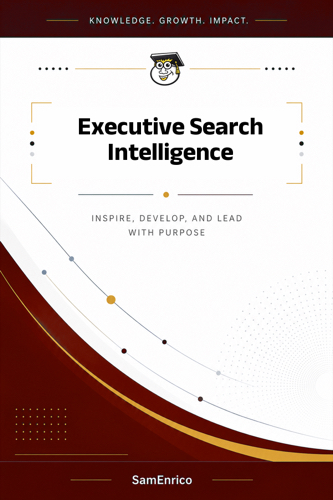
Non-FictionStrategic AtlasExecutive Search
Executive Search Intelligence eBook
Reveal how fast growing firms recruit C suite and
by Teel Cris
Reveal how fast growing firms recruit C suite and VP level talent.
Formats
Free sample
Chapter 1: The Speed Trap--The voicemail arrived at 11:47 PM on a Tuesday. The founder's voice was hoarse, like he had been shouting or crying—or both. "We need to terminate the COO. Effective immediately. I don't care about the severance.
Just make it go away."Nine months earlier, this same founder had been euphoric. He had just closed a $60 million Series C round. His software company was growing at 70 percent annually. And he had done what every investor, every board member, and every business article told him to do: he hired "adult supervision." A Fortune 500 COO with twenty years of experience, an MBA from a top program, and a reputation for operational excellence.The COO arrived with a ninety-day plan, a binder of process improvements, and a quiet confidence that impressed everyone in the room. He spoke about "scaling infrastructure," "implementing KPIs," and "professionalizing the organization." The founder sat back and thought: Finally, someone who knows what they are doing.Within six months, revenue growth had slowed from 70 percent to 22 percent.
Three key engineers had resigned. The product roadmap had frozen while the COO implemented a "stage-gate approval process." And the founder—who had built the company from nothing in his garage—found himself spending more time mediating conflicts than talking to customers.The COO was not incompetent. His references had been flawless. His track record was impeccable. He had transformed operations at two different Fortune 500 companies, generating hundreds of millions in efficiency gains.
He was, by every traditional measure, a perfect hire.He was also the wrong hire.Not because of anything he did wrong. Because of where he did it. The systems and processes that made him a hero at a fifty-thousand-person corporation made him a villain at a two-hundred-person hypergrowth startup. He was a master of operational efficiency hired to lead chaotic innovation. He was a chess grandmaster brought in to coach a rugby team.The cost of that misalignment?
Forty million dollars in burned capital. Three irreplaceable engineers. An eighteen-month setback in product development. And a founder who swore he would never hire another "experienced executive" again—which was exactly the wrong lesson to take.This is the Speed Trap. And nearly every fast-growing company falls into it.The Paradox That Kills Growth Here is the central truth of this book, stated as simply as possible: The faster your company grows, the slower and more deliberate your executive hiring must become.This is not intuitive.
In fact, it feels wrong. When a company is growing at forty, sixty, or eighty percent annually, every instinct screams for speed. The product team is overwhelmed. Customer support is drowning. Sales is leaving money on the table.
The founder feels like they are drinking from a fire hose, and the natural response is to hire someone—anyone—who can grab the hose and point it somewhere useful.But that instinct is precisely wrong. It is the Speed Trap.Traditional hiring methods were designed for stable or slowly changing environments. They assume that the problems you have today will be roughly the same as the problems you will have in twelve months. They assume that a candidate who succeeded in a similar role two years ago will succeed in this role now. They assume that the structure of the organization, the demands of the market, and the capabilities of the team will remain relatively constant.Hypergrowth destroys every single one of these assumptions.In a company growing at forty percent annually, the problems you have at the beginning of the year are not the same problems you have at the end.
The team you inherit is not the team you will lead. The market you understand today will be unrecognizable in twelve months. And the candidate who was perfect for your VP of Sales role six months ago would be completely wrong for the same role today, because the role itself has transformed.This is not theory. This is pattern recognition from studying hundreds of hypergrowth companies across software, consumer goods, financial services, and manufacturing. The companies that survive and thrive learn to slow down their executive hiring process even as everything else accelerates.
The companies that crash and burn hire fast, rationalize their mistakes as "learning experiences," and then make the same mistake again with the next role.The Speed Trap can be summarized in a single sentence: Velocity without vector is chaos. Precision is the only sustainable source of speed.The Two Failure Windows Before we go any further, we need to understand when and why executive hires fail in hypergrowth environments. This is not academic. The data behind this chapter comes from analyzing executive searches at over two hundred high-growth companies, tracking outcomes for more than four thousand C-suite and VP-level hires.The findings are stark and consistent across industries.Executive failures in hypergrowth companies cluster around two distinct timelines. There is almost nothing in between.
You either lose an executive in the first six months, or you lose them between months twelve and eighteen. Executives who survive past eighteen months tend to stay for years—they have weathered the transition and become part of the fabric of the company.Early Failure: Months Four to Six The first failure window, months four to six, is driven by cultural capital depletion. This is a concept we will explore in depth in Chapter Eleven, but the short version is this: every new executive arrives with a bank account of goodwill. Their title gives them formal authority. Their reputation gives them initial trust.
Their mandate from the founder gives them permission to make changes.But every change they make withdraws from that bank account. Every conflict they resolve costs goodwill. Every process they implement, every person they fire, every decision they make without consulting a long-tenured employee—all of it draws down cultural capital.If the executive spends cultural capital faster than they earn it, they go bankrupt somewhere between month four and month six. They are not fired for incompetence. They are fired because they have alienated everyone they need to work with.
The founder loses confidence. The team stops cooperating. The executive becomes isolated, frustrated, and eventually useless.Early failures are preventable. They are almost always the result of poor onboarding, insufficient listening, or a mismatch between the executive's style and the founder's expectations. Chapter Eleven is devoted entirely to preventing this specific failure mode through the Bamboo Protocol.Delayed Failure: Months Twelve to Eighteen The second failure window, months twelve to eighteen, is driven by structural misalignment.
This is the deeper, more insidious problem that this chapter exists to address.Delayed failures occur when an executive was hired for the problems of today but cannot adapt to the problems of tomorrow. They are excellent at the role they were hired to do. They deliver on their initial mandate. They earn the trust of the team and the founder. And then, somewhere between the first and second year, the company changes around them.Consider a VP of Engineering hired when the company had eighty engineers and a chaotic but functional development process.
Eighteen months later, the company has two hundred engineers, and the chaos has become unmanageable. The skills that made the…
This is the end of the free sample. Get the eBook to keep going. Buy now
About this book
Details
- Author
- Teel Cris
- Publisher
- SamEnrico
- Language
- English
- Genre
- Non-Fiction, Strategic Atlas, Executive Search
- Released
- 2026-06-08
- Pages (approx.)
- 151
- Available as
- eBook, Audiobook

Read better in the ZLOADR app
Your eBooks on your phone or tablet. Sign in with your SamEnrico account and start reading.
More by Teel Cris
 The Complicated Grief Couple GuideTeel Cris$11.99
 Beginner Mindfulness for Dentist AnxietyTeel Cris$11.99
 Peter Cartwright Methodist CircuitTeel Cris$11.99
 The Virtual Watercooler GuideTeel Cris$11.99
 The Scarlet Letter of Power: The Untold Story of Queen Elizabeth I’s SpymasterTeel Cris$11.99
 How to Start a Calendering of Textiles Business (Beginners Guide)Teel Cris$11.99
 Understanding Subvalvular Aortic StenosisTeel Cris$17.99
 Desert Ironwood HarvestingTeel Cris$11.99
 Technology IP Valuation GuideTeel Cris$12.99
 Fairtrade Shea Butter ExportTeel Cris$12.99
You may also like
 Hong Kong Handover 1997Dunn Johnnie$11.99
 Zumba For Postnatal Recovery CourseNeal Christian$11.99
 Zumba for BeginnersLadner Nikia$11.99
 YouTube Comment Mining GuideHumes Pandora$12.99
 Worry Box MeditationCarlin Rudy$11.99
 Workplace Stress MeditationNguyen Lynn$11.99
 Workplace Stress and Sleep RepairHawley Ivory$11.99
 Workplace Perfectionism CureDelaney Jeffry$11.99
 Workplace Injustice Anger GuideWallen Isabelle$11.99
 Work Addiction and Burnout LinkGreenwood Ester$11.99
 Women in Yoga and WellnessBeattie Galina$11.99
 Women in Stand Up ComedyChun Evangeline$11.99