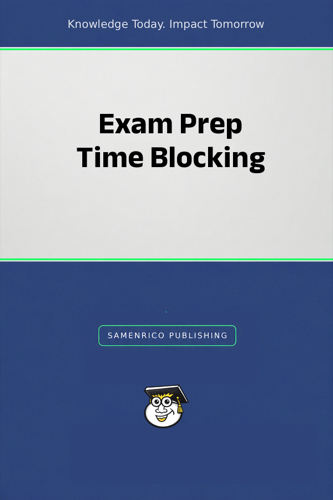
Exam Prep Time Blocking eBook
Reviews subjects in spaced repetition blocks.
Reviews subjects in spaced repetition blocks.
Formats
Free sample
Chapter 1: The 24-Hour Thief--You have already forgotten most of what you learned yesterday.Not because you are lazy. Not because you are distracted. Not because you lack discipline or intelligence or the right “study mindset.” You have forgotten because your brain was designed to forget. That is its job. The real miracle is not memory—it is that you remember anything at all.Let that land for a moment.Every time you sit down to study, you are fighting a war against your own biology.
And right now, you are losing. Not because you aren’t trying. You are probably trying harder than ever. You are losing because you are using weapons that were obsolete a century ago while your enemy—the forgetting curve—has been perfecting its strategy for 200,000 years.This chapter will show you exactly how that enemy works, why cramming is the study equivalent of setting money on fire to keep warm, and how a simple shift in timing can turn you from a victim of forgetting into someone who remembers what matters, when it matters, for as long as it matters.The Story of Sarah Let me tell you about a student I’ll call Sarah.Sarah is a pre-med sophomore. She is not lazy.
She wakes up at 6:00 AM, goes to class until noon, studies in the library until 6:00 PM, eats dinner, studies again until 10:00 PM, and goes to bed. She does this six days a week. Her parents are proud of her. Her roommate thinks she is a machine. And Sarah believes that if she just works harder—longer hours, more highlighters, more rereading—she will eventually break through and get the A’s she needs for medical school.But here is what Sarah does not say out loud.
She studies for eight hours and cannot remember what she read two days ago. She rereads a chapter three times and still blanks on the practice questions. She pulled an all-nighter before her organic chemistry midterm, felt confident walking into the exam, and got a 62%. Two weeks later, she could not tell you the difference between an SN1 and SN2 reaction.Sarah is not stupid. She is using study methods that are scientifically broken.She is not alone.
Over 90% of college students report using rereading and highlighting as their primary study strategies. The same percentage report feeling like those strategies do not work. And yet they keep doing them, because no one ever taught them the alternative. The average student graduates high school having received exactly zero hours of instruction on how memory actually works. They are expected to learn for twelve years without ever being told what learning is.This book ends that silence.The Forgetting Curve: Your Brain’s Built-In Enemy In the 1880s, a German psychologist named Hermann Ebbinghaus did something that no one had thought to do before.
He decided to study memory scientifically—not as philosophy, not as introspection, but as measurable, repeatable data. He invented 2,300 nonsense syllables (like “ZOF” and “KAD”) so that prior knowledge would not contaminate his results. Then he memorized lists of them and tested himself at different intervals.What he discovered became the foundation of everything we know about memory today.Ebbinghaus documented what he called the forgetting curve. It looks like a steep ski slope that starts high and drops fast. Immediately after learning something, your memory is at 100%.
One hour later, if you have done no review, you have forgotten approximately 50% of what you learned. Twenty-four hours later, you have forgotten approximately 70%. After one week, with no reinforcement, you are down to about 20-25%.Here is the graph in words: you lose half of new information within sixty minutes and three-quarters within a day.Let that sink in. If you study for two hours today and do nothing with that material tomorrow, by the time you wake up on Thursday, you have essentially wasted 70% of your effort. You worked.
You sat in the chair. You turned the pages. And your brain looked at all that work and said, “Apparently this isn’t important” and deleted it.This is not a flaw in your brain. It is a feature.Your brain is not a hard drive. It is not designed to store everything you encounter.
It is designed to survive. From an evolutionary perspective, remembering the location of water sources and the faces of predators was important. Remembering the capital of North Dakota or the formula for the area of a circle was not. Your brain is constantly making a calculation: “Is this information likely to be needed again? If yes, keep it.
If no, delete it to save energy.”The problem is that your brain uses a very crude metric to make that calculation. It asks one question: “How many times have I been asked to retrieve this information?”If you have retrieved it recently and successfully, your brain thinks: “This must be important. Strengthen the connection.” If you have not retrieved it, your brain thinks: “This must be junk. Prune the connection.”This is called use-dependent retention. The more you practice retrieving a memory, the stronger it gets.
The less you retrieve it, the faster it decays. And here is the brutal part: rereading does not count as retrieval. Rereading is passive exposure. Your brain can be exposed to a sentence one hundred times and still not flag it as important if you never have to pull it out of storage on your own.The Cramming Trap: Why Hard Work Feels Like Progress Cramming feels productive. There is a reason for this.
When you sit down the night before an exam and spend six hours rereading your notes and highlighting your textbook, you are flooding your brain with familiarity. The information passes in front of your eyes again and again. It feels warm. It feels known. You close the book and think, “I’ve got this.”That feeling is an illusion.Psychologists distinguish between familiarity and recall.
Familiarity is the sense that you have seen something before. You walk down the street and see a face that looks familiar—you cannot name the person, but you know you know them. That is familiarity. Recall is the actual ability to produce the information from scratch—to name the face, to write the formula, to explain the concept without cues.Cramming produces familiarity. Exams test recall.This is why students so often walk out of exams feeling confident and then get crushed by their scores.
They were not overconfident. They were correctly reporting their feeling of familiarity. They did not realize that familiarity is not the same as knowing. The exam did not ask, “Have you seen this before?” It asked, “Can you produce this from nothing?” And cramming does almost nothing to build that ability.The numbers are damning. Students who cram for an exam typically forget 80-90% of the material within 48 hours of the test.
Not weeks. Days. Forty-eight hours. That means the knowledge you thought you earned by pulling an all-nighter evaporates before your professor has even finished grading. You did not learn.
You rented the information for seventy-two hours and then returned it.Even worse, cramming creates interference. When you stuff your brain…
This is the end of the free sample. Get the eBook to keep going. Buy now
About this book
Details
- Author
- Saylor Patrick
- Publisher
- SamEnrico
- Language
- English
- Genre
- Non-Fiction, Self-Help, Exam Prep
- Released
- 2026-06-06
- Pages (approx.)
- 128
- Available as
- eBook, Audiobook

Read better in the ZLOADR app
Your eBooks on your phone or tablet. Sign in with your SamEnrico account and start reading.
More by Saylor Patrick
 Retail Space Lease NegotiationSaylor Patrick$11.99
 Stop Interrupting Yourself CourseSaylor Patrick$11.99
 Desert Oasis EscapeSaylor Patrick$11.99
 Miscarriage Prolonged GriefSaylor Patrick$11.99
 Energy Efficient Depreciation BonusSaylor Patrick$11.99
 Memory for TeachingSaylor Patrick$11.99
 Loving Kindness for a One Night StandSaylor Patrick$11.99
 Vietnam Dustoff MedicSaylor Patrick$11.99
 Whispers of the Black Stone: The Lost Rites of the DruidsSaylor Patrick$11.99
 The Last Transmission: The Titanic’s Wireless Operators and Their Final BroadcastsSaylor Patrick$11.99
 The Iron Makers of the Sahel: Forging the Future of AfricaSaylor Patrick$11.99
 Understanding Allergic Autoimmune ThyroiditisSaylor Patrick$17.99