
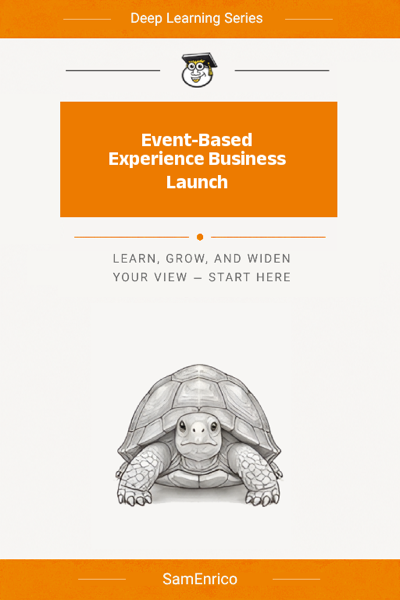
Non-FictionInformativeEducational
Event-Based Experience Business Launch eBook
A Coursebook on Event-Based Experience Business La
by Bauman Tana
A Coursebook on Event-Based Experience Business Launch
Formats
Free sample
Chapter 1: The Order-Taker’s Graveyard...--–- The voicemail arrived at 11:47 PM on a Tuesday. "Hey, it's Melissa from the Smith wedding. I know we signed the contract for 12,000,butmycousin′sfriendsaidshecandothesamethingfor12,000, but my cousin's friend said she can do the same thing for 12,000,butmycousin′sfriendsaidshecandothesamethingfor3,500. Can we cancel? I'm really sorry."Three months of work—venue sourcing, vendor negotiations, timeline building, twelve vendor contracts, four client meetings, and one tearful debate over napkin colors—evaporated in seventeen seconds.
The bride did not apologize for wasting your time. She apologized for the inconvenience of canceling. There is a difference, and it tells you everything about the value of what you were selling.You were selling a service. Services are replaceable. Services are price-shopped.
Services leave you lying awake at 2 AM wondering why you worked sixty hours to make 2,000inprofitwhilethebride′scousin′sfriend—whohasnoinsurance,nobackupplan,andnobusinesslicense—isabouttoruinaweddingfor2,000 in profit while the bride's cousin's friend—who has no insurance, no backup plan, and no business license—is about to ruin a wedding for 2,000inprofitwhilethebride′scousin′sfriend—whohasnoinsurance,nobackupplan,andnobusinesslicense—isabouttoruinaweddingfor3,500 and face zero consequences because no one signed a contract that meant anything.This chapter is about why that voicemail exists, why it will keep happening, and how to build a business that never receives it again.The Graveyard Is Full of People Who Were Really Good at Logistics Before we build anything, we need to walk through a graveyard. It is not a physical place. It is a professional condition. It is where event professionals go when they mistake busyness for business.Walk with me.In this graveyard, you will find the wedding planner who booked forty-two weddings last year and made less than a full-time barista because she kept discounting her "day-of coordination" package to beat the competitor down the street. She was excellent at timelines.
She died financially.You will find the corporate event manager who planned flawless product launches for a tech company, got laid off, and tried to start her own firm—only to discover that her entire network saw her as "the person who executes," not "the person who creates." She knew every hotel ballroom in the city. She had no ideas of her own.You will find the nonprofit gala producer who could manage five hundred volunteers but could not name a single proprietary experience he owned. When the nonprofit cut his budget, he had nothing to sell. His skills were entirely transferable to anyone who paid him. That is the problem.
Transferable skills are rentable, not ownable.You will find the pop-up market organizer who built a beloved local event with eighty vendors and two thousand attendees—and then watched a competitor copy every single element, launch two months earlier, and steal half her vendors because there was no intellectual property, no trademark, no barrier to entry. She built a parking lot. Someone else built a slightly shinier parking lot next door.And you will find the person reading this book who has not yet launched anything, paralyzed by the fear that their idea is not special enough to charge for. That person is standing at the gate of the graveyard, not yet inside, but walking toward it slowly because no one has handed them a map out.Here is the map.The Progression That Changes Everything There is a framework that explains why the order-taker's graveyard exists. It is called the Progression of Economic Value, and it was first articulated by strategists Pine and Gilmore in their seminal work on the experience economy.
You do not need to remember their names. You need to internalize their insight.The progression has five rungs. Each rung represents a different type of economic offering. Each rung has a different pricing power, different customer loyalty, and different vulnerability to commoditization.Rung One: Commodities. These are raw, undifferentiated materials—wheat, copper, crude oil.
You cannot brand a commodity. You cannot charge a premium for a commodity. You can only compete on price. The moment someone offers cheaper wheat, you lose.Rung Two: Goods. These are physical products—a hammer, a t-shirt, a bottle of water.
Goods can be branded. Nike sells a t-shirt for 40thatcosts40 that costs 40thatcosts4 to make. That is branding power. But goods are still vulnerable. A competitor can make a very similar shirt for $35.
The gap closes.Rung Three: Services. This is where most event professionals live. A service is an activity performed for a client—planning a wedding, managing a conference, booking a venue. Services have higher margins than goods, but they are still fundamentally replaceable. Your client is buying your time and expertise.
Time is finite. Expertise can be learned. The bride's cousin's friend can claim to offer the same service for less. Sometimes she can even deliver it. Not well, but cheaply—and cheap is a powerful drug.Rung Four: Experiences.
An experience is not an activity performed for a client. An experience is a memorable event that engages the client personally. When you buy a service, you pay for time and output. When you buy an experience, you pay for a memory. Memories cannot be price-shopped the same way services can.
No one says, "I found a cheaper memory of my child's birthday party." Experiences create emotional differentiation.Rung Five: Transformations. A transformation is an experience that changes the customer permanently. A fitness retreat that alters your health. A financial workshop that changes your spending habits. A grief ritual that reshapes how you mourn.
Transformations are the most pricing-powerful offering of all. People pay extraordinary sums to become a different person.Here is the brutal truth that most event business books will not tell you: Ninety percent of event professionals are stuck on Rung Three. They sell services. They compete on price. They burn out.The other ten percent have figured out how to climb.The Commodity Trap Diagnostic Before you read another word, take sixty seconds to diagnose whether your current idea—or your existing business—is sitting in the order-taker's graveyard.Answer these ten questions honestly.One: If a client described what you do to a friend, would they say "she plans events" or would they say a specific, memorable phrase like "she runs the silent disco hiking trips"?
If the first, write one point. If the second, write zero.Two: Do you have a single, ownable element—a name, a ritual, a format, a trademarked phrase—that appears in every event you produce? If no, one point. If yes, zero.Three: Have you ever lost a client to someone who charged less but offered an identical service? If yes, one point.
If no, zero.Four: Could a moderately organized person with a spreadsheet and a willingness to make phone calls replicate your core offering within three months? If yes, one point. If no, zero.Five: Do you spend more than fifty percent of your working hours on logistics, coordination, and vendor management rather than creative design? If yes, one point.Six: When you tell strangers what you do, do they immediately ask "oh, so you plan weddings?" with a tone that suggests they already understand your entire business model? If yes, one point.Seven: Have you ever discounted your price to win a…
This is the end of the free sample. Get the eBook to keep going. Buy now
About this book
Details
- Author
- Bauman Tana
- Publisher
- SamEnrico
- Language
- English
- Genre
- Non-Fiction, Informative, Educational
- Released
- 2026-05-08
- Pages (approx.)
- 140
- Available as
- eBook, Audiobook

Read better in the ZLOADR app
Your eBooks on your phone or tablet. Sign in with your SamEnrico account and start reading.
More by Bauman Tana
 Emotional Contagion GuideBauman Tana$11.99
 Funeral Gathering SponsorshipBauman Tana$11.99
 Canva Brand Identity for ConsultantsBauman Tana$11.99
 Nicotine Detox Diet PlanBauman Tana$11.99
 Valhalla’s Brew: The Viking Age of Ale and EmpireBauman Tana$11.99
 Learn to Play the Jazz FluteBauman Tana$11.99
 AI Translation Management GuideBauman Tana$12.99
 How to Start a Carpet Making Machinery Business (Beginners Guide)Bauman Tana$11.99
You may also like
 Hong Kong Handover 1997Dunn Johnnie$11.99
 Zumba For Postnatal Recovery CourseNeal Christian$11.99
 Zumba for BeginnersLadner Nikia$11.99
 YouTube Comment Mining GuideHumes Pandora$12.99
 Worry Box MeditationCarlin Rudy$11.99
 Workplace Stress MeditationNguyen Lynn$11.99
 Workplace Stress and Sleep RepairHawley Ivory$11.99
 Workplace Perfectionism CureDelaney Jeffry$11.99
 Workplace Injustice Anger GuideWallen Isabelle$11.99
 Work Addiction and Burnout LinkGreenwood Ester$11.99
 Women in Yoga and WellnessBeattie Galina$11.99
 Women in Stand Up ComedyChun Evangeline$11.99