
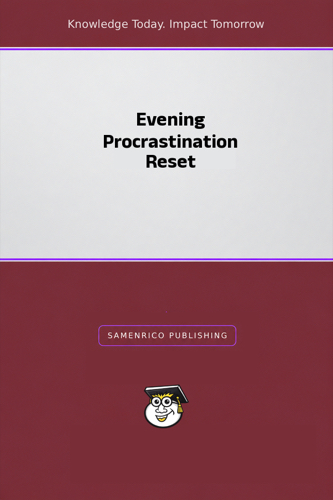
Non-FictionSelf-HelpEvening Routine
Evening Procrastination Reset eBook
End the day prepared to prevent morning avoidance.
by Wester Vonda
End the day prepared to prevent morning avoidance.
Formats
Free sample
Chapter 1: The Morning Hangover--–- Sarah had been awake for eleven minutes, and she had already failed. The alarm on her phone had screamed at 6:15 AM, the same time it had screamed every weekday for the past three years. She had silenced it with a blind swipe and burrowed deeper into her pillow, bargaining with herself in the foggy language of the half-asleep: Just ten more minutes. I'll skip breakfast. I can wear yesterday's jeans.
When she finally opened her eyes, the clock read 6:47. Thirty-two minutes lost. Not to rest—she hadn't truly rested. Thirty-two minutes lost to a low-grade war between her exhausted body and her anxious mind.She swung her legs out of bed and immediately encountered the first obstacle: a pile of laundry she had meant to put away three nights ago. She stepped over it, stubbed her toe on a dumbbell she had promised herself she would use "tomorrow," and stumbled into the bathroom.
The mirror revealed the predictable consequences of last night's choices—dark circles, puffy eyes, the particular pallor that comes from falling asleep to Netflix at midnight with the bedside lamp still burning.The search for her work badge began at 7:02. By 7:09, she had upturned the laundry pile, rifled through the kitchen counter (still cluttered with last night's dinner dishes), and checked her coat pockets twice. The badge was, of course, in the pocket of the pants she had worn yesterday—the pants she had left in the bathroom after her post-work collapse. She found them at 7:11, wedged between the toilet and the wall.At 7:15, she poured coffee into a travel mug that still had last Tuesday's residue because she had not run the dishwasher the night before. She skipped breakfast entirely.
At 7:22, she was in her car, heart rate elevated, mouth dry with the particular anxiety of someone who knows they are already behind. The email from her boss, sent at 6:58 AM, glowed on her phone screen: *"Quick check-in before the 9 AM? Need the revised numbers."*She had not revised the numbers. She had meant to do it last night. She had opened the spreadsheet at 8 PM, stared at it for ninety seconds, and then opened You Tube instead.
Just one video. Then one more. Then a documentary about octopuses that she did not remember watching. At 11:30 PM, she had told herself she would wake up early and do the numbers then. But she had not woken up early.
She had woken up late, disoriented, and already defeated.This is not a story about laziness. Sarah is not lazy. She is a senior analyst at a mid-sized financial firm, the primary caregiver for her aging mother, and the unpaid administrator of a household that runs on her invisible labor. By any objective measure, she works twelve to fourteen hours a day, seven days a week. She is exhausted.
She is overwhelmed. And every single morning, she wakes up already losing a battle that she did not know she was fighting.The battle is not against her alarm clock. It is not against her boss or her mother or the pile of laundry. The battle is against a vicious cycle that begins and ends in the evening—specifically, in the hours between 8 PM and midnight, when Sarah sits on her couch, phone in hand, watching time slip away while her brain whispers: You deserve this rest. You'll do it tomorrow.
Just five more minutes.Tomorrow, of course, never comes. Tomorrow is just today with a different name. And the cycle continues.The Great Deception of "Morning People"There is a pervasive myth in productivity culture—whispered in every self-help book, shouted from every Linked In influencer, encoded into the very structure of capitalist work—that some people are simply "morning people" and others are not. This myth suggests that the ability to wake up early, alert, and organized is a personality trait, like being an extrovert or having a sweet tooth. You either have the gene or you do not.
If you do not, the reasoning goes, you must simply accept that your mornings will be chaotic, rushed, and stressful. You are a night owl. That is just who you are.This is a lie. It is not merely an exaggeration or a simplification. It is a falsehood that causes measurable harm to millions of people who have been told, implicitly or explicitly, that their morning chaos is an immutable characteristic rather than a predictable outcome of specific, changeable behaviors.The scientific literature on chronotypes—the technical term for individual differences in circadian rhythms—does suggest that some people naturally peak earlier in the day and others later.
This is real. Genetics matter. But the variation between most people's chronotypes is measured in hours, not in the binary of "morning disaster" versus "morning success." More importantly, the research consistently shows that evening chronotypes who adopt morning-oriented routines experience significant improvements in mood, productivity, and mental health—often within two to three weeks. The trait is not destiny. The behavior is.What, then, explains the difference between a Sarah and someone who wakes up calmly, drinks coffee while reading a book, and arrives at work fifteen minutes early?
The answer, which will be repeated throughout this book because it is the single most important insight you will encounter, is this: A calm morning is not a product of willpower or genetics. It is a product of preparation. And preparation happens the night before.Every frantic search for keys, every skipped breakfast, every forgotten deadline, every moment of morning avoidance—the impulse to pull the covers over your head and hide from the day—can be traced backward in a straight line to a specific evening action that did not happen. You did not put your keys in the bowl. You did not pack your bag.
You did not run the dishwasher. You did not look at tomorrow's calendar. You did not go to bed at a reasonable hour. These are not moral failures. They are logistical failures.
And logistical failures have logistical solutions.The Hidden Cost of Morning Chaos Before we can solve the problem, we must fully understand its dimensions. Most people underestimate the cost of a chaotic morning because the costs are diffuse, accumulating in small increments that never appear on a single ledger sheet. Let us make them visible.The Time Cost. A 2018 survey conducted by One Poll and reported in the New York Post found that the average American adult spends approximately 55 minutes per day on "morning chaos behaviors"—searching for misplaced items, redoing tasks that should have been done the night before, making decisions that could have been made in advance, and recovering from the consequences of rushed or forgotten actions. Fifty-five minutes.
Every day. Over the course of a 240-day work year (accounting for weekends and some vacation), that amounts to 220 hours. That is nearly ten full days. Ten days per year spent not on work, not on family, not on rest—on chaos. On searching.
On recovery. On the low-grade misery of starting every single day already behind.The Cognitive Cost. Morning chaos does not merely consume time; it consumes cognitive bandwidth. The concept of "decision fatigue," first…
This is the end of the free sample. Get the eBook to keep going. Buy now
About this book
Details
- Author
- Wester Vonda
- Publisher
- SamEnrico
- Language
- English
- Genre
- Non-Fiction, Self-Help, Evening Routine
- Released
- 2026-06-09
- Pages (approx.)
- 152
- Available as
- eBook, Audiobook

Read better in the ZLOADR app
Your eBooks on your phone or tablet. Sign in with your SamEnrico account and start reading.
More by Wester Vonda
 Crisis Communication Outbreak HandbookWester Vonda$11.99
 Emotion Exposure DBT GuideWester Vonda$11.99
 Simple Carb Timing GuideWester Vonda$11.99
 Lifting Toddler from FloorWester Vonda$11.99
 My Suitcase Life StoryWester Vonda$11.99
 Widow Brain Fog WorkbookWester Vonda$11.99
 Nobel Prize for the Structure of DNAWester Vonda$11.99
 The Ransom of Marathon: Athens' Desperate Gambit Against Persia (490 BC)Wester Vonda$11.99
 Oriana Fallaci: The Journalist Who Shook the WorldWester Vonda$11.99
 How to Start a Metal Window Fixing Business (Beginners Guide)Wester Vonda$11.99
 How to Produce WheelbarrowsWester Vonda$11.99
 How to Produce Marine SpeakersWester Vonda$11.99
You may also like
 Hong Kong Handover 1997Dunn Johnnie$11.99
 Zumba For Postnatal Recovery CourseNeal Christian$11.99
 Zumba for BeginnersLadner Nikia$11.99
 YouTube Comment Mining GuideHumes Pandora$12.99
 Worry Box MeditationCarlin Rudy$11.99
 Workplace Stress MeditationNguyen Lynn$11.99
 Workplace Stress and Sleep RepairHawley Ivory$11.99
 Workplace Perfectionism CureDelaney Jeffry$11.99
 Workplace Injustice Anger GuideWallen Isabelle$11.99
 Work Addiction and Burnout LinkGreenwood Ester$11.99
 Women in Yoga and WellnessBeattie Galina$11.99
 Women in Stand Up ComedyChun Evangeline$11.99