
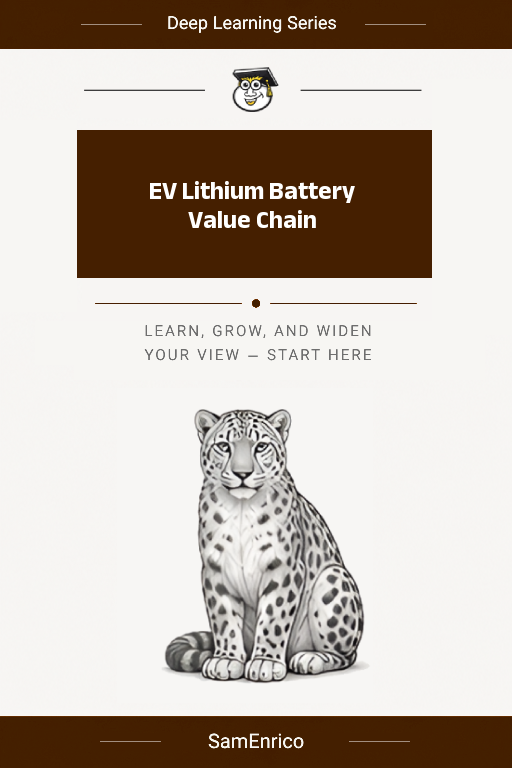
Non-FictionForecast & OutlookEV Supply Chain
EV Lithium Battery Value Chain eBook
Analyze cathode precursor production, battery asse
Analyze cathode precursor production, battery assembly, and recycling opportunities in Mercosur.
Formats
Free sample
Chapter 1: The White Gold Lie...--The salt flats of northwestern Argentina do not look like the birthplace of a revolution. Stretching across the Puna plateau at 3,700 meters above sea level, the Salar de Olaroz is a blinding white expanse of cracked crust, rimmed by rust-colored mountains and a sky so thin and blue it feels artificial. The air carries only the smell of minerals and silence. For centuries, this landscape produced little of value to the global economy—some borax, some cattle grazing on scrub grass, and a great deal of nothing. Then, around 2015, the mining companies arrived.
They came with earthmoving equipment, rubber liners, and long rows of shallow evaporation ponds. They came to pump brine. The brine beneath the salt flats is not water as most people understand it. It is a dense, salty slurry containing dissolved lithium chloride, potassium, magnesium, boron, and a dozen other elements. The companies pump this brine to the surface, pour it into lined ponds the size of soccer fields, and wait.
The sun and wind do the work, evaporating the water over twelve to eighteen months until the lithium concentration rises from approximately 0.2 percent to 6 percent. Then the concentrated brine is trucked to a nearby chemical plant, where it undergoes further processing to become lithium carbonate—the white powder that has been called "white gold" by every financial journalist, every mining executive, and every politician who has ever stood in front of a salt flat and promised prosperity.The metaphor is seductive. Gold is rare, valuable, and worth fighting over. Lithium, the thinking goes, must be the same. The world is electrifying.
Every electric vehicle requires approximately eight to ten kilograms of lithium. By 2030, analysts project annual lithium demand to exceed 2.5 million metric tons, up from approximately 500,000 tons in 2020. The countries that sit atop the world's lithium reserves—Chile, Argentina, Bolivia, Australia, China—are supposedly the new oil kingdoms, destined for wealth and geopolitical power. The "white gold" rush has inspired billions in exploration spending, dozens of mining startups, and a wave of nationalist rhetoric across South America. Bolivia's president has spoken of lithium as the country's "sovereign resource." Argentina's provincial governors have fought over tax regimes.
Chile has proposed state control over its lithium operations. All of them believe the same thing: that owning the mine is the prize.This book argues that they are all wrong. Spectacularly, dangerously, expensively wrong.The White Gold Lie is not that lithium lacks value. It is that the value lies in the ground at all. The global EV revolution is not constrained by the availability of lithium in the earth's crust.
There is plenty of lithium. The United States Geological Survey estimates identified lithium reserves at approximately 22 million tons, with total resources—including undiscovered deposits—far higher. Even at 2030 demand levels, known reserves alone could supply the world for nearly a decade before a single new discovery. The constraint is not geological scarcity but industrial capacity: the ability to refine raw lithium into battery-grade material, and then to formulate that material into the precise chemical compounds that actually go inside a battery. The real value, the real bottleneck, and the real opportunity lie not in the mine but in the refinery, the chemical plant, and the cathode precursor facility.
The companies and countries that understand this will capture the profits. Those that do not will find themselves exporting cheap raw materials while Asia captures 80 percent of the value.This chapter introduces the central thesis of this book: that the Mercosur bloc—specifically Argentina and Brazil—is uniquely positioned to leapfrog from extraction directly into high-value cathode precursor production and battery recycling, but only if it abandons the white gold fantasy and embraces a more sophisticated, industrial strategy. Argentina brings high-purity brines. Brazil brings low-cost hydropower and critical industrial minerals. Together, they have something that no other region on earth can match: system complementarity.
Not one resource, but the convergence of energy, chemistry, and industrial infrastructure. This chapter will dismantle the white gold metaphor, explain the real economics of the battery value chain, and set the stage for the detailed regional analysis that follows.The Mining Trap To understand why lithium mining is not the prize, consider the history of the Democratic Republic of Congo and cobalt. The DRC holds approximately 70 percent of the world's known cobalt reserves—a higher concentration than any country's share of lithium. Cobalt is essential for the nickel-manganese-cobalt (NMC) batteries that power most long-range EVs. When the EV boom began, conventional wisdom held that the DRC would become a critical geopolitical player, as essential to the energy transition as Saudi Arabia was to the oil age.
That has not happened. Instead, most Congolese cobalt is mined under dangerous and often artisanal conditions, then shipped to China for refining. Chinese companies have invested heavily in DRC mining operations, but the value capture—the refining, the processing into cobalt sulfate, the incorporation into cathode materials—happens in China. The DRC remains a raw material exporter, earning approximately 15 to 20 percent of the final battery's cobalt value. The rest accrues to refiners and manufacturers outside its borders.
The country is no richer, no more powerful, and no more industrialized than it was before the cobalt boom. It has simply become a quarry for Chinese industry.Lithium is following the same trajectory. China does not have particularly large lithium reserves—approximately 7 percent of the global total—yet it controls approximately 70 to 80 percent of global lithium refining capacity. This is not an accident of geology. It is the result of deliberate industrial policy spanning two decades.
Chinese firms began investing in lithium refining technology and capacity long before the EV boom materialized. They purchased stakes in Australian, Chilean, and Argentine mines. They built refining facilities in coastal provinces, close to ports, where imported raw materials could be processed cheaply using coal-fired electricity. They then integrated those refiners with cathode and battery manufacturing plants, creating a vertically controlled supply chain from mine to cell. By 2020, when Western automakers finally woke up to the lithium imperative, China had already locked in its position.
Today, a lithium atom extracted from an Argentine salt flat can be shipped to China as raw brine concentrate, refined in Hunan province, converted to cathode precursor in Jiangsu, assembled into a cell in Fujian, and shipped back to Europe as a finished battery. Argentina earns the mining margin. China earns everything else.The white gold metaphor obscures this reality. It directs attention to the mine, not the refinery. It celebrates resource ownership rather than industrial capability.
And it encourages resource-rich countries to think of themselves as passive landlords rather than active manufacturers. This is the trap that Mercosur must avoid.The Real Value Chain A lithium-ion battery is not a simple object. It contains dozens of materials and components, each with its own supply chain and value-add. To understand where the money flows, it helps to walk through the chain from the ground to the finished pack.The first step is extraction. For brine operations, this means pumping lithium-bearing water to the surface and evaporating it.
The output is a concentrated brine or, after further processing, a solid product such as lithium carbonate or lithium hydroxide.…
This is the end of the free sample. Get the eBook to keep going. Buy now
About this book
Details
- Author
- Franco Vernetta
- Publisher
- SamEnrico
- Language
- English
- Genre
- Non-Fiction, Forecast & Outlook, EV Supply Chain
- Released
- 2026-05-30
- Pages (approx.)
- 138
- Available as
- eBook, Audiobook

Read better in the ZLOADR app
Your eBooks on your phone or tablet. Sign in with your SamEnrico account and start reading.
More by Franco Vernetta
 Legacy Letter Writing CourseFranco Vernetta$11.99
 Uber Driver Vehicle MaintenanceFranco Vernetta$11.99
 Anger De escalation Communication GuideFranco Vernetta$11.99
 The Montenegro Digital Nomad Visa GuideFranco Vernetta$11.99
 Audience Scan for AlliesFranco Vernetta$11.99
 The Battle of Saratoga: Turning Point of the American RevolutionFranco Vernetta$11.99
 Understanding Lutz–richner–landolt SyndromeFranco Vernetta$17.99
 Head of Business DevelopmentFranco Vernetta$11.99
 How to Become a Larry OperatorFranco Vernetta$11.99
 Executive Summary Funding AskFranco Vernetta$12.99
You may also like
 Hong Kong Handover 1997Dunn Johnnie$11.99
 Zumba For Postnatal Recovery CourseNeal Christian$11.99
 Zumba for BeginnersLadner Nikia$11.99
 YouTube Comment Mining GuideHumes Pandora$12.99
 Worry Box MeditationCarlin Rudy$11.99
 Workplace Stress MeditationNguyen Lynn$11.99
 Workplace Stress and Sleep RepairHawley Ivory$11.99
 Workplace Perfectionism CureDelaney Jeffry$11.99
 Workplace Injustice Anger GuideWallen Isabelle$11.99
 Work Addiction and Burnout LinkGreenwood Ester$11.99
 Women in Yoga and WellnessBeattie Galina$11.99
 Women in Stand Up ComedyChun Evangeline$11.99