
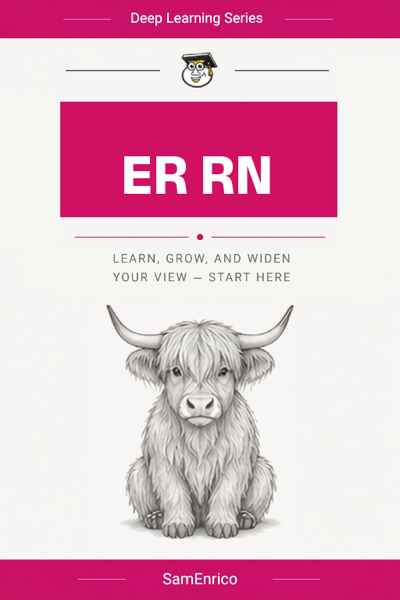
ER RN eBook
A Coursebook on ER RN
by Obryan Kyung
A Coursebook on ER RN
Formats
Free sample
Chapter 1: The Hidden Toolkit...--–- You are standing in the hallway of your first emergency department orientation, and the charge nurse has just handed you a pager, a set of trauma shears, and a piece of paper with four patient rooms scribbled on it. “Room 3 is crushing chest pain, Room 7 is a possible stroke, Room 12 is a psych hold who threw a chair at breakfast, and the waiting room has thirty-seven people who have been waiting an average of four hours. Go.”You look down at your new running shoes, touch the dark chocolate bar you stuffed in your pocket that morning, and realize that every textbook you read in nursing school did not prepare you for this specific moment. The beeping, the fluorescent lights, the family member crying two rooms down, the smell of antiseptic mixed with coffee and fear – this is the emergency department, and you are now one of its nurses.This chapter is not about pathophysiology. It is not about the Krebs cycle or nursing theory or the proper way to write a nursing diagnosis.
This chapter is about survival. It is about understanding the physical environment you have just entered, the tools you will need to find in the dark at three in the morning, the medications you will push before you have time to look up their side effects, and the unspoken rules that keep you safe, sane, and employed. Welcome to the hidden toolkit of the ER nurse. Everything in this chapter assumes you have already read the introduction, which established why ER nursing is fundamentally different from floor nursing – the undifferentiated patient, the compressed timeline, the chaos. Now let us put tools in your hands.The Geography of Chaos: Understanding Your ER's Zones Every emergency department is designed around a simple but often invisible logic: patients move from sickest to least sick, and so should you.
Before you can save anyone, you need to know where you are. Most ERs are divided into four zones, though the names vary by hospital. Learn yours on day one, not day thirty.The first zone is Resuscitation – commonly called Resus, the trauma bay, or Rooms 1-2. This is where the sickest patients go: cardiac arrests, multi-system trauma, respiratory failure, any patient who could die in the next five minutes. Resus bays are usually the closest rooms to the ambulance bay and the trauma elevator.
They have the most equipment – a dedicated crash cart, a rapid infuser for blood products, a video laryngoscope, an ultrasound machine, and often a negative pressure setup for airborne precautions. If you are assigned to Resus, you do not leave. You do not answer the phone. You do not go get coffee. You stay until your patient is stable, transferred to the ICU, or pronounced dead.
Resus is where you earn your reputation.The second zone is Acute Care – sometimes called the high-acuity side, the cardiac monitoring area, or Rooms 3-12. These patients are unstable but not actively dying. Think strokes within the t PA window, septic patients who are responding to fluids, asthma exacerbations on Bi PAP, elderly patients with altered mental status. These patients need continuous monitoring, frequent vital signs, IV medications, and nursing assessment every fifteen to sixty minutes. You will run between these rooms all shift.
You will discover that multiple patients can decompensate simultaneously. You will learn to prioritize not by loudest complaint but by most likely to arrest next.The third zone is Fast Track – also called the minor care area, the urgent care side, or the “I just need a note for work” section. These are ESI Level 4 or 5 patients: ankle sprains, ear infections, small lacerations, medication refills, and the endless parade of patients who should have gone to their primary care doctor but did not. Fast track is often staffed by a single nurse with a nurse practitioner or physician assistant. The pace is relentless – you may see thirty to forty patients in a twelve-hour shift – but the medical complexity is low.
Do not dismiss fast track as unimportant: one missed appendicitis or ectopic pregnancy can still kill a patient, and fast track patients can deteriorate like anyone else.The fourth zone is Behavioral Health – sometimes called the psych pod, the holding area, or simply “the dangerous side.” These are patients awaiting psychiatric admission, patients with acute agitation, patients under involuntary holds, and patients who have been in the ER for days or weeks waiting for a bed. This zone has fewer sharp objects, no IV poles that can be thrown, and often a security officer stationed at the door. If you work in behavioral health, your primary tools are de-escalation, observation, and medication. Your primary risks are assault and burnout. Never turn your back on an agitated patient.
Always know your exit. And remember that psychiatric emergencies are medical emergencies – undiagnosed brain tumors, infections, and metabolic disorders can present as psychosis.Between these zones are the common spaces you will live in: the nurses' station (your command center, where you will chart, eat, cry, and laugh), the medication room (where you will learn the location of every drug by week two), the supply closets (where you will hoard IV start kits and flushes like a squirrel preparing for winter), the break room (where the good coffee is hidden in the top cabinet), and the bathroom (the only place you will ever find five minutes of peace).The Crash Cart: Your Best Friend in the Worst Moments You will run to a crash cart at least once during orientation. You should know its contents before you need them. While hospitals organize carts differently, most follow a drawer-by-drawer system based on AHA recommendations.The top drawer – or the first pull-out tray – contains airway equipment. You will find laryngoscope handles (check that the batteries work – they die at the worst times), Macintosh and Miller blades of various sizes (size 3 and 4 Mac for adults, size 2 for children, size 0-1 for infants), endotracheal tubes from size 3.0 to 8.0 (cuffed for adults, uncuffed for children under 8 years or at physician discretion), stylets (always keep one in the tube before passing it), oral and nasal airways, a bougie (the single most underrated intubation tool – passes when you cannot see the cords), supraglottic airways (King LT or LMA as backup if intubation fails), a suction device with Yankauer tip (turn it on before you need it, and test suction strength), and a bag-valve-mask with reservoir and oxygen tubing (size adult, child, and infant – and a mask that actually fits).The second drawer holds emergency medications, typically organized by ACLS algorithm.
You will find epinephrine 1:10,000 (1mg/10m L prefilled syringes for cardiac arrest – push IV push every 3-5 minutes), epinephrine 1:1000 for anaphylaxis (0.3-0.5mg IM), amiodarone 150mg/3m L vials (first-line for shockable rhythms, 300mg IV push then 150mg if needed), lidocaine (alternative to amiodarone, 1-1.5mg/kg IV push), atropine (1mg for symptomatic bradycardia, up to 3mg total – no longer recommended for PEA/asystole), adenosine (6mg rapid push then 20m L saline flush, second dose 12mg for SVT – warn patients they will feel impending doom and chest pressure for ten seconds), calcium chloride or calcium gluconate (for hyperkalemia, calcium channel blocker…
This is the end of the free sample. Get the eBook to keep going. Buy now
About this book
Details
- Author
- Obryan Kyung
- Publisher
- SamEnrico
- Language
- English
- Genre
- Non-Fiction, Informative, Educational
- Released
- 2026-05-08
- Pages (approx.)
- 137
- Available as
- eBook, Audiobook

Read better in the ZLOADR app
Your eBooks on your phone or tablet. Sign in with your SamEnrico account and start reading.
More by Obryan Kyung
 US Gaming Market DemographicsObryan Kyung$11.99
 First Date Conversation GuideObryan Kyung$11.99
 King and Malcolm X DebateObryan Kyung$11.99
 Body Scan For Flight AnxietyObryan Kyung$11.99
 The Eight Week MBSR Course GuideObryan Kyung$11.99
 The Silent Champions: Europe's First Adaptive Athletes and the Birth of Paralympic SpiritObryan Kyung$11.99
 Understanding Pterygium ColliObryan Kyung$17.99
 SpaceX Hiring GuideObryan Kyung$12.99
 Customer Retention One Page PlanObryan Kyung$12.99
 How to Become a CompensatorObryan Kyung$11.99