
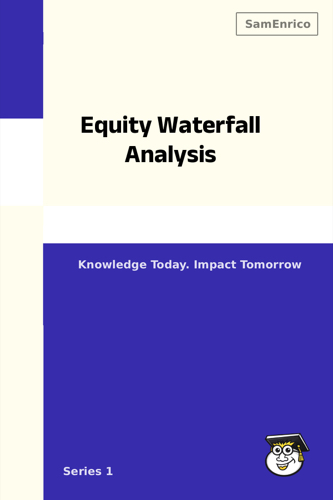
Non-FictionCapital & Valuation Register
Equity Waterfall Analysis eBook
Models distribution priorities across sponsor, co-
Models distribution priorities across sponsor, co-investors, and management.
Formats
Free sample
Chapter 1: The Alignment Crisis--–- In the winter of 2016, a $400 million real estate fund completed a spectacular exit. The asset—a portfolio of logistics warehouses acquired for $280 million just thirty-six months earlier—sold for $520 million. The co-investors, mostly pension funds and insurance companies, had trusted the sponsor with their capital. They expected a fair return. What they received instead was a masterclass in misalignment.The sponsor’s waterfall was structured as an aggressive American-style, deal-by-deal model with a 6% preferred return and a 100% catch-up that flipped to a 70/30 split in the sponsor’s favor after only a single tier.
Because the fund had no loss recovery feature, the sponsor collected over $18 million in carried interest on this single successful deal—even though the fund’s other two investments had lost a combined $45 million. The co-investors, net of all gains and losses, ended up with a paltry 3.2% annualized return. The sponsor walked away with $18 million in promotes and $12 million in management fees. The pension fund’s investment committee chairman later testified before a state legislature: “We didn’t lose money on the warehouse deal. We lost money on the waterfall.”That phrase became the epigraph for this book.
Because it captures the essential truth that most investors learn only after it is too late: returns are not the same as distributions. A fund can generate robust gross returns and still deliver mediocre net returns to co-investors if the equity waterfall is poorly designed or aggressively tilted toward the sponsor. Conversely, a fund with modest gross returns but a well-aligned waterfall can create durable, fair partnerships that last for decades.This chapter establishes the foundational problem that equity waterfalls solve: the natural, inevitable conflict of interest between those who provide capital (co-investors, limited partners, passive capital) and those who provide labor, deal flow, operational expertise, and risk-taking (sponsors, general partners, active management). Without a distribution rulebook—a waterfall—this conflict destroys value. With a well-designed waterfall, it creates alignment.
But alignment is not automatic. It must be engineered.The Irreducible Conflict at the Heart of Private Investing Every private investment vehicle—whether a real estate fund, a private equity partnership, a venture capital syndicate, or a co-investment vehicle—faces the same structural tension. The co-investor wants safety, liquidity, and steady returns. The sponsor wants upside, control, and compensation for effort. These are not merely different preferences.
They are opposing forces.Consider the simplest possible joint venture: one sponsor and one co-investor, each contributing $1 million to buy an apartment building. Without any waterfall provisions, they might agree to split all profits 50/50. But is that fair? The co-investor contributed capital but no time. The sponsor contributed capital and found the deal, negotiated the purchase, managed the renovation, hired the property manager, and handled the sale.
The co-investor’s capital was at risk, but the sponsor’s time and reputation were also at risk. A 50/50 split ignores the sponsor’s labor. A 90/10 split in the sponsor’s favor ignores the co-investor’s capital.The waterfall is the mechanism that resolves this tension by establishing priorities. It answers four questions in sequence:Who gets the first dollars of cash flow?At what point does the sponsor begin to share in profits?How does the sponsor “catch up” to a fair profit share after the co-investor has been paid a priority return?How are the remaining profits divided?Without answers to these questions, every distribution becomes a negotiation. And negotiations over cash flow—especially when large sums are involved—are the death of partnerships.
The waterfall replaces negotiation with mathematics. It is the constitution of the investment vehicle, and like any constitution, its design determines whether the union survives or collapses.The Three Parties (And Why Most Books Get This Wrong)Most treatments of equity waterfalls present a binary world: sponsor versus co-investor. This book introduces a third party from the very beginning: management. In large funds, the sponsor (the GP entity) is often a legal vehicle owned by a management company. The individuals who actually do the work—the deal team, the asset managers, the CFO, the CEO—are not the same as the sponsor entity.
They are employees or partners of the sponsor.This distinction matters enormously because management must be incentivized separately from the sponsor’s equity. A sponsor entity that receives 20% of profits might distribute none of that to its employees, leading to a demoralized deal team that generates mediocre deal flow. Conversely, a sponsor that gives away too much of its promote to management might find itself unable to retain key talent. Chapter 10 of this book is devoted entirely to management participation structures, but the concept appears throughout because ignoring management is like designing a ship without a crew.The three parties in any complete waterfall analysis are:Co-investors (Limited Partners / LPs): Passive capital providers. They provide most of the money, take most of the downside risk, and receive a priority return before the sponsor participates significantly.
Their primary protection is the waterfall’s senior tiers.Sponsors (General Partners / GPs): The legal entity that controls the fund, makes investment decisions, and receives the promote (carried interest). The sponsor is liable for the fund’s obligations (though this liability is often structured through special purpose entities).Management: The individuals who perform the day-to-day work. They may be employees of the sponsor, partners in the sponsor entity, or independent contractors. Their compensation may include a share of the sponsor’s promote, phantom equity, or co-investment opportunities.Each party has a different risk profile, time horizon, and tax situation. Each party will negotiate different terms.
And each party can destroy value for the others if the waterfall is misaligned.The Promote: Why Sponsors Earn Disproportionate Profits The central mechanism of alignment in any waterfall is the promote (also called carried interest or performance allocation). The promote is the sponsor’s share of profits after co-investors have received a minimum return on their capital. In a classic 80/20 waterfall, co-investors receive 80% of remaining profits after the promote, and the sponsor receives 20%. But that 20% is not a gift. It is earned through performance.Why does the promote exist?
Three reasons.First, effort-based compensation. The sponsor works. The co-investor does not. Finding deals, underwriting investments, negotiating terms, managing assets, and arranging exits are all labor-intensive activities. If the sponsor received only a pro-rata share of profits based on its capital contribution (typically 1-5% of total equity), the sponsor would have no economic incentive to work hard.
The promote compensates the sponsor for sweat equity.Second, risk-taking. The sponsor typically has a junior position in the capital stack. In many funds, the sponsor’s capital is the last to be returned and the first to be lost if the fund underperforms. This “first-loss” position is not theoretical: if a fund loses money, the sponsor’s capital is often wiped out before co-investors lose anything. The promote compensates the sponsor for bearing this disproportionate risk.Third, alignment of interests.
A sponsor that earns promote only after co-investors achieve a preferred return (say, 8% per annum) has a strong incentive to avoid mediocre deals. If the fund earns 6%, the sponsor gets nothing. If the fund earns 12%, the sponsor gets a significant…
This is the end of the free sample. Get the eBook to keep going. Buy now
About this book
Details
- Author
- Sherwood Reanna
- Publisher
- SamEnrico
- Language
- English
- Genre
- Non-Fiction, Capital & Valuation Register
- Released
- 2026-06-06
- Pages (approx.)
- 158
- Available as
- eBook, Audiobook

Read better in the ZLOADR app
Your eBooks on your phone or tablet. Sign in with your SamEnrico account and start reading.
More by Sherwood Reanna
 Mindful Sobriety: An Alcoholism Recovery CourseSherwood Reanna$11.99
 Creative Professional BurnoutSherwood Reanna$11.99
 Workaholism and ADHDSherwood Reanna$11.99
 Neural Dawn: The Unseen Architect of the First AI UprisingSherwood Reanna$11.99
 How to Produce Airsoft EquipmentSherwood Reanna$11.99
 Cross Border Payment Insurance GuideSherwood Reanna$12.99
 How to Start a Ferrosilicon Chromium Business (Beginners Guide)Sherwood Reanna$11.99
 Sound DesignerSherwood Reanna$11.99
You may also like
 Hong Kong Handover 1997Dunn Johnnie$11.99
 Zumba For Postnatal Recovery CourseNeal Christian$11.99
 Zumba for BeginnersLadner Nikia$11.99
 YouTube Comment Mining GuideHumes Pandora$12.99
 Worry Box MeditationCarlin Rudy$11.99
 Workplace Stress MeditationNguyen Lynn$11.99
 Workplace Stress and Sleep RepairHawley Ivory$11.99
 Workplace Perfectionism CureDelaney Jeffry$11.99
 Workplace Injustice Anger GuideWallen Isabelle$11.99
 Work Addiction and Burnout LinkGreenwood Ester$11.99
 Women in Yoga and WellnessBeattie Galina$11.99
 Women in Stand Up ComedyChun Evangeline$11.99