
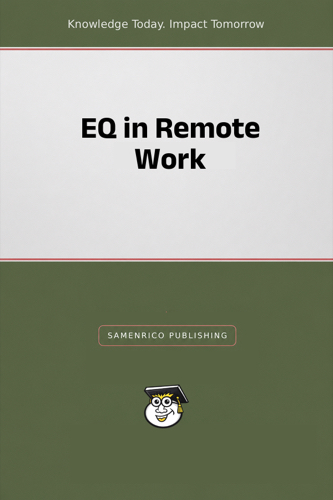
EQ in Remote Work
Build emotional connection in distributed teams.
Build emotional connection in distributed teams.
Formats
About this book
Free sample
Chapter 1: The Productivity Paradox--–- In 2021, a mid-level engineering manager named Sarah led a team of fourteen people across six time zones. By every traditional metric, her team was thriving. They shipped code 22% faster than any other department. Their project completion rate was 94%. Senior leadership celebrated them as the model of remote success.
Then, in a span of six weeks, three of her best engineers resigned. In their exit interviews, each used nearly identical language: “I just didn’t feel like anyone knew me.” “I was productive, but I was invisible.” “The work was fine. The connection was not.”Sarah was blindsided. She had done everything right by the remote work playbook. Daily standups on Zoom.
A lively Slack channel with emoji reactions. Virtual coffee breaks. Monthly team socials. She had read the articles, attended the webinars, implemented the tools. And still, her people were leaving not because the work was hard, but because the work was lonely.This is the paradox that defines our moment.
Remote work has delivered on its promise of productivity. The data is undeniable. Stanford economist Nicholas Bloom’s landmark study of 16,000 workers found that remote work boosted productivity by 13% — not because people worked more hours, but because they worked more focused hours, free from the distractions of open offices and performative presence. Global consulting firms reported that distributed teams could operate at 80-90% of in-office efficiency within weeks of going remote, a feat that would have seemed impossible a decade ago.And yet, something else was happening beneath the surface. The same Stanford study contained a troubling footnote: while productivity rose, the percentage of workers who reported feeling “connected to their company’s mission” dropped by nearly 40%.
A separate Harvard Business School study of remote teams found that while task efficiency increased, affective conflict — personal friction, resentment, and emotional distance — increased by nearly 10%. Digital communication, for all its speed and convenience, strips away what organizational psychologists call “non-verbal repair mechanisms.” The raised eyebrow that signals confusion. The softening of the voice that says “I’m still on your side.” The quick touch…
This is the end of the free sample. Get the eBook to keep going. Buy now
Contents
- Chapter 1
- Chapter 2
- Chapter 3
- Chapter 4
- Chapter 5
- Chapter 6
- Chapter 7
- Chapter 8
- Chapter 9
- Chapter 10
- Chapter 11
- Chapter 12
Details
- Author
- Longoria Eric
- Publisher
- SamEnrico
- Language
- English
- Genre
- Non-Fiction, Self-Help, Remote Work
- Released
- 2026-06-09
- Pages (approx.)
- 146
- Available as
- eBook, Audiobook

Read better in the ZLOADR app
Your eBooks on your phone or tablet. Sign in with your SamEnrico account and start reading.
More by Longoria Eric
 TM Transcending ProcessLongoria Eric$11.99
 Async Compliance Audit Trail GuideLongoria Eric$11.99
 OUD Stigma Reduction GuideLongoria Eric$11.99
 Imposter Syndrome Self Assessment WorkbookLongoria Eric$11.99
 The Codebreaker and the Quantum Leap: How a Cold War Spy Built the FutureLongoria Eric$11.99
 The Day the Internet Broke: Inside the Great DDoS Attack of 2016Longoria Eric$11.99
 Percentage Rent Clause UpdateLongoria Eric$12.99
 Digital Products on ShopifyLongoria Eric$12.99
 How to Start a Prepared Dyes Business (Beginners Guide)Longoria Eric$11.99
 Customer Project ManagerLongoria Eric$11.99
 Understanding Covesdem SyndromeLongoria Eric$17.99
You may also like
 Remote Work Anger ManagementClay Marlo$11.99
 Weekly Review for Remote WorkersReid Dustin$11.99
 Virtual Networking Success GuideWilloughby Eun$11.99
 Virtual Body Language GuideGilman Marx$11.99
 Virtual Assistant Deployment GuideGossett Kevin$11.99
 Remote Work Self Esteem HandbookTucker Lillie$11.99
 Remote Work Loneliness GuideDennison Karon$11.99
 Remote Work Isolation GuideDurant Shea$11.99
 Remote Work Anger Management GuideCampos Ivey$11.99
 Remote Communication Skills GuideLoomis Billie$11.99
 Breath Awareness For Zoom FatigueParkinson Cassey$11.99
 Virtual Meeting Body Language GuideFeldman Lenna$11.99