
Non-FictionSelf-HelpProject Management
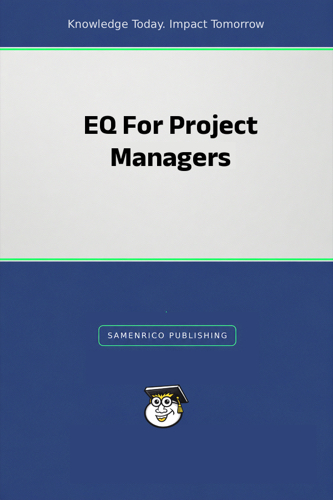
EQ For Project Managers eBook
Applies emotional intelligence to stakeholder mana
by Eng Aretha
Applies emotional intelligence to stakeholder management, team motivation, and deadline pressure.
Formats
Free sample
Chapter 1: The 70% Rule...--–- You were hired for your PMP. You'll be fired for your temper.Let that land for a moment. You’ve spent years mastering Gantt charts, critical path analysis, risk registers, earned value management, and Agile frameworks. You can build a schedule in your sleep. You can spot a floating milestone from across the room.
You have certifications that cost thousands of hours and even more dollars. And none of it will save you when your face flushes, your jaw clenches, and the wrong words fly out of your mouth in a steering committee meeting.This book is not an indictment of technical skills. You need them. They are the price of admission. But here is the brutal truth that no PMP prep course will teach you: technical skills account for only 20 to 30 percent of project success.
The other 70 to 80 percent belongs to something that almost no one trains you for—emotional intelligence under fire.The Research That Should Scare You In 2016, researchers at Carnegie Mellon and Stanford collaborated on a longitudinal study of project managers across technology, construction, finance, and healthcare. They tracked over 1,200 projects for three years. Their finding was so inconvenient that the PMI initially refused to publish it in their main journal: technical competence—scheduling, budgeting, risk management, tool proficiency—predicted project success only in low-pressure, predictable environments. Once you added ambiguity, stakeholder hostility, or tight deadlines, technical skill became nearly irrelevant. The only consistent predictor of on-time, on-budget delivery was the project manager's ability to regulate their own emotions and navigate the emotions of others.Let me repeat that because it sounds like heresy.
When things go wrong—and they always go wrong—your perfect Gantt chart is worthless if you cannot manage your own fear, your team's frustration, and your sponsor's anxiety.Yet the industry does the opposite. According to a 2024 training audit by the Project Management Institute, 90 percent of all corporate PM training budgets go to hard skills. Software. Templates. Methodology certifications.
The remaining 10 percent is split between generic "leadership" seminars that teach you to "be a good listener" without any neuroscience or practical tools. The result is a generation of project managers who can build a flawless schedule but cannot have a difficult conversation without escalating into blame, defensiveness, or silence.The Pressure Paradox Here is the central concept of this book, and you will see it reappear in every chapter that follows. I call it The Pressure Paradox:Under normal conditions, your IQ, your technical training, and your logical reasoning carry the day. You can plan, analyze, and execute. But when timelines shrink, budgets are cut, a key resource walks out, or a stakeholder publicly undermines you, your brain’s prefrontal cortex—the seat of logical reasoning—begins to shut down.
In that vacuum, your amygdala (threat detection) and your limbic system (emotional reaction) take over. You do not think. You react.The paradox is this: the very conditions that demand your best thinking (pressure, ambiguity, hostility) are the conditions that disable your thinking. And the only thing that can override that shutdown is emotional intelligence—not as a vague concept, but as a set of trainable physiological and cognitive skills.I have seen this play out hundreds of times. A PM with perfect documentation watches a sponsor change a requirement three days before launch.
The PM’s heart rate spikes. They feel heat in their face. They say, "You cannot be serious. We agreed to this months ago." The sponsor feels attacked. The meeting derails.
The relationship never recovers. The project fails not because the PM lacked technical skill, but because they could not regulate a six-second emotional surge.That PM was not a bad person. They were not incompetent. They were simply never taught what you are about to learn.The Glorified Status-Reporter vs. The Project Leader Before we go further, we need to name the enemy.
Not the enemy outside you—the difficult stakeholder, the unreasonable deadline, the underfunded budget. The enemy inside you.I distinguish between two kinds of project managers. The first is the Glorified Status-Reporter. This PM collects updates from the team, formats them into a slide deck, and forwards them to stakeholders. When something goes wrong, they announce the problem and wait for someone else to solve it.
They are technically correct. They follow the process. And they are utterly replaceable.The second is the Project Leader. This PM uses emotional data as seriously as they use schedule data. They notice when a team member hesitates before saying "everything is fine." They sense when a sponsor’s question is really a hidden fear.
They anticipate risks not from the risk register but from the shift in tone at the end of a meeting. They do not just report problems—they de-escalate them before they become crises.This book will turn you from a Glorified Status-Reporter into a Project Leader. But the transformation starts with one uncomfortable truth: you cannot lead anyone else’s emotions until you can lead your own.The Trigger Audit: Your First and Most Important Tool This is the foundational tool of the entire book. Every subsequent chapter will ask you to return to it. Every case study will assume you have completed it.
So do not skim this section. Do not tell yourself you will come back to it. Do it now.The Trigger Audit is a self-diagnostic exercise that identifies the specific situations that hijack your prefrontal cortex. Not generic stressors like "deadlines" or "conflict." Specific, vivid situations.Take out a notebook or open a new document. You are going to identify your top three emotional triggers.
A trigger is any situation that consistently produces a strong emotional reaction that you later regret—snapping, shutting down, over-explaining, blaming, or crying.Common triggers for project managers include:Being interrupted while presenting a status update A sponsor changing requirements after formal sign-off A team member missing a deadline without warning Being publicly criticized in a steering committee meeting A functional manager pulling a resource without notice Someone questioning your competence or authority Being ambushed with bad news in front of your boss For each of your top three triggers, map the following:1. The situation. Be specific. "When my sponsor adds a requirement after sign-off" is good. "When my sponsor, Dave, adds a 'quick' requirement three days before UAT, in front of the executive team" is better.2.
The physiological signs. What happens in your body? Tight chest? Clenched jaw? Heat in the face?
Shallow breathing? Racing heart? Tunnel vision? The urge to interrupt or flee? You need to know your physical early warning system because your body will react before your mind does.3.
The typical reactive behavior. What do you actually do when triggered? Snap? Go silent? Over-explain?
Blame someone else? Apologize excessively? Make a sarcastic comment? Cry? Withdraw?4.
A planned alternative response. What would you like to do instead? This is not about suppressing your emotion. It is about channeling it. Examples: take a sip of water (which forces a pause), say "I need 60 seconds to think about that," ask a clarifying question, call for a five-minute break, or use a physical anchor (which you will…
This is the end of the free sample. Get the eBook to keep going. Buy now
About this book
Details
- Author
- Eng Aretha
- Publisher
- SamEnrico
- Language
- English
- Genre
- Non-Fiction, Self-Help, Project Management
- Released
- 2026-06-10
- Pages (approx.)
- 142
- Available as
- eBook, Audiobook

Read better in the ZLOADR app
Your eBooks on your phone or tablet. Sign in with your SamEnrico account and start reading.
More by Eng Aretha
 Assertiveness With Roommates GuideEng Aretha$11.99
 Stretch Mark Acceptance GuideEng Aretha$11.99
 MACRS Depreciation SystemEng Aretha$11.99
 The EQ for Mental Health Professionals GuideEng Aretha$11.99
 Nefertiti's Lost Voice: The Silent Queen of EgyptEng Aretha$11.99
 Marketing and Social Media InternEng Aretha$11.99
 How to Start a On-line Publishing of Statistics and other Information Business (Beginners Guide)Eng Aretha$11.99
 Procurement Reporting and DashboardingEng Aretha$12.99
 Strategy Meeting Energy ManagementEng Aretha$12.99
 Understanding Malignant Hyperthermia Arthrogryposis TorticollisEng Aretha$17.99
You may also like
 Hong Kong Handover 1997Dunn Johnnie$11.99
 Zumba For Postnatal Recovery CourseNeal Christian$11.99
 Zumba for BeginnersLadner Nikia$11.99
 YouTube Comment Mining GuideHumes Pandora$12.99
 Worry Box MeditationCarlin Rudy$11.99
 Workplace Stress MeditationNguyen Lynn$11.99
 Workplace Stress and Sleep RepairHawley Ivory$11.99
 Workplace Perfectionism CureDelaney Jeffry$11.99
 Workplace Injustice Anger GuideWallen Isabelle$11.99
 Work Addiction and Burnout LinkGreenwood Ester$11.99
 Women in Yoga and WellnessBeattie Galina$11.99
 Women in Stand Up ComedyChun Evangeline$11.99