
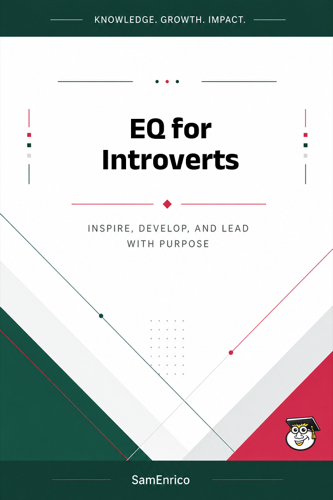
Free sample
Chapter 1: The Social Battery--–- The first time Mara realized she was an introvert, she was thirty-four years old, standing in a crowded hotel ballroom at a professional conference, wearing shoes that hurt her feet and a smile that hurt her face. She had just spent forty-five minutes “working the room”—shaking hands, laughing at jokes she didn’t find funny, and asking the same three questions (“What do you do?” “How long have you been in the field?” “Enjoying the conference?”) on a loop that felt like torture disguised as networking. When she finally escaped to the bathroom stall, she locked the door, leaned her forehead against the cool metal, and stayed there for seven minutes. Not because she was sad. Not because she was anxious.
But because she felt completely, utterly empty. Her mind was blank. Her social energy was gone. She had nothing left to give anyone, and the thought of saying one more word made her want to cry.That night, she Googled “Why do I feel exhausted after parties?” and discovered the word that changed her life: introvert. Not shy.
Not broken. Not antisocial. Just someone whose battery drained differently than the people who seemed to thrive in that ballroom.This chapter is for every Mara who has ever left a social event early, pretended to take a phone call to escape a conversation, or sat in their car for ten minutes after work before going inside. It is for the quiet ones who have been told, directly or indirectly, that their natural way of being is a problem to solve. And it begins with a single, liberating truth: you are not broken.
You are simply running a different operating system.The Two Lies Introverts Are Taught Before we can build emotional intelligence for introverts, we must first clear away the debris of bad advice. Most introverts grow up internalizing two damaging lies, and these lies are the source of more burnout, shame, and performative exhaustion than any other factor.The first lie is that social success requires high volume. From childhood, we are rewarded for speaking up, talking often, and filling silence with words. The child who raises their hand first is praised. The employee who speaks in every meeting is seen as engaged.
The person who can tell a funny story at a dinner party is considered charming. Volume—quantity of words, speed of speech, frequency of contribution—is mistaken for quality of connection. Introverts learn to perform volume even when it feels unnatural, and the performance is exhausting.The second lie is that your natural state is broken. Because you are not energized by the same things that energize extroverts, you are told—explicitly or implicitly—that something is wrong with you. “You’re too quiet.” “Why don’t you talk more?” “You should get out more.” These messages accumulate like sediment, layer upon layer, until you begin to believe them.
You start to think that your need for solitude is laziness, your thoughtfulness is slowness, and your preference for depth over breadth is social incompetence.Both lies are false. And both lies lead introverts to a destructive strategy: faking it.The Faking It Trap When you believe that you need to be loud to succeed and that your quiet nature is broken, the logical solution seems to be pretending. You fake extroversion. You force yourself to talk more, laugh louder, and stay longer. You adopt what psychologists call “performative socializing”—acting energetic and outgoing to gain approval, even when it drains you to the core.The problem is not that faking it never works.
It can work, in the short term. You might make a connection, close a deal, or survive a party. The problem is that faking it comes with a hidden cost that compounds over time: cognitive dissonance, emotional exhaustion, and a slow erosion of your sense of self.Every time you act against your nature, your brain experiences a small conflict between who you are and who you are pretending to be. Resolving that conflict requires mental energy. Do that once a week, and it is manageable.
Do it multiple times a day, every day, and you enter a state of chronic drain. This is why so many introverts describe feeling like a fraud. You are not a fraud. You are simply running a performance that your system was not designed to sustain.Drawing on the research of Susan Cain in Quiet and Marti Laney in The Introvert Advantage, we can see that performative socializing is a losing strategy for three reasons. First, it is unsustainable.
You cannot fake extroversion for forty years without paying a price in anxiety, depression, or burnout. Second, it is inefficient. The relationships built on performance are shallow and require constant maintenance. Third, and most importantly, it prevents you from developing your actual strengths—depth, preparation, listening, and strategic thinking—because you are too busy pretending to be someone else.Authentic connection, by contrast, works with your wiring rather than against it. Authentic connection means engaging deeply with a few people rather than superficially with many.
It means showing up as yourself—quiet, thoughtful, observant—and finding the people who appreciate that. It means leaving events when you are done, not when the host is done. And here is the counterintuitive truth: authentic connection often drains your battery less than solitude does. A genuine conversation with one trusted friend can be energizing. A performative hour with twenty strangers can leave you hollow.The Social Battery: Your New Operating Framework Throughout this book, we will use a single, consistent metaphor to understand introvert energy: the Social Battery.
Every introvert has a battery that drains at a predictable rate depending on stimulus, social intensity, and preparation. The battery has three zones:Green Zone (70-100%): This is optimal engagement. You feel alert, curious, and capable. You can listen well, contribute thoughtfully, and handle unexpected questions. In the Green Zone, emotional intelligence comes naturally because you have the cognitive reserve to regulate yourself and attend to others.Yellow Zone (30-70%): This is overstimulated but functional.
You are still performing, but you notice the signs: your listening slips, you feel irritable, you start checking the clock, and small annoyances feel larger than they should. In the Yellow Zone, you can still succeed, but you are running on a diminishing reserve. Every additional demand pushes you closer to the edge.Red Zone (0-30%): This is shutdown mode. You cannot access your empathy, your vocabulary shrinks, and you may feel physically tired or emotionally numb. In the Red Zone, you are not capable of emotional intelligence because your brain has diverted all resources to survival.
The only effective response to the Red Zone is withdrawal and recharge.The goal of this book is not to keep you in the Green Zone forever—that is impossible. The goal is to help you recognize which zone you are in, make intentional choices about how you spend your battery, and recharge before you hit Red.One of the most important insights from the neuroscience we will explore in Chapter 2 is that introverts have a lower arousal threshold than extroverts. This means your battery drains faster…
This is the end of the free sample. Get the eBook to keep going. Buy now
About this book
Details
- Author
- Nunn Rocky
- Publisher
- SamEnrico
- Language
- English
- Genre
- Non-Fiction, Self-Help / Introvert
- Released
- 2026-06-07
- Pages (approx.)
- 144
- Available as
- eBook, Audiobook

Read better in the ZLOADR app
Your eBooks on your phone or tablet. Sign in with your SamEnrico account and start reading.
More by Nunn Rocky
 Heartsaver Course GuideNunn Rocky$11.99
 Priority Task First RuleNunn Rocky$11.99
 Social Media Detox ProtocolNunn Rocky$11.99
 Indoor Cycling HIIT WorkoutNunn Rocky$11.99
 Healthcare Worker TriggersNunn Rocky$11.99
 Social Proof StrategiesNunn Rocky$11.99
 Burn Nutrition GuideNunn Rocky$11.99
 The Last Stand of the Miracle on Ice: The Untold 1980 U.S. Olympic Team's Secret Training CampNunn Rocky$11.99
 The Phantom of Buenos Aires: The Daring Escapes of Juan MorelNunn Rocky$11.99
 How to Produce Fishing Reel Replacement SpoolsNunn Rocky$11.99
 How to Become a Paymaster Of PursesNunn Rocky$11.99
 Price Matching Policy InflationNunn Rocky$12.99
You may also like
 Hong Kong Handover 1997Dunn Johnnie$11.99
 Zumba For Postnatal Recovery CourseNeal Christian$11.99
 Zumba for BeginnersLadner Nikia$11.99
 YouTube Comment Mining GuideHumes Pandora$12.99
 Worry Box MeditationCarlin Rudy$11.99
 Workplace Stress MeditationNguyen Lynn$11.99
 Workplace Stress and Sleep RepairHawley Ivory$11.99
 Workplace Perfectionism CureDelaney Jeffry$11.99
 Workplace Injustice Anger GuideWallen Isabelle$11.99
 Work Addiction and Burnout LinkGreenwood Ester$11.99
 Women in Yoga and WellnessBeattie Galina$11.99
 Women in Stand Up ComedyChun Evangeline$11.99