
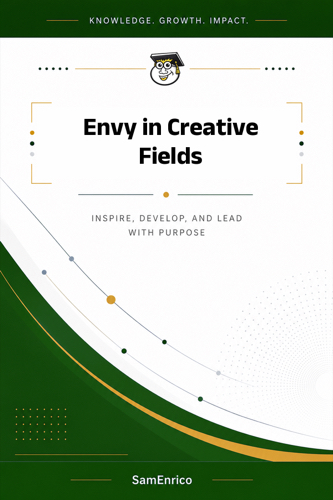
Envy in Creative Fields eBook
Handle jealousy of other artists, writers, and mus
Handle jealousy of other artists, writers, and musicians success.
Formats
Free sample
Chapter 1: The Comparison Trap--–- The first time I realized jealousy had become a full-time job, I was standing in a used bookstore, my hand frozen on the spine of a novel written by someone I’d once shared a workshop with. Three years ago, we had been equals—struggling, unknown, trading anxious drafts over bad coffee. Now her face was on the back cover. Her book had won something I hadn’t even known existed until she won it. And instead of feeling pride, or even indifference, I felt something far more precise: a hot, shameful calculation of exactly how much further along she was than me.
I put the book back on the shelf and walked out without buying anything. That night, I didn’t write. I spent two hours scrolling through her social media, noting every accolade, every smiling author photo, every reader’s gushing review. I was not inspired. I was not motivated.
I was a wound wrapped in a person pretending to still be an artist.If you have ever done something like this—and if you are reading this book, you almost certainly have—then you already know the central paradox of creative jealousy. It feels like a moral failure, but it operates like a reflex. You don’t choose to feel it. It arrives before you can stop it, a spike of heat in the chest or a sudden coldness in the stomach, and by the time you’ve named it, the damage is already spreading. You compare.
You shrink. You turn away from your own work. And then you hate yourself for being small enough to care.This chapter is not here to scold you. It is here to explain why professional jealousy is not a character flaw but an occupational hazard—and why, once you understand the mechanics of the comparison trap, you can begin to dismantle it piece by piece. By the end of this chapter, you will understand the neurological loop that turns another person’s success into your personal failure.
You will know the difference between comparison sickness and healthy ambition, and why confusing the two has derailed more creative careers than rejection ever could. And you will begin a simple, seven-day practice that will transform jealousy from an invisible enemy into a collection of useful data.The Neuroscience of Exclusion: Why Jealousy Literally Hurts Let us start with a strange and liberating fact: your brain does not distinguish between physical pain and social pain. When researchers at UCLA placed subjects in f MRI machines and simulated social exclusion—a game of virtual catch where the other players suddenly stopped throwing the ball to the participant—the scans lit up in the anterior cingulate cortex, the same region activated by physical pain. Subsequent studies extended this finding to envy. When participants watched someone else receive a reward they themselves had been denied, their brains registered it as a form of injury.This means that when you see a peer’s book announcement, gallery opening, or sold-out show, and you feel that familiar twist in your gut, you are not being dramatic.
You are not being petty. You are experiencing a genuine neurological event. Your brain has processed another person’s success as a threat to your social standing, and in evolutionary terms, social standing once meant survival. The tribe that excluded you left you vulnerable to predators, starvation, and isolation. Your ancient brain does not know the difference between being left out of a hunting party and being left off a fellowship shortlist.
It reacts the same way: with alarm, pain, and a desperate urge to protect your position.This is not weakness. This is evolution. And evolution can be outsmarted, but only once you stop fighting it and start understanding it.The Negative Feedback Loop: How Jealousy Feeds Itself Here is where most artists get stuck. The pain of envy triggers a predictable sequence—what I call the negative feedback loop—and each stage of the loop makes the next stage worse. Understanding this loop is the single most important step in breaking it.Stage one is exposure.
You see, hear, or read about a peer’s achievement. Perhaps it is a formal announcement: a grant, a residency, a publication, a commission. Perhaps it is a casual social media post: a photo of their new studio, a screenshot of a glowing review, a caption that reads “Thrilled to announce…” Whatever the form, the achievement enters your awareness.Stage two is automatic comparison. Before you can consciously decide how to respond, your brain has already begun measuring. It compares their timeline to yours.
Their resources to yours. Their recognition to your obscurity. This is not a choice. It is a cognitive habit, honed over years of living in a culture that ranks, sorts, and valorizes visible success.Stage three is shame. Because you have compared yourself unfavorably, you now feel smaller.
But shame rarely attaches to the comparison itself. Instead, it attaches to you. You tell yourself: I shouldn’t feel this way. I should be happy for them. What kind of person resents a friend’s good news?
This secondary shame is far more destructive than the initial envy, because it adds a layer of self-contempt to an already painful feeling.Stage four is withdrawal. To avoid further exposure, you pull back. You stop checking the group chat where people are celebrating. You skip the opening, the reading, the concert. You put your own work aside—not because you are busy, but because your studio now feels like a crime scene.
Every blank page or unsold painting or unfinished song seems to mock you.Stage five is increased susceptibility. Because you have withdrawn, you have less momentum, less community, less evidence of your own forward motion. The next time you encounter a peer’s success, you have even fewer internal resources to resist the loop. You fall faster and harder. And around it goes.The only way out of the loop is to interrupt it at one of its stages.
This book will teach you how to interrupt each one. But before you can interrupt, you must recognize. The seven-day trigger log at the end of this chapter is your first tool for recognition.Comparison Sickness vs. Healthy Ambition Not all comparisons are created equal. In fact, the distinction between destructive comparison and constructive comparison is so important that it will resurface throughout this book—most directly in Chapter Five, when we learn to deconstruct success strategically, and in Chapter Six, when we use envy as a compass toward latent desire.
But we need to establish the difference now, because without it, you might believe that all comparison is toxic and that your only option is to somehow stop noticing other artists entirely. That is neither possible nor desirable.Comparison sickness is automatic, shaming, and endless. It operates without your consent. It leaves you feeling hollow, not energized. It focuses on what you lack rather than what you can learn.
And it has no off switch—one comparison leads to another, which leads to another, in a chain that can consume hours or days. The hallmark of comparison…
This is the end of the free sample. Get the eBook to keep going. Buy now
About this book
Details
- Author
- Hebert Rosana
- Publisher
- SamEnrico
- Language
- English
- Genre
- Non-Fiction, Self-Help, Creative
- Released
- 2026-06-09
- Pages (approx.)
- 135
- Available as
- eBook, Audiobook

Read better in the ZLOADR app
Your eBooks on your phone or tablet. Sign in with your SamEnrico account and start reading.
More by Hebert Rosana
 Incubation For Autoimmune Disease CourseHebert Rosana$11.99
 The Self Talk for ChangeHebert Rosana$11.99
 TM for Retirement TransitionHebert Rosana$11.99
 The New Pet After Loss GuideHebert Rosana$11.99
 The Timbuktu Codebreakers: The Secret Math of the Golden AgeHebert Rosana$11.99
 Understanding Tibial Aplasia Ectrodactyly HydrocephalusHebert Rosana$17.99
 Ghana Invoice Factoring GuideHebert Rosana$12.99
 Free Zapier Validation GuideHebert Rosana$12.99
 How to Become a Drying-rack ChangerHebert Rosana$11.99
 Service Team ManagerHebert Rosana$11.99
You may also like
 Hong Kong Handover 1997Dunn Johnnie$11.99
 Zumba For Postnatal Recovery CourseNeal Christian$11.99
 Zumba for BeginnersLadner Nikia$11.99
 YouTube Comment Mining GuideHumes Pandora$12.99
 Worry Box MeditationCarlin Rudy$11.99
 Workplace Stress MeditationNguyen Lynn$11.99
 Workplace Stress and Sleep RepairHawley Ivory$11.99
 Workplace Perfectionism CureDelaney Jeffry$11.99
 Workplace Injustice Anger GuideWallen Isabelle$11.99
 Work Addiction and Burnout LinkGreenwood Ester$11.99
 Women in Yoga and WellnessBeattie Galina$11.99
 Women in Stand Up ComedyChun Evangeline$11.99