
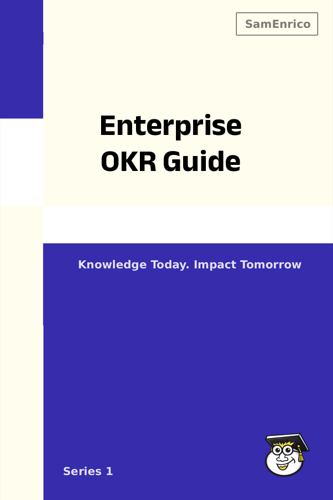
Enterprise OKR Guide
Scale objectives across large organizations.
Scale objectives across large organizations.
Formats
About this book
Free sample
Chapter 1: The Iron Triangle--–- Most enterprise OKR failures are not execution failures. They are design failures. I have watched this truth unfold in boardrooms across three continents, from a European bank losing $47 million on a misguided transformation to a Silicon Valley unicorn that abandoned OKRs after two quarters because “they felt like homework.” In every case, the leaders had read the books. They had hired the consultants. They had built the spreadsheets.
What they had not done was recognize that the startup model of OKRs—the one celebrated in bestsellers and case studies—collapses under its own weight when applied to a 10,000-person organization with legacy systems, geographic dispersion, and entrenched political dynamics.This chapter is not an introduction. It is a warning. And then it is a path forward.I spent the first decade of my career inside a Fortune 50 company watching six different goal-setting frameworks come and go. MBOs arrived with great fanfare and left in quiet embarrassment. Balanced Scorecards generated three-inch binders that no one ever opened after the offsite.
“Agile transformation” became a punchline. When OKRs finally appeared, brought in by a new CEO who had read Measure What Matters on a flight from San Francisco, the energy was different. This felt like the real thing. Until it didn't.Within nine months, the same pattern emerged that I have since documented in more than forty enterprises across twelve industries. The executive team wrote beautiful OKRs.
The cascading produced hundreds of team-level objectives. The quarterly reviews happened on schedule. And nothing changed. Revenue projections missed. Product launches delayed.
Employee engagement flatlined. The machinery of OKRs turned smoothly, but the engine produced no forward motion.That experience launched my obsession. Why do OKRs work so reliably in high-growth technology companies and so unreliably in large enterprises? The answer, I eventually discovered, is not about commitment or intelligence or even leadership quality. It is about architecture.
The startup model of OKRs is designed for a specific organizational form: flat, transparent, fast-moving, and small enough that the CEO can know every person’s name. When you try to bolt that…
This is the end of the free sample. Get the eBook to keep going. Buy now
Contents
- Chapter 1
- Chapter 2
- Chapter 3
- Chapter 4
- Chapter 5
- Chapter 6
- Chapter 7
- Chapter 8
- Chapter 9
- Chapter 10
- Chapter 11
- Chapter 12
Details
- Author
- Welker Sheena
- Publisher
- SamEnrico
- Language
- English
- Genre
- Non-Fiction, Self-Help, Enterprise OKRs
- Released
- 2026-06-06
- Pages (approx.)
- 121
- Available as
- eBook, Audiobook

Read better in the ZLOADR app
Your eBooks on your phone or tablet. Sign in with your SamEnrico account and start reading.
More by Welker Sheena
 Response Friction EngineeringWelker Sheena$11.99
 Hoffa Disappearance 50th Anniversary Cold CaseWelker Sheena$11.99
 Burnout Recovery For Physical TherapistsWelker Sheena$11.99
 Remote Meeting ManagementWelker Sheena$11.99
 Trello Board Export and BackupWelker Sheena$11.99
 ACL Prevention GuideWelker Sheena$11.99
 Glassdoor Salary Comparison TrapWelker Sheena$11.99
 The Tide of Titans: How the Dutch Ruled the WavesWelker Sheena$11.99
 The Unseen Empire: How a Secretive Tech Mogul Built a Digital DynastyWelker Sheena$11.99
 How to Start a Converter for Computer Business (Beginners Guide)Welker Sheena$11.99
 How to Produce SnacksWelker Sheena$11.99
 How to Produce Mushrooms and TrufflesWelker Sheena$11.99