
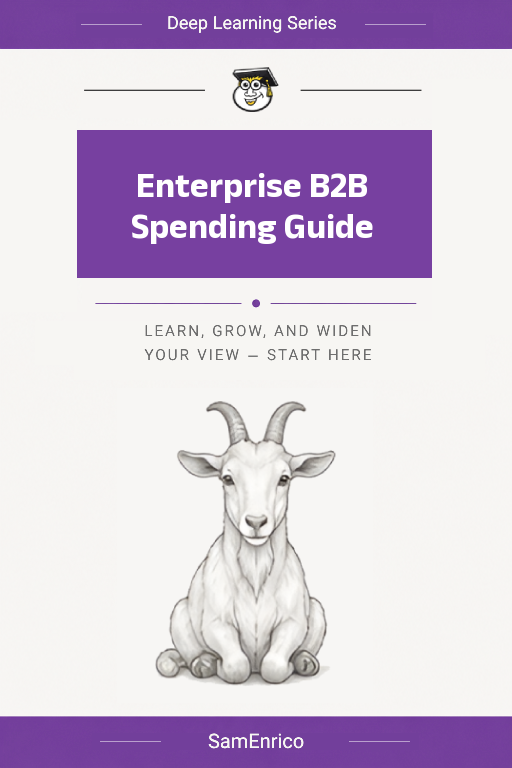
Non-FictionForecast & OutlookEnterprise Spend
Enterprise B2B Spending Guide eBook
Project Fortune 500 procurement complexity, global
Project Fortune 500 procurement complexity, global sourcing, and strategic supplier consolidation.
Formats
Free sample
Chapter 1: The Price Trap--–- In 2018, a Fortune 500 automotive supplier we will call Omni Craft achieved what every procurement leader dreamed of: they drove down the unit cost of a critical micro-controller by 22 percent through a competitive e-auction. The winning supplier, based in Southeast Asia, offered a price per component that was nearly half of the incumbent European manufacturer. The chief procurement officer celebrated. The CFO rewarded the team. The board praised the quarterly earnings bump.Twenty-two months later, Omni Craft lost $470 million in a single quarter.
A factory fire at a Tier-3 raw silicon supplier—three layers down in the supply chain, wholly invisible to the procurement team—created a cascade of shortages. The cheap micro-controller supplier, operating on thin margins, had no buffer stock and no alternative upstream sources. Deliveries stopped. Omni Craft's assembly lines idled for eighteen days. Customer contracts carried penalty clauses for late delivery.
The company's stock price fell 31 percent before the situation stabilized.The unit cost saving of 22 percent, when recalculated to include disruption costs, regulatory fines, and customer penalties, became a net loss of 340 percent. The cheapest supplier turned out to be the most expensive decision Omni Craft ever made.This is not an isolated cautionary tale. It is the new normal of Fortune 500 procurement.The Illusion of Cost Reduction For three decades, the dominant paradigm in enterprise procurement was simple, seductive, and ultimately dangerous: find the lowest unit price, award the business, and move on. This approach, borrowed from textbook economics, assumed that supply chains were stable, suppliers were interchangeable, and risk was someone else's problem. The purchasing department was measured almost exclusively on one metric: cost avoidance, or year-over-year price reduction.The results were predictable.
Procurement teams optimized for what they could measure—price—and ignored what they could not easily quantify. Suppliers were squeezed until their margins disappeared. Quality, delivery reliability, and financial stability were treated as secondary concerns. Relationships became transactional. Trust evaporated.Then the world changed.The COVID-19 pandemic exposed the brittleness of just-in-time supply chains.
The semiconductor shortage of 2020–2023 revealed that cost-optimized meant risk-ignorant. Geopolitical tensions turned once-reliable sourcing corridors into minefields of tariffs, sanctions, and export controls. The Suez Canal blockage in 2021, the war in Ukraine in 2022, and the escalating trade restrictions between the United States and China all demonstrated the same underlying truth: lowest price is a dangerous strategy when the cost of failure is existential.And yet, most Fortune 500 procurement organizations continue to operate as if the last five years did not happen. They still issue request-for-quotations that emphasize price above all else. They still evaluate suppliers on annual cost reduction targets.
They still treat third-party risk as an annual compliance checkbox rather than a continuous strategic function.This book exists because that era is over.The Birth of Total Cost of Risk Before we can fix procurement, we must redefine how we measure value. The traditional metric—Total Cost of Ownership, or TCO—was a step forward from unit price alone. TCO added freight, maintenance, training, and integration costs. But it still treated risk as an afterthought, if it treated it at all.Consider the Omni Craft example. Traditional TCO would have calculated:Unit price: reduced by 22 percent Freight and logistics: slightly higher due to distance, but still net favorable Training and integration: minimal for a commodity component Maintenance: not applicable Verdict: TCO positive.
The supplier looked like a winner.But TCO ignored:The supplier's financial fragility (thin margins meant no buffer inventory)The supplier's own supply chain (no visibility into Tier-2 or Tier-3 sources)The geopolitical risk of the sourcing region The cost of a disruption (lost production, customer penalties, stock drop)The regulatory risk (non-compliance with emerging supply chain disclosure laws)These are not ancillary concerns. They are the dominant drivers of total cost for any non-trivial spend category. A supplier that is 10 percent cheaper but has a 15 percent higher annual disruption risk is not a bargain. It is a liability.Enter Total Cost of Risk—TCo R.TCo R is not a replacement for TCO. It is the missing half of the equation.
The full formula for intelligent sourcing is:Total Cost of Ownership 2.0 = Traditional TCO + TCo RWhere TCo R explicitly quantifies:The probability of a disruption event (based on supplier financial health, geographic risk, geopolitical exposure, and historical performance)The impact of that disruption (remediation costs, regulatory fines, brand damage, lost revenue, customer penalties)The cost of risk mitigation (dual sourcing, buffer inventory, insurance premiums, monitoring systems)When Omni Craft recalculated their micro-controller sourcing decision using TCO 2.0, the Southeast Asian supplier went from winning bid to distant third. A slightly more expensive supplier from Mexico, with better financial reserves, geographic proximity, and transparent Tier-2 sourcing, delivered the lowest total cost over three years—even though their unit price was 11 percent higher.This is not abstract theory. Companies that have adopted TCO 2.0 reduce supply disruptions by an average of 42 percent and total procurement costs by 18 to 24 percent, according to data from the Institute for Supply Management and multiple Fortune 500 case studies. The math is clear: you cannot save money by ignoring risk. You can only defer the bill, with interest.The Buying Committee: From Friction to Function If TCO 2.0 is the new math of procurement, the buying committee is the new reality of procurement governance.
Twenty years ago, a procurement manager could approve a vendor with a handshake and a signature. Today, that same decision requires sign-off from six to twelve stakeholders across Legal, Information Security, Compliance, Finance, Sustainability, and Risk Management.This sounds like bureaucracy. In many organizations, it is. But the buying committee is not going away. Regulatory pressures, cybersecurity threats, and ESG mandates have made cross-functional vendor approval a legal and financial necessity.
The question is not whether to have a committee. The question is how to make it work.Let us examine the typical incentives inside a Fortune 500 buying committee:Legal wants zero liability exposure. They will flag any indemnification clause they have not seen before, any limitation of liability that seems too favorable to the supplier, any data protection gap that could trigger a privacy lawsuit. Their default position is "no" until proven otherwise.Info Sec wants zero cyber risk. They will subject every vendor to a 200- to 300-question security assessment.
They will demand SOC2 Type 2 reports, penetration testing results, and evidence of employee security training. Their default position is "no" until the vendor passes a checklist that grows longer every year.Finance wants the lowest price or the best payment terms. They will push for extended net payment terms, volume discounts, and quarterly cost reductions. Their default position is "cheaper is better."Compliance wants to avoid regulatory fines. They will check sanctions lists, debarment registers, and conflict mineral disclosures.
Their default position is "no" if any red flag appears, however minor.Sustainability wants auditable ESG performance. They will request carbon emissions data, human rights audits, and diversity supplier certifications. Their default position is "no" unless the vendor meets standards that may not exist in their industry.Procurement wants speed and compliance with internal policies. They are caught in the middle, trying to push a decision through a gauntlet of objections, each valid within its own…
This is the end of the free sample. Get the eBook to keep going. Buy now
About this book
Details
- Author
- Palacios Mariano
- Publisher
- SamEnrico
- Language
- English
- Genre
- Non-Fiction, Forecast & Outlook, Enterprise Spend
- Released
- 2026-05-30
- Pages (approx.)
- 154
- Available as
- eBook, Audiobook

Read better in the ZLOADR app
Your eBooks on your phone or tablet. Sign in with your SamEnrico account and start reading.
More by Palacios Mariano
 False Endorsement Lawsuit GuidePalacios Mariano$11.99False Endorsement Lawsuit GuidePalacios Mariano$11.99
 The Car Wash Operation FamiliesPalacios Mariano$11.99
 Governor's Healthcare FightPalacios Mariano$11.99
 Goal Visualization Meditation GuidePalacios Mariano$11.99
 The Home Equity Harvest StrategyPalacios Mariano$11.99
 Stardust and Static: The Forgotten Signals of Pioneer 10Palacios Mariano$11.99
 Understanding Iodine DeficiencyPalacios Mariano$17.99
 Enterprise Security ArchitectPalacios Mariano$11.99
 A Beginners Guide to Blood Bowl (Volume 1)Palacios Mariano$11.99
 Wealthy Enough ManualPalacios Mariano$12.99
You may also like
 Hong Kong Handover 1997Dunn Johnnie$11.99
 Zumba For Postnatal Recovery CourseNeal Christian$11.99
 Zumba for BeginnersLadner Nikia$11.99
 YouTube Comment Mining GuideHumes Pandora$12.99
 Worry Box MeditationCarlin Rudy$11.99
 Workplace Stress MeditationNguyen Lynn$11.99
 Workplace Stress and Sleep RepairHawley Ivory$11.99
 Workplace Perfectionism CureDelaney Jeffry$11.99
 Workplace Injustice Anger GuideWallen Isabelle$11.99
 Work Addiction and Burnout LinkGreenwood Ester$11.99
 Women in Yoga and WellnessBeattie Galina$11.99
 Women in Stand Up ComedyChun Evangeline$11.99