
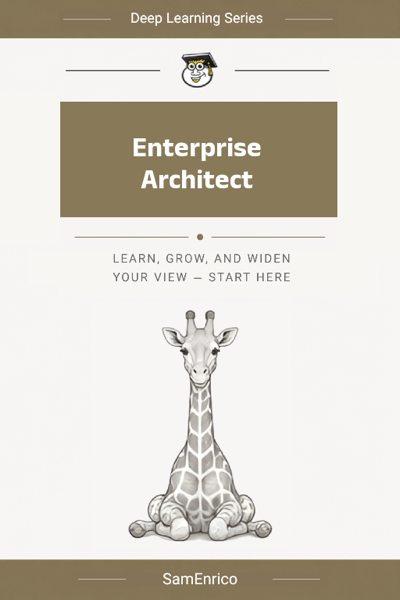
Non-FictionInformativeEducational
Enterprise Architect eBook
A Coursebook on Enterprise Architect
by Ritter Aimee
A Coursebook on Enterprise Architect
Formats
Free sample
Chapter 1: The Confession Booth--– You have probably committed architecture sins. I certainly have. Let me confess mine first.It was a Tuesday afternoon, three weeks into my first Enterprise Architect role at a mid-sized financial services firm. I had been hired with great fanfare – a newly minted TOGAF certification still warm in my hands, a double-door corner office, and a mandate to “fix the architecture.” The CIO, a harried woman named Priya who looked like she hadn't slept since the Clinton administration, had walked me through the problem in her thick Manchester accent.“We have six hundred applications,” she said, spreading a printed spreadsheet across the conference table like a battlefield map. “No one knows what they do.
No one knows who owns them. Last month, we kept paying a license for a server that had been decommissioned in 2019.”I nodded sagely, making notes in my new leather journal. “We need to establish an Architecture Review Board,” I said. “A formal governance structure with clear approval gates. We'll document every capability, every data entity, every interface.
Eighteen months, maybe two years, and you'll have a pristine architecture.”Priya looked at me with something between hope and desperation. “That long?”“Enterprise Architecture is a marathon, not a sprint,” I said, quoting directly from the textbook I had memorized the week before.I was an idiot.Eighteen months later, I had produced exactly four deliverables: a 147-page Business Capability Map that no one read, a Zachman grid with so many empty cells it resembled urban blight, a Power Point deck with 842 slides, and a reputation as the most useless person in the building. Priya had been fired. My corner office had been reassigned to a compliance officer. And I had learned the first and most painful lesson of Enterprise Architecture, a lesson that no certification exam, no textbook, and no framework document had ever bothered to mention.The architecture is not the deliverable.
The change is.You are not paid to draw diagrams. You are not paid to fill out matrices. You are not paid to achieve “framework compliance.” You are paid to make the damn system work better, faster, cheaper, and safer – and if you can't connect your work to those three words, you are not an architect. You are a very expensive artist.This book exists because that version of me – the certified, clueless, freshly minted architect – needs to be saved from himself. And if you are reading these words, chances are excellent that you are that version of yourself right now.
Or you are a student wondering if Enterprise Architecture is a real career or a bureaucratic fever dream. Or you are a developer who has been told to “become an architect” without being told what that actually means.Let me tell you what it actually means.The Big Lie of Enterprise Architecture The big lie – and I want you to tattoo this somewhere visible – is that Enterprise Architecture is about creating comprehensive documentation of an enterprise's information systems.It is not.Documentation is a tool. It is a means. It is not the end. The end is decision velocity – the ability of an organization to make good technical decisions quickly, at scale, without blowing things up.Let me repeat that, because it is the single most important sentence in this entire book: Enterprise Architecture is the discipline of increasing an organization's ability to make good technical decisions quickly, without breaking existing value.Every diagram you draw, every standard you write, every review you conduct – every single thing you do as an architect – must be evaluated against that single metric.
Does this increase decision velocity? Does it help someone – a developer, a product manager, a business stakeholder – make a better decision faster? If the answer is no, you are wasting time. If the answer is “I don't know,” you are guessing. And guessing is not architecture.This insight did not come to me in a flash of inspiration.
It came to me in the form of a screaming match with a development lead named Carlos, six months into my failed transformation project. Carlos had refused to use the approved integration pattern I had spent three weeks documenting. He said it was “too slow” and “didn't fit our use case.” I had marched to his desk, printed diagram in hand, ready to enforce compliance.“You have to follow the standard,” I said.“The standard is wrong,” he said, not looking up from his keyboard.“I spent three weeks on that standard. I interviewed fifteen stakeholders.”“Then you wasted three weeks and bored fifteen people.” He looked at me then, and his eyes were not angry. They were tired.
“Look, mate. I have a feature that needs to ship on Friday. The approved pattern adds 400 milliseconds of latency per call. That breaks my SLA. So I'm not using it.
If you want me to use it, fix the latency. Otherwise, get out of my workspace.”He was right. I was wrong. And in that moment, I understood something that no TOGAF course had ever taught me.An architecture that no one follows is not an architecture. It is a fantasy.Carlos didn't need a more complete diagram.
He didn't need a more rigorous governance process. He didn't need a better metamodel. He needed a standard that was fast enough to meet his SLA. And I had failed to discover that requirement because I had been too busy “doing architecture” to actually talk to the people who would have to live with it.This is the confession booth, and I am telling you all of this up front because you need to understand the stakes. Enterprise Architecture is not a technical discipline.
It is a social discipline that happens to have technical consequences. You can have the most elegant model in the world, and it will fail if the people who need to use it don't trust it, don't understand it, or don't have any incentive to follow it.The Four Kinds of Debt (And Why You Need to Name Them)Before we go any further, we need to talk about technical debt – but not in the sloppy, one-size-fits-all way most people use the term. Most architects say “technical debt” and mean “that code is bad.” That is like a doctor saying “you're sick” without telling you whether you have a cold, cancer, or a stubbed toe. The treatment is different. The urgency is different.
And the architecture response is different.Throughout this book, we will use a four-category taxonomy of technical debt. You need to memorize these, because they will appear in every diagnosis, every case study, and every exercise from now until Chapter 12.1. Code Debt – This is what most developers think of when they say “technical debt.” It lives at the level of individual functions, classes, and methods. High cyclomatic complexity (too many branching paths). Deep nesting.
Duplicated logic. Inconsistent naming. No tests. Code debt is painful because it makes changes slow and buggy. It is usually fixed through refactoring, pair programming, and test coverage.
Good developers can manage code debt without an architect's help – but they need an architect to create the space and prioritization to do so.2.…
This is the end of the free sample. Get the eBook to keep going. Buy now
About this book
Details
- Author
- Ritter Aimee
- Publisher
- SamEnrico
- Language
- English
- Genre
- Non-Fiction, Informative, Educational
- Released
- 2026-05-11
- Pages (approx.)
- 155
- Available as
- eBook, Audiobook

Read better in the ZLOADR app
Your eBooks on your phone or tablet. Sign in with your SamEnrico account and start reading.
More by Ritter Aimee
 Personal Ing For Success Case StudiesRitter Aimee$11.99
 Self Hypnosis For Lucid DreamsRitter Aimee$11.99
 Binge Eating and Body Dysmorphia GuideRitter Aimee$11.99
 Adrenal Fatigue and Mold IllnessRitter Aimee$11.99
 Open Door Policy Distraction GuideRitter Aimee$11.99
 Whispers from the Great Gathering: The Lost Oracle of Delphi’s Final ProphecyRitter Aimee$11.99
 The Phoenix Code: How a Fallen Tech Titan Rose from the AshesRitter Aimee$11.99
 How to Become a ModelerRitter Aimee$11.99
 LinkedIn Bookkeeping ClientsRitter Aimee$12.99
 Global Freight Forwarders DBRitter Aimee$12.99
 Understanding Eec Syndrome Without Cleft Lip PalateRitter Aimee$17.99
You may also like
 Hong Kong Handover 1997Dunn Johnnie$11.99
 Zumba For Postnatal Recovery CourseNeal Christian$11.99
 Zumba for BeginnersLadner Nikia$11.99
 YouTube Comment Mining GuideHumes Pandora$12.99
 Worry Box MeditationCarlin Rudy$11.99
 Workplace Stress MeditationNguyen Lynn$11.99
 Workplace Stress and Sleep RepairHawley Ivory$11.99
 Workplace Perfectionism CureDelaney Jeffry$11.99
 Workplace Injustice Anger GuideWallen Isabelle$11.99
 Work Addiction and Burnout LinkGreenwood Ester$11.99
 Women in Yoga and WellnessBeattie Galina$11.99
 Women in Stand Up ComedyChun Evangeline$11.99