
Non-FictionMental WealthMindfulness Finance
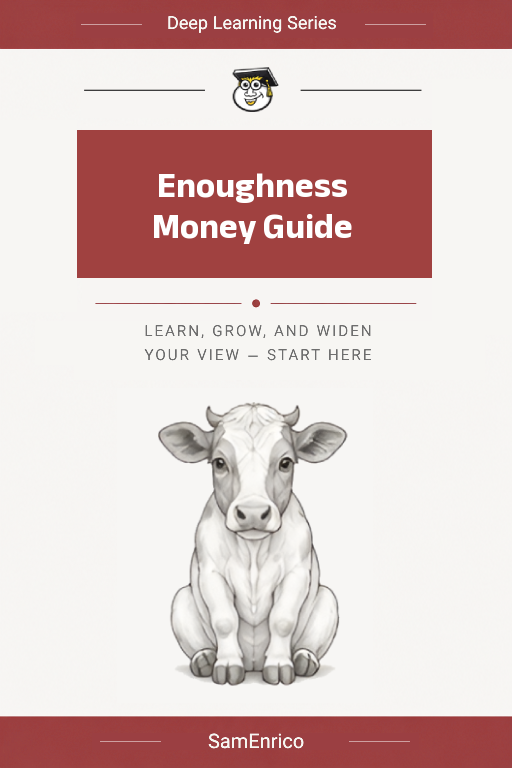
Enoughness Money Guide eBook
Heal the 'never enough' childhood message using su
by Ortiz Ollie
Heal the 'never enough' childhood message using sufficiency audits, spending ceilings, and gratitude-based financial tracking.
Formats
Free sample
Chapter 1: The Ghost in Your Wallet...--If you have ever stood in a store, holding an item you do not need, bought it anyway, and felt nothing—not joy, not relief, only a dull numbness—you have met the ghost.If you have ever received a paycheck, felt a brief surge of safety, and then immediately worried it was not enough—you have met the ghost.If you have ever looked at your bank balance, seen a perfectly reasonable number, and felt a tightness in your chest anyway—you have met the ghost.The ghost is not a metaphor for laziness or weak willpower. The ghost is a very real, very specific set of neural pathways and emotional memories that were installed in your brain before you were old enough to tie your shoes. It is the voice that says "more" when you have enough. It is the feeling that you are falling behind even when you are standing still. And it is the single greatest obstacle between you and financial peace.This chapter is an excavation.
We are going to dig into the soil of your earliest money memories, find the moment when "enough" became "never enough," and bring that moment into the light. Not to shame you. Not to blame your parents. But to free you.Because you cannot heal what you cannot name. And you cannot out-earn a wound that lives below the level of logic.The 7-Year Imprint: How Your Nervous System Learned Scarcity Let us start with a fact that will either relieve you or disturb you, depending on how much you enjoy having your illusions dismantled: your money habits are not rational.You did not learn to save, spend, or stress about money through careful analysis of interest rates and budgeting spreadsheets.
You learned it the same way you learned your native language—by absorption, repetition, and emotional association, before you had the cognitive ability to question what you were learning.Neuroscience research is clear on this point. Between birth and approximately age seven, your brain operates primarily in what psychologists call "theta state"—a highly impressionable, hypnotic-like mode of learning. During these years, you did not reason about money. You absorbed it. You watched your caregivers' faces when they opened bills.
You heard the tone of their voices when they said "we cannot afford that." You felt the tension in the room when an unexpected expense arrived. And you encoded all of that as survival information.This is the 7-Year Imprint.Your nervous system does not distinguish between "we are low on cash this week" and "we are in danger." To a child's brain, a stressed caregiver is a threat to safety. So your brain learned: money equals safety. Lack of money equals danger. And it learned this at a level so deep that no amount of rational reassurance—"I have a good job now, I have savings, I am fine"—can override it without conscious intervention.Here is what the 7-Year Imprint looks like in practice:You check your bank account.
You see a balance of $5,000. Logically, you know this is enough to cover your expenses for two months. But your chest tightens. Your stomach drops. You think, "This is not enough."That is not your adult brain speaking.
That is your six-year-old brain, which learned that any mention of money meant danger, and any danger required hypervigilance. The $5,000 is invisible to that child. Only the fear remains.Or consider the opposite pattern. You receive a bonus at work—2,000thatyouwerenotexpecting.Youfeelabriefflashofjoy.Withintwenty−fourhours,youhavespent2,000 that you were not expecting. You feel a brief flash of joy.
Within twenty-four hours, you have spent 2,000thatyouwerenotexpecting.Youfeelabriefflashofjoy.Withintwenty−fourhours,youhavespent1,800 of it on things you did not plan for and do not particularly want. The money is gone, and you feel nothing but emptiness.That is also the 7-Year Imprint. For some children, scarcity taught them to hoard. For others, scarcity taught them that money will disappear if you do not spend it immediately—so you had better spend it before someone takes it away. Both responses are rational adaptations to an irrational childhood environment.
Neither response serves you now.The 7-Year Imprint explains why financial advice that relies on logic alone almost never works. You can read all the budgeting books in the world. You can create the most elegant spreadsheet. You can automate your savings and cut up your credit cards. And then one bad day—one rejection, one argument, one moment of exhaustion—and the ghost takes over.
You order the expensive takeout. You buy the shoes. You hide the receipt.This is not weakness. This is neurology. And neurology can be rewired.
But first, you have to see the ghost.The Four Money Personalities: Which Ghost Lives in You?The 7-Year Imprint does not affect everyone the same way. Depending on what you observed, what you experienced, and how your particular temperament responded to stress, you developed one of four dominant Money Personalities. These are not rigid categories—most people are a blend of two—but one will feel like home.Identifying your personality is not an excuse to stay the same. It is a diagnosis. You cannot treat an infection until you know whether it is bacterial or viral.
You cannot heal your money wounds until you know which wound you are carrying.Personality 1: The Hoarder (Fear-Driven)The Hoarder grew up in an environment where money was unpredictable. Maybe a parent lost a job. Maybe there were arguments about bills. Maybe you heard "we cannot afford it" so often that you learned to assume that any spending was dangerous.As an adult, the Hoarder saves compulsively. You have an emergency fund—perhaps several.
You have retirement accounts. You have cash in a drawer "just in case." You are proud of your frugality. But you also cannot enjoy your money. Every purchase feels like a betrayal. Every dollar spent feels like a step toward disaster.The Hoarder's inner monologue: "If I spend this, something bad will happen.
I need to keep saving. Just a little more. Then I will feel safe."The tragedy of the Hoarder is that the number never arrives. You save 10,000andwant10,000 and want 10,000andwant20,000. You save 50,000andwant50,000 and want 50,000andwant100,000.
The fear does not decrease with accumulation because the fear was never about the number. It was about the childhood environment. And no amount of money can retroactively make that environment safe.The Hoarder's hidden wound: You believe that money is the only thing you can trust. People leave. Jobs end.
Luck runs out. But money in the bank is a cold, reliable companion. The problem is that money cannot hug you. It cannot tell you that you are enough. And deep down, you are starving for that reassurance.Personality 2: The Spender (Emotional Regulator)The Spender grew up in an environment where money was used to soothe.
Maybe your parents bought you gifts after arguments. Maybe treats were the primary way you received affection. Maybe you learned that spending felt good, and feeling good was rare enough that you should grab it whenever you could.As an adult, the Spender uses purchases to regulate emotions. Bad day at…
This is the end of the free sample. Get the eBook to keep going. Buy now
About this book
Details
- Author
- Ortiz Ollie
- Publisher
- SamEnrico
- Language
- English
- Genre
- Non-Fiction, Mental Wealth, Mindfulness Finance
- Released
- 2026-06-01
- Pages (approx.)
- 152
- Available as
- eBook, Audiobook

Read better in the ZLOADR app
Your eBooks on your phone or tablet. Sign in with your SamEnrico account and start reading.
More by Ortiz Ollie
 Senior Housing Options GuideOrtiz Ollie$11.99
 Boomer Fitness SpendingOrtiz Ollie$11.99
 Fluoride Bone Health DebateOrtiz Ollie$11.99
 Difficult Conversations with ChildrenOrtiz Ollie$11.99
 Sales Assertive GuideOrtiz Ollie$11.99
 Holiday Loneliness for SeniorsOrtiz Ollie$11.99
 Birth Control Libido EffectsOrtiz Ollie$11.99
 Self Hypnosis for Pain ManagementOrtiz Ollie$11.99
 The Forge of the First Dawn: How the World Was WroughtOrtiz Ollie$11.99
 The Silk Conspiracy: The 1873 Boston Textile Heist That Shook the NationOrtiz Ollie$11.99The Silk Conspiracy: The 1873 Boston Textile Heist That Shook the NationOrtiz Ollie$11.99
 Indochinese Tigers: Tiger SubspeciesOrtiz Ollie$11.99
You may also like
 Hong Kong Handover 1997Dunn Johnnie$11.99
 Zumba For Postnatal Recovery CourseNeal Christian$11.99
 Zumba for BeginnersLadner Nikia$11.99
 YouTube Comment Mining GuideHumes Pandora$12.99
 Worry Box MeditationCarlin Rudy$11.99
 Workplace Stress MeditationNguyen Lynn$11.99
 Workplace Stress and Sleep RepairHawley Ivory$11.99
 Workplace Perfectionism CureDelaney Jeffry$11.99
 Workplace Injustice Anger GuideWallen Isabelle$11.99
 Work Addiction and Burnout LinkGreenwood Ester$11.99
 Women in Yoga and WellnessBeattie Galina$11.99
 Women in Stand Up ComedyChun Evangeline$11.99