
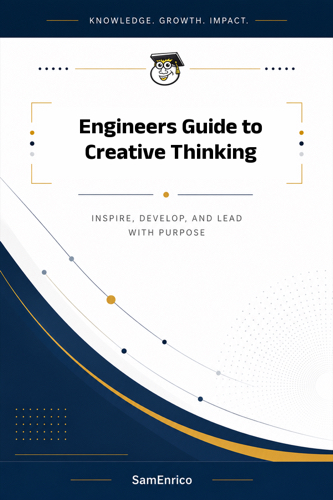
Engineers Guide to Creative Thinking eBook
Balance constraints with imagination to design ele
Balance constraints with imagination to design elegant, innovative solutions.
Formats
Free sample
Chapter 1: The Two Voices--Every engineer has two voices in their head.The first voice speaks in requirements, tolerances, and risk matrices. It is precise, cautious, and deeply analytical. “What are the specifications? What are the constraints? Show me the data.” This voice has kept bridges from collapsing, software from crashing, and planes from falling from the sky.
Without it, engineering is merely daydreaming.The second voice speaks in possibilities, analogies, and what-ifs. It is playful, restless, and wildly imaginative. “What if we turned the problem upside down? What would a child suggest? What if the constraint became the feature?” This voice has produced every breakthrough in human history—from the wheel to the microprocessor, from the arch to the space elevator.
Without it, engineering is merely bureaucracy.Most engineers spend their entire careers strengthening the first voice while accidentally strangling the second. They are trained to evaluate, critique, and optimize. These are essential skills. But when evaluation arrives too early—before ideas have had a chance to breathe, to mutate, to fail privately—it kills novelty. The result is brittle solutions: products that meet every specification yet nobody wants to use, designs that are mathematically optimal yet practically useless, systems that are perfectly safe yet so complex that operators bypass the safety features.This book is about balance.
Not a 50/50 compromise where neither voice wins, but a dynamic equilibrium where each voice speaks at the right time and listens at the right time. The engineers who master this balance do not choose between analysis and imagination. They sequence them. They know when to loosen constraints and when to tighten them. They produce solutions that are not merely functional but elegant—solutions that feel inevitable in retrospect yet surprising at first glance.This chapter introduces the central tension, the failure modes on either side, and the unifying framework that will guide the rest of the book: The Elegance Equation.The False Choice That Is Crippling Engineering Walk into any engineering department and ask: “Who here is creative?” A few hands might go up, hesitantly.
Most engineers will assume you are talking about artists, designers, or marketers—not them. Some will even look offended, as if you have accused them of being unprofessional.This is a catastrophic misunderstanding.Creativity, in the engineering context, is not about painting or poetry or “blue-sky thinking.” It is the ability to generate novel, useful solutions to constrained problems. That is not a soft skill. It is a technical skill, as learnable as thermodynamics or finite element analysis. The false dichotomy between “analytical thinkers” (engineers) and “creative thinkers” (everyone else) is a modern invention, and it is causing billions of dollars in waste.Consider the evidence.
A study of 1,500 product development projects published in the Journal of Engineering Design found that teams with balanced cognitive diversity—members who scored high on both analytical and imaginative reasoning—delivered solutions that were 47 percent more likely to exceed performance targets than teams that skewed heavily toward either pole. Yet the same study found that engineering hiring practices systematically favor analytical scores over imaginative ones, by a factor of nearly four to one.The false choice manifests in everyday language. Engineers say: “I’m just not a creative person.” Or: “Creativity is fine for the concept phase, but we have real work to do.” Or: “Let’s be practical here.” Each of these statements is a small act of self-sabotage. They treat imagination as a luxury rather than a requirement. They assume that rigor and novelty are opposites rather than partners.They are wrong.The most rigorous engineering in history—the Apollo program, the construction of the Large Hadron Collider, the development of the COVID-19 vaccines—was also the most imaginative.
Those projects did not succeed despite creativity. They succeeded because of it. Engineers had to invent new materials, new processes, new ways of thinking under impossible constraints. The analytical voice kept them safe. The imaginative voice kept them moving.Failure Mode One: Constraint-Ignorant Creativity The first failure mode is what happens when imagination runs wild without respect for real constraints.
These solutions are beautiful, clever, and completely useless.A famous example is the “concept car” that auto manufacturers display at trade shows. Sleek lines, butterfly doors, a cockpit straight from a fighter jet. Journalists swoon. The public takes photos. Then the car never reaches production because the driver cannot see out the rear window, the doors require six feet of clearance to open, and the engine overheats in stop-and-go traffic.
The imagination was real. The constraints were ignored. The result was a sculpture, not a solution.Engineering history is littered with such failures. The Tacoma Narrows Bridge, nicknamed “Galloping Gertie,” was aerodynamically imaginative but structurally ignorant. Its designers prioritized slenderness and grace over wind resistance.
Four months after opening, in a 42-mile-per-hour wind, the bridge twisted itself apart on camera. The footage is still shown in engineering classrooms as a warning: beauty without rigor is a trap.The De Lorean DMC-12 had stainless steel body panels and gull-wing doors—imaginative materials and styling that turned heads in Back to the Future. But it also had an underpowered engine, poor build quality, and doors that required awkward contortions to close from the inside. The imagination was real. The constraints of cost, manufacturing, and human factors were ignored.
The company went bankrupt after producing fewer than nine thousand cars.More recently, several high-profile “smart city” projects have produced beautiful master plans that failed because they ignored existing social systems, utility infrastructure, and political realities. Sidewalk Labs’ Quayside project in Toronto promised a futuristic neighborhood built from scratch. After three years and tens of millions of dollars, the project collapsed because the team underestimated the complexity of existing governance, data privacy laws, and community opposition. The imagination was breathtaking. The constraint analysis was not.The pattern is always the same: someone falls in love with an idea and assumes that constraints are merely obstacles to be overcome by cleverness.
But constraints are not obstacles. They are boundary conditions that define the problem. Ignoring them does not make you bold. It makes you wrong.Failure Mode Two: Constraint-Obsessed Thinking The second failure mode is more common in engineering, and therefore more dangerous. Constraint-obsessed thinking happens when the analytical voice dominates so completely that imagination is never invited to the table.
These solutions are rigorous, optimized, and unusable.Consider the safety-critical system with forty-seven confirmation dialogs. Every possible edge case has been considered. Every failure mode has been mitigated. The system is mathematically safe. And no operator can use it during an emergency because they are buried under layers of confirmation dialogs.
The engineers optimized for the wrong variable. They maximized safety-on-paper while minimizing real-world usability.This happens constantly. Medical devices with incomprehensible interfaces. Software with every feature imaginable and no coherence. Manufacturing processes that are perfectly efficient at theoretical capacity but break the moment any variable shifts.
Bridges that meet every load specification but cost so much that the city cannot afford to maintain them. The constraint-obsessed engineer asks “Can we?” but never asks “Should we?” They mistake optimization for innovation.The root cause is usually fear. Fear of criticism. Fear of liability. Fear of…
This is the end of the free sample. Get the eBook to keep going. Buy now
About this book
Details
- Author
- Smoot Cassondra
- Publisher
- SamEnrico
- Language
- English
- Genre
- Non-Fiction, Self-Help
- Released
- 2026-06-08
- Pages (approx.)
- 129
- Available as
- eBook, Audiobook

Read better in the ZLOADR app
Your eBooks on your phone or tablet. Sign in with your SamEnrico account and start reading.
More by Smoot Cassondra
 Staffing Agency Transaction AnalysisSmoot Cassondra$11.99
 183 Day Rule AvoidingSmoot Cassondra$11.99
 Arnold Palmer Army StorySmoot Cassondra$11.99
 The Amazon Forest VictimSmoot Cassondra$11.99
 Innocence Project Identification CasesSmoot Cassondra$11.99
 Alcohol and Cancer RiskSmoot Cassondra$11.99
 Checking OCD GuideSmoot Cassondra$11.99
 The Great Bitcoin Heist: How a Rogue Trader Bankrupted Mt. GoxSmoot Cassondra$11.99
 The King and the Crown: The Divorce That Shook Middle Eastern FootballSmoot Cassondra$11.99
 How to Produce a Hot PlateSmoot Cassondra$11.99
 A Collector's Handbook to the Ford Zodiac Ii 206eSmoot Cassondra$11.99
 FSC Recycled Export GuideSmoot Cassondra$12.99
You may also like
 Hong Kong Handover 1997Dunn Johnnie$11.99
 Zumba For Postnatal Recovery CourseNeal Christian$11.99
 Zumba for BeginnersLadner Nikia$11.99
 YouTube Comment Mining GuideHumes Pandora$12.99
 Worry Box MeditationCarlin Rudy$11.99
 Workplace Stress MeditationNguyen Lynn$11.99
 Workplace Stress and Sleep RepairHawley Ivory$11.99
 Workplace Perfectionism CureDelaney Jeffry$11.99
 Workplace Injustice Anger GuideWallen Isabelle$11.99
 Work Addiction and Burnout LinkGreenwood Ester$11.99
 Women in Yoga and WellnessBeattie Galina$11.99
 Women in Stand Up ComedyChun Evangeline$11.99