
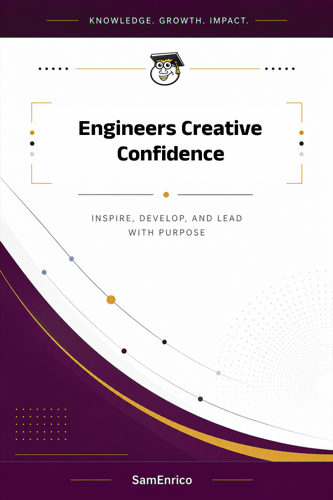
Engineers Creative Confidence eBook
Overcome self doubt about creativity using evidenc
by Autry Ferne
Overcome self doubt about creativity using evidence based skill building.
Formats
Free sample
Chapter 1: The Stick Figure Lie--The senior structural engineer had designed bridges that survived earthquakes, buildings that withstood hurricanes, and foundations that held millions of tons of steel and concrete. His calculations had saved lives. His inspections had prevented collapses. His career was a testament to precision, rigor, and the disciplined application of physical laws.And yet, when asked to join a brainstorming session for a new pedestrian bridge concept, he waved his hand and said, "I'll sit this one out. I can't even draw a stick figure.
I'm not the creative type."He said it with a small, self-deprecating smile. He meant it as humility. He was, in fact, declaring himself professionally disabled for an entire phase of the innovation process—not because he lacked skill, but because he had confused creativity with art.This engineer is not an exception. He is the rule.Walk into almost any engineering firm, R&D department, or software development team, and you will hear some version of this confession. A mechanical engineer who can machine a part to within one-thousandth of an inch but believes he cannot generate novel ideas.
A firmware engineer who writes elegant, efficient code but freezes when asked to sketch a user flow on a whiteboard. A civil engineer who optimizes supply chains with mathematical elegance but avoids "creative" meetings because she thinks she has nothing to contribute.They have all swallowed the same lie. And it is costing them—and their organizations—billions in lost innovation.The Lie You Have Been Told The lie is simple, pervasive, and almost never challenged: Creativity is a personality trait that you either have or you don't. It belongs to people who wear black turtlenecks, listen to obscure music, and draw things. It is mysterious, emotional, and fundamentally incompatible with the logical, analytical, precision-oriented mind of the engineer.This lie is reinforced everywhere.
Movies show the "mad genius" inventor having a eureka moment in a bathtub. Corporate innovation workshops are led by people who use words like "synergy" and hand out crayons. The message is clear: creative people are different. They are born, not made.The lie has a name. Psychologists call it the entity theory of creativity—the belief that creative ability is a fixed entity, like eye color or height.
You either have it or you don't. And if you don't, you should stay in your lane, do your calculations, and leave the ideation to the "creative types."This is not just wrong. It is destructively wrong.What the Research Actually Says Teresa Amabile, a Harvard Business School professor who has spent four decades studying creativity, has a counterintuitive finding. In study after study, across industries and job levels, she has found that self-perceived creativity is a stronger predictor of innovative output than IQ, education, technical skill, or past performance.Think about what that means. Your belief about whether you are creative matters more for your actual creative output than your ability to write code, calculate stress loads, or design circuits.The mechanism is simple and brutal:If you believe you are not creative, you will not try.If you do not try, you will not generate ideas.If you do not generate ideas, you will not succeed.If you do not succeed, you will reinforce the belief that you are not creative.The belief becomes a self-fulfilling prophecy, entirely disconnected from your actual potential.Amabile calls this the creativity fallacy: the mistaken assumption that creative output requires rare, innate talent rather than deliberate practice, the right processes, and permission to try.
Her research shows that when people are told that creativity is a learnable skill, their output improves. When they are told it is an innate trait, their output does not improve, even when given identical training.The lie is not just false. It is a performance-killer.Redefining Creativity for the Analytical Mind So let us fix the definition. For the purposes of this book—and for your career—here is the definition we will use:Creativity is valid problem-solving under ambiguity.Let us break that down.Problem-solving. Creativity is not self-expression.
It is not art. It is not about your feelings. It is about solving problems. Engineers solve problems for a living. You already do this every day.
The only question is whether you solve them in novel, useful ways or in routine, repetitive ways.Valid. Creativity is not about being weird for the sake of weird. A solution that is novel but does not work is not creative; it is just wrong. The solution must actually solve the problem. It must be valid within the constraints of physics, budget, time, and user needs.Under ambiguity.
This is the key. When a problem is well-defined—when the requirements are clear, the constraints are fixed, and the optimal solution is known—you do not need creativity. You need execution. But when the problem is ambiguous, when the requirements are conflicting or unknown, when the constraints are fluid—that is when creativity is required.Here is the liberating implication: You are already creative every time you solve a problem that does not have a clear answer.Consider the following scenarios, none of which require a paintbrush or a poetry degree:A logistics engineer finds a way to route deliveries that saves 10 driver-hours per week. That is creative.
The problem was ambiguous (traffic patterns vary, customer demands shift, fuel costs fluctuate). She found a novel, valid solution.A software engineer discovers that a bug is caused by an interaction between two libraries that were never designed to work together. She writes a wrapper that resolves the conflict. That is creative. The problem was ambiguous (no documentation existed for this edge case).
He found a novel, valid solution.A mechanical engineer notices that a vibration issue in a pump assembly could be solved by rotating the mounting bracket 90 degrees—a change that requires no new parts, no additional cost, and five minutes of labor. That is creative. The problem was ambiguous (the vibration had multiple potential causes). He found a novel, valid solution.None of these engineers considered themselves "creative types." All of them solved problems under ambiguity. All of them were, by our definition, creative.The only thing missing was the label.
And the label matters because it determines whether you try.The Optimization Trap Engineers are trained in convergent thinking. This is not a flaw; it is a feature. Convergent thinking—the ability to narrow down possibilities, evaluate options against criteria, and select the single best answer—is essential for execution. It is what allows a bridge to stand, a program to run, a circuit to function.But convergent thinking has a dark side when applied too early or in the wrong context.The problem is that convergent thinking feels good. It feels productive.
When you evaluate an idea and find its flaws, you experience a small dopamine hit of correctness. When you eliminate an option as impractical, you feel smarter. When you converge on the optimal solution, you feel done.The trouble is that you cannot converge on a solution that you never generated.Creative output requires two distinct cognitive modes that are often in tension:Divergent thinking: Generating many possible solutions…
This is the end of the free sample. Get the eBook to keep going. Buy now
About this book
Details
- Author
- Autry Ferne
- Publisher
- SamEnrico
- Language
- English
- Genre
- Non-Fiction, Self-Help, Creative Confidence
- Released
- 2026-06-08
- Pages (approx.)
- 127
- Available as
- eBook, Audiobook

Read better in the ZLOADR app
Your eBooks on your phone or tablet. Sign in with your SamEnrico account and start reading.
More by Autry Ferne
 Moderate Wine LongevityAutry Ferne$11.99
 The Wes Studi BiographyAutry Ferne$11.99
 Two Minute Rule GuideAutry Ferne$11.99
 Pain Relief through SoundAutry Ferne$11.99
 Mediterranean Diet MoodAutry Ferne$11.99
 Loma Linda AdventistsAutry Ferne$11.99
 Fairness Anger RestructuringAutry Ferne$11.99
 The Lost Fleet of Vasco da Gama: A New World ConqueredAutry Ferne$11.99
 The Lion of Macedon: Alexander the Great and the Birth of a Cosmopolitan EmpireAutry Ferne$11.99
 How to Start a Mineral Water Production Business (Beginners Guide)Autry Ferne$11.99
 The Essential Guide to Foreign CinemaAutry Ferne$11.99
 How to Produce RemediationAutry Ferne$11.99
You may also like
 Teen Creativity Confidence GuideKitchen Cecily$11.99
 Teen Artistic Confidence GuideBoling Jospeh$11.99
 Teen Arts Self Esteem GuideFortenberry Trinidad$11.99
 Team Creative Confidence BuildingAyers Breanna$11.99
 Creative Confidence GuideCoward Elmer$11.99
 Artistic Teen Self EsteemMalcolm Misha$11.99
 Creative Fear of FailureDabney Irmgard$11.99