
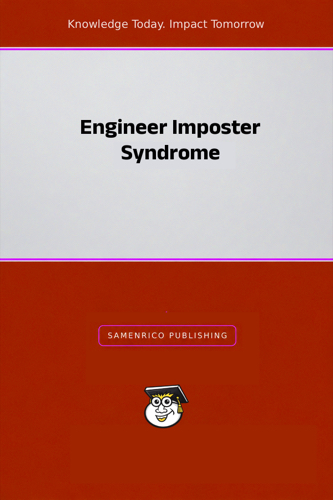
Non-FictionSelf-HelpEngineering
Engineer Imposter Syndrome eBook
Trust your designs and calculations without the co
Trust your designs and calculations without the constant fear that something will fail.
Formats
Free sample
Chapter 1: The 3 AM Calculation...--–- The numbers don’t lie, but you might have misread them. That thought arrives without warning, usually between 2:00 and 4:00 AM, when the house is silent and your phone is dark. You were asleep moments ago, dreaming of nothing in particular. Now you are wide awake, heart pounding, because a single calculation has surfaced from the depths of your memory. It is not a vague worry about belonging or a general sense of being underqualified.
It is specific, technical, and terrifying. You used the wrong yield strength for fastener number forty-seven. Or you forgot to convert millimeters to meters in the deflection equation. Or you assumed a load case that does not actually exist.Your rational mind knows that you checked this work. You reviewed it yesterday afternoon, maybe twice.
You ran the numbers through the standard formula, verified the units, compared the result to industry benchmarks. But the rational mind is not in charge at 3:00 AM. The fear is in charge. And the fear has a name.This is Engineer Imposter Syndrome.It is not the imposter syndrome you have read about in general self-help books. Those books describe a diffuse sense of fraudulence: the feeling that you do not belong, that you will be exposed as a fake, that everyone else knows more than you do.
That version of imposter syndrome is about identity. It whispers, “You are not smart enough to be here.” Engineer Imposter Syndrome is different. It does not whisper about your identity. It screams about your calculations. It does not ask whether you belong in engineering.
It asks whether your specific design will fail, whether your name on that drawing will become synonymous with disaster, whether someone will die because you misplaced a decimal point.The fear is not abstract. It is technical. And that makes it uniquely unbearable.The Anatomy of Engineering Fear Let us be precise about what Engineer Imposter Syndrome actually is. After interviewing dozens of engineers across civil, mechanical, aerospace, software, and chemical disciplines, a clear pattern emerges. The syndrome has four core components, each distinct from general imposter feelings.First, there is calculation-specific anxiety.
This is the fear that a particular number, equation, or assumption in your current work is wrong. It is not about your overall competence. It is about the shear stress at node 47, the pressure drop across valve twelve, the memory allocation in a specific function. You can feel completely confident about ninety-nine percent of your design and still be paralyzed by the remaining one percent.Second, there is the stamp of approval terror. For licensed engineers, this is literal: signing and sealing a drawing with your professional stamp means you are legally and ethically responsible for every number on that page.
For unlicensed engineers and software developers, the stamp is metaphorical but no less real. Clicking “merge” on a code review, approving a manufacturing drawing, giving verbal authorization to proceed with construction—these acts carry the same weight. Your name is attached. If something fails, people will look at that signature.Third, there is the hindsight dread. This is the fear that you have already made a mistake that will be discovered later, after it is too late to fix.
Unlike general anxiety, which tends to focus on future events, engineering fear often fixates on past work that cannot be undone. The concrete is already poured. The code is already deployed. The part is already machined. You cannot go back and check it again, so your brain checks it again and again and again, running the same calculation in your head like a broken loop.Fourth, there is the cascade fantasy.
This is the brain’s tendency to simulate the chain of failure. You imagine the small error you might have made. Then you imagine that error propagating through the system. Then you imagine the catastrophic result. A missing negative sign becomes a bridge collapse.
An off-by-one error becomes a rocket explosion. A mislabeled unit becomes a hospital equipment failure. Your brain is not just afraid of being wrong. It is afraid of being wrong in a way that compounds into disaster.These four components form the core of Engineer Imposter Syndrome. They are not irrational.
They are exaggerated versions of real engineering concerns. Every engineer should worry about calculation errors. Every engineer should take the stamp of approval seriously. Every engineer should consider downstream consequences. The problem is not the presence of these concerns.
The problem is their intensity and their timing.The 3:00 AM calculation check is not a productive review session. It is a hijacking of your rest by a fear response that cannot distinguish between a genuine error and a phantom one.Why General Imposter Syndrome Books Fail Engineers If you have read any of the popular books on imposter syndrome, you may have noticed that their advice does not quite land. They tell you to challenge your negative thoughts, to reframe your self-talk, to accept that you belong. This advice works reasonably well for the identity-based version of imposter syndrome. It falls apart for the calculation-based version.Consider the standard cognitive restructuring technique: “When you think ‘I don’t belong here,’ ask yourself for evidence.” For general imposter syndrome, the evidence usually falls apart.
You have a degree. You passed the interview. You have done this job before. The thought is exposed as irrational.Now apply the same technique to Engineer Imposter Syndrome. You think, “I might have used the wrong units in that pressure calculation.” You ask yourself for evidence.
And here is the problem: you do not have evidence either way. You cannot prove you used the correct units without re-checking the work. And you cannot re-check the work at 3:00 AM because the files are at the office. The thought is not obviously irrational. It is merely unverified.
That is why it sticks.General imposter syndrome books assume that your fears are false. Engineer Imposter Syndrome is different because your fears might be true. You might have made an error. That is the whole point of engineering quality control. Errors happen.
Designs fail. Bridges crack. Code crashes. The possibility of error is real.This is the central paradox of Engineer Imposter Syndrome. The fear is not irrational, but its intensity is disproportionate.
You cannot eliminate the possibility of error. You can only calibrate your response to that possibility. The 3:00 AM panic is not a useful response. It does not prevent errors. It only prevents sleep.What you need is not a method for eliminating doubt—doubt is a useful engineering tool.
What you need is a method for distinguishing between productive doubt and unproductive terror. You need to know when to check your work again and when to trust that you have already checked it enough.The Productive Doubt Distinction This book introduces a distinction that will appear in every chapter. It is the single most important idea in these pages, and understanding it will change how you relate to your own work.Doubt before verification is useful. Doubt after verification is noise.Let us explain what this means.Doubt before verification occurs when you are still in the process of checking your work. You have not yet…
This is the end of the free sample. Get the eBook to keep going. Buy now
About this book
Details
- Author
- Moreau Melodee
- Publisher
- SamEnrico
- Language
- English
- Genre
- Non-Fiction, Self-Help, Engineering
- Released
- 2026-06-09
- Pages (approx.)
- 134
- Available as
- eBook, Audiobook

Read better in the ZLOADR app
Your eBooks on your phone or tablet. Sign in with your SamEnrico account and start reading.
More by Moreau Melodee
 Trotsky Ice AxeMoreau Melodee$11.99
 Extracurricular LogisticsMoreau Melodee$11.99
 Contract Abstraction Certification PrepMoreau Melodee$11.99
 Constipation Success StoriesMoreau Melodee$11.99
 Sacred Dance Leadership GuideMoreau Melodee$11.99
 The Reformation Printing PressMoreau Melodee$11.99
 Listening to Trauma SurvivorsMoreau Melodee$11.99
 SEC DOJ FCPA Case LogMoreau Melodee$11.99
 The Great Conundrum: The Math Behind the Lost City of ZMoreau Melodee$11.99
 The Art of War: Nguyen Si Kha’s Brushstrokes of ResistanceMoreau Melodee$11.99
 Frozen Fire: The Arctic Volcano Hunters of 1912Moreau Melodee$11.99
 The Dancer's Guide to Cossack DanceMoreau Melodee$11.99
You may also like
 Hong Kong Handover 1997Dunn Johnnie$11.99
 Zumba For Postnatal Recovery CourseNeal Christian$11.99
 Zumba for BeginnersLadner Nikia$11.99
 YouTube Comment Mining GuideHumes Pandora$12.99
 Worry Box MeditationCarlin Rudy$11.99
 Workplace Stress MeditationNguyen Lynn$11.99
 Workplace Stress and Sleep RepairHawley Ivory$11.99
 Workplace Perfectionism CureDelaney Jeffry$11.99
 Workplace Injustice Anger GuideWallen Isabelle$11.99
 Work Addiction and Burnout LinkGreenwood Ester$11.99
 Women in Yoga and WellnessBeattie Galina$11.99
 Women in Stand Up ComedyChun Evangeline$11.99