
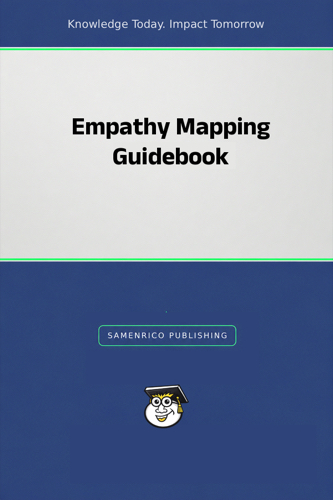
Empathy Mapping Guidebook
Understand user needs and pain points through stru
Understand user needs and pain points through structured empathy interviews and observation.
Formats
About this book
Free sample
Chapter 1: The Assumption Tax--Most product failures do not die from bad execution. They die from wrong assumptions, buried so deep in the planning process that no one remembers making them.Consider this: eighty percent of feature requests from stakeholders, users, or internal teams are not solutions at all. They are symptoms of a deeper problem dressed up as a request. When a user asks for an “export to CSV” button, they are not telling you they love CSV files. They are telling you the dashboard is too slow to work with directly, or the data visualization is unreadable, or they need to manipulate numbers in ways your system does not allow.
The button is a clue. The real need is buried beneath it.The same distortion applies to what you think you know about your users. Another eighty percent of your assumptions about who they are, what they want, and why they behave the way they do are likely wrong. The remaining twenty percent is either trivial or already common knowledge. This is not pessimism.
It is a mathematical observation from decades of post-mortems on failed products. Teams do not set out to build things nobody wants. They set out to build things that seem perfectly reasonable based on what they assume to be true. Then they discover, six months and hundreds of thousands of dollars later, that the assumptions were fiction.This chapter is about recognizing the cost of those fictions. It introduces the Empathy Map not as a poster exercise for design thinking workshops but as a forensic tool for uncovering where your assumptions are leaking value.
By the end of this chapter, you will be able to audit your last three feature launches and identify which decisions were based on direct observation of users and which were based on unexamined beliefs. That distinction is the difference between building what works and building what you hope will work.The Eighty Percent Assumption Tax Let us be precise about the two eighty percent rules because they are easy to confuse and both are essential.The first rule applies to feature requests.…
This is the end of the free sample. Get the eBook to keep going. Buy now
Contents
- Chapter 1
- Chapter 2
- Chapter 3
- Chapter 4
- Chapter 5
- Chapter 6
- Chapter 7
- Chapter 8
- Chapter 9
- Chapter 10
- Chapter 11
- Chapter 12
Details
- Author
- Goldberg Karine
- Publisher
- SamEnrico
- Language
- English
- Genre
- Non-Fiction, Self-Help, Design Thinking
- Released
- 2026-06-10
- Pages (approx.)
- 129
- Available as
- eBook, Audiobook

Read better in the ZLOADR app
Your eBooks on your phone or tablet. Sign in with your SamEnrico account and start reading.
More by Goldberg Karine
 Long Distance RelationshipGoldberg Karine$11.99
 Alcoholism in Rural Areas Recovery GuideGoldberg Karine$11.99
 Self Esteem for Abandonment FearGoldberg Karine$11.99
 Memory Care Unit EconomicsGoldberg Karine$11.99
 HIIT for Time CrunchGoldberg Karine$11.99
 Expense Categorization For StartupsGoldberg Karine$11.99
 Type 2 Diabetes and FoodGoldberg Karine$11.99
 The Battle of Tabora: The Last Stand of the Maji Maji Rebellion (1905)Goldberg Karine$11.99
 The Ballad of the Wandering Minstrels: How Medieval Troubadours Smuggled Latin American Folklore into EuropeGoldberg Karine$11.99
 How to Produce Stamp BlocksGoldberg Karine$11.99
 How to Produce Guitar SlidesGoldberg Karine$11.99
 Rainforest Alliance CertificationGoldberg Karine$12.99
You may also like
 Design Thinking Collaboration GuideLovett Barbra$11.99
 Design Thinking Collaboration WorkbookMarcus Ardith$11.99
 Design Sprint Collaboration ManualGoldberg Dorris$11.99
 The Design Sprint CollaborationMccutcheon Jacalyn$11.99
 How Might We GuideHoyle Rosario$11.99
 Design Thinking Team Workshop GuideJordon Jenice$11.99
 Empathy Stage Design ThinkingShull Tony$11.99
 Design Thinking Team GuideCurrier Lura$11.99
 Design Thinking CollaborationKeaton Darius$11.99
 The Non Artist Design Thinking GuideFischer Tracie$11.99
 Design Thinking for TeamsHoliday Cecil$11.99
 Design Thinking TogetherGrigsby Ling$11.99